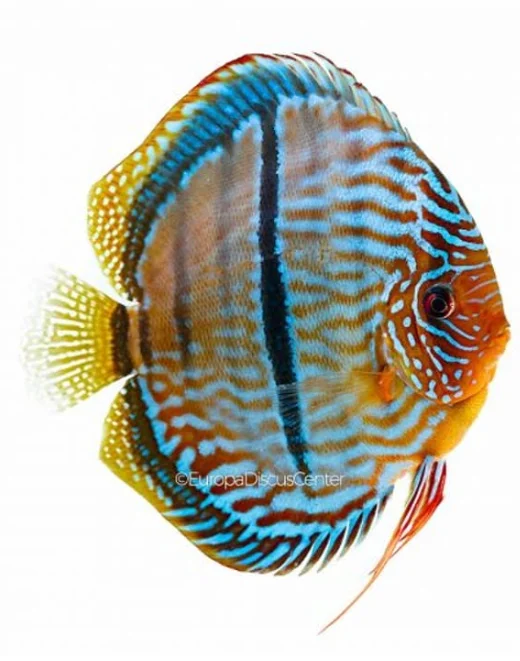
200L setup

Complete 200L discus tank setup

Everything you need for a 200 litre discus tank: filtration, heating, water testing, food and a maintenance routine.

Why 200L isn't ideal, but can work

A 200L tank can be a starting point for discus, but it isn't a very forgiving setup. The smaller volume means the water can swing out of balance faster, and mistakes in feeding, filtration or water changes show up more quickly. This setup suits: • beginners who want to start cautiously; • aquarists who already own a 200L tank; • people who want a small group and a clear routine; • users who want to avoid the wrong purchases. Note: 200L isn't ideal for overstocking. If you want many discus or a very relaxed routine, a larger tank is more suitable.

Filtration: the most important decision

In a 200L tank, filtration has to be chosen carefully. Discus need clean, stable water, and weak filtration can quickly lead to debris build-up and biological instability. Recommendation: an external filter rated 1000-1200 L/h (at least 4x the volume per hour). A single quality filter is enough if it's maintained properly — cleaned every 2-3 weeks. Safety bonus: combine the main external filter with an internal sponge filter for extra circulation. If the main filter fails, you have a 24-48 hour buffer before water quality degrades.

Heating and testing — not optional

Discus need a stable temperature around 28-30°C. Use a quality heater sized at 1W/litre (200W for 200L), with an external thermostat for safety. At 200L, testing isn't optional. pH, NO2, NO3, KH/GH and temperature must be tracked, especially at the start. A complete test set (JBL, API) and a TDS meter are essential investments that save you from serious problems.

Water changes and food — the rhythm matters more than the product

For a 200L tank, the rhythm of water changes matters more than the product you use. Recommendation: 30–40% weekly. Leftover food and accumulated waste spoil the water fast in a smaller volume. Food must be controlled strictly — less, but more varied. Food not eaten within 2–3 minutes turns into pollution immediately.

✓ What's included

Tick them off as you get them — progress saves automatically on this device.

Progress: 0/100%

Clear steps: from box to your first discus

  1. 1Place the tank on solid furniture (200L full = ~250 kg) and check it supports the weight on all 4 corners.
  2. 2Wash the tank with warm water (no detergent), add substrate (3–5 cm) and hardscape.
  3. 3Mount the external filter and heater, then fill with dechlorinated water (Seachem Prime).
  4. 4Start the filter + heater, set the temperature to 28–29°C and check for leaks.
  5. 5Biological cycling 4–6 weeks: with pure ammonia or small amounts of food, testing NO2/NO3.
  6. 64-week quarantine for new fish in a separate tank (see quarantine kit).
  7. 7Slow acclimation (drip 2–3 hours) and introduce 4–5 discus at once, not one by one.

Common mistakes to avoid

  • Undersized filter (under 4× the volume per hour) — at 200L the water swings out of balance fast.
  • A single large heater (200W+) — risk of boiling if it gets stuck ON.
  • No quarantine — adding discus straight into the tank often leads to outbreaks.
  • Stocking too fast — 4–5 discus at once, not 1+1+1 over the weeks.
  • Infrequent water changes (under 30% weekly) — at 200L nitrates climb fast.
  • Overfeeding — food not eaten in 2–3 minutes spoils the water immediately.

Frequently asked questions

Is a 200L tank enough for discus?

It can be used, but it requires attention to the number of fish, filtration and water changes. It isn't the ideal volume, but with a rigorous routine it works.

How many discus can I keep in 200L?

It depends on age, filtration and routine. Practical recommendation: 4–5 adults. Avoid overstocking and use the stocking calculator for an estimate tailored to your situation.

Do I absolutely need an external filter?

For discus at 200L, external filtration (or a very well-sized one) is usually safer than a simple internal filter. An internal filter doesn't provide enough biological volume for discus.

Can I start without reverse osmosis?

It depends on your tap water. Test pH, KH, GH and TDS first. If they're in decent ranges (TDS under 300, KH 4-6), well-conditioned tap water works. If the values are excessive, things get complicated.

discus.ro Newsletter

Get notified when we publish new guides, articles and news about discus care.

No spam. Unsubscribe anytime.

discus.ro logodiscus.ro

A practical resource for discus fish keepers worldwide: in-depth care guides, a complete variety encyclopedia, and free aquarium tools.

Note: our shop currently ships within Romania only — international shipping is coming soon.

Company details

discus.ro is operated by:

Company: SC Libraria Junior S.R.L
VAT ID: RO47180412
Reg. No.: J10/1518/2022
Address: Sos. Bucuresti, nr 5, Buzau, Buzau
Email: admin@discus.ro
ANPC - Alternative Dispute ResolutionODR - Online Dispute Resolution
© 2026 discus.ro — All rights reserved