Complete Beginner Guide
Everything you need to know before and after buying your first discus: choosing the fish, the aquarium, acclimation and the mistakes to avoid.

Why keep discus: 4 reasons and who they suit
Discus (Symphysodon) live 10–15 years and reach 12–18 cm (4.7–7 in). The guide covers 4 objective reasons they're worth keeping, the right…

Monthly cost of a discus aquarium: a realistic breakdown
How much a discus aquarium really costs per month — a category-by-category breakdown (electricity, food, water, tests) with 3 scenarios…

Before you buy discus: the complete 7-step checklist
Before buying discus, work through a 7-step checklist — a fully cycled aquarium, a verified source, 7 visual signs of health, a minimum…

Essential discus aquarium equipment: the complete list
Discus aquarium equipment — the complete list of required gear (tank, external filter, two heaters, digital thermometer, water test kit)…

Discus water parameters for beginners (simple version)
Discus water parameters for beginners — a simple table with just 4 key values (temperature, pH, ammonia, nitrite). No TDS, KH, GH or other…

Cycling a discus aquarium: a complete step-by-step guide
Biological cycling is the vital step before adding discus. A guide to the nitrogen cycle, nitrifying bacteria (Nitrosomonas + Nitrospira),…

How to choose a healthy discus: 7 visual signs to check before you buy
How to recognize a healthy discus when buying — 7 must-have visual signs (clear eyes, vivid colors, complete fins, round body, calm…

Discus quarantine for beginners: a simple 2-week protocol
Simplified quarantine for beginners — a 2-week protocol based on observation and light feeding, no complex treatments. When it's mandatory,…

Acclimating new discus: the drip method step by step (45–60 min)
Acclimating new discus with the drip method — a 45–60 minute procedure that minimizes transport stress. Materials, detailed steps, and…

The first 72 hours with discus: what's normal, what isn't
The first 72 hours after bringing discus home — normal behavior vs warning signs, feeding, lighting, and mistakes to avoid in this critical…

Feeding discus for beginners (simple version)
Feeding discus for beginners — a simple guide on which food to choose, when and how much, in the first week and first month. No homemade…

Discus water changes for beginners (how, when, how much)
Water changes for beginners — how to do them (gravel vacuum + dechlorinator), when (2–3×/week) and how much (20–30%), plus the 5 mistakes…

The first 3 months with discus: a realistic weekly calendar
The first 3 months with discus — a realistic week-by-week plan: adaptation (1–2), stabilization (3–4), consolidation (months 2–3). What's…

Discus body language: reading stress bars, colors and behavior
Discus body language — a visual guide to stress bars (9 vertical bars), posture, colors, fins and behavior. Spot problems days before they…

10 common beginner mistakes with discus
The 10 most common beginner mistakes with discus — for each one you get the consequence, the cause and a concrete fix. Learn from others'…
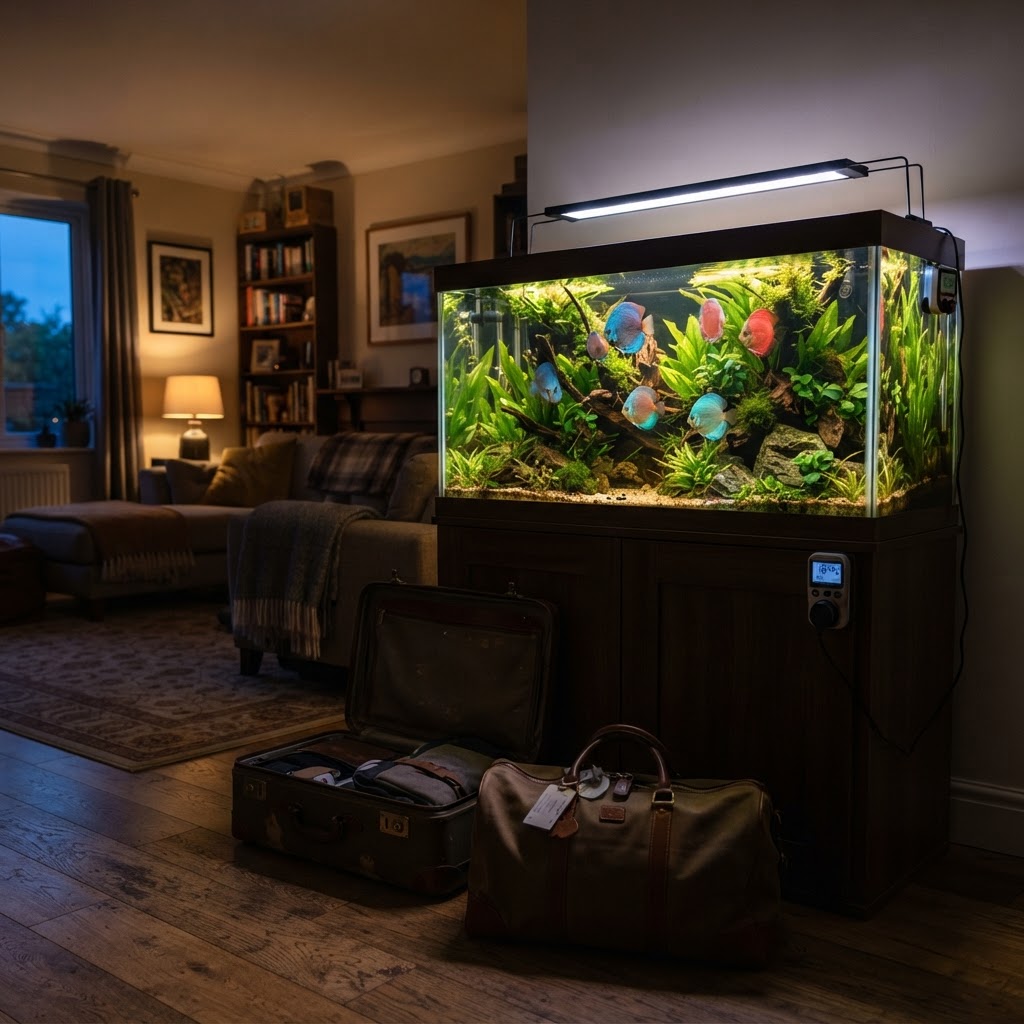
Discus while you're on vacation: how long they last without food and what to prepare
Healthy adult discus easily go 5–7 days without food. Fry don't. Here is the full checklist for a worry-free holiday.
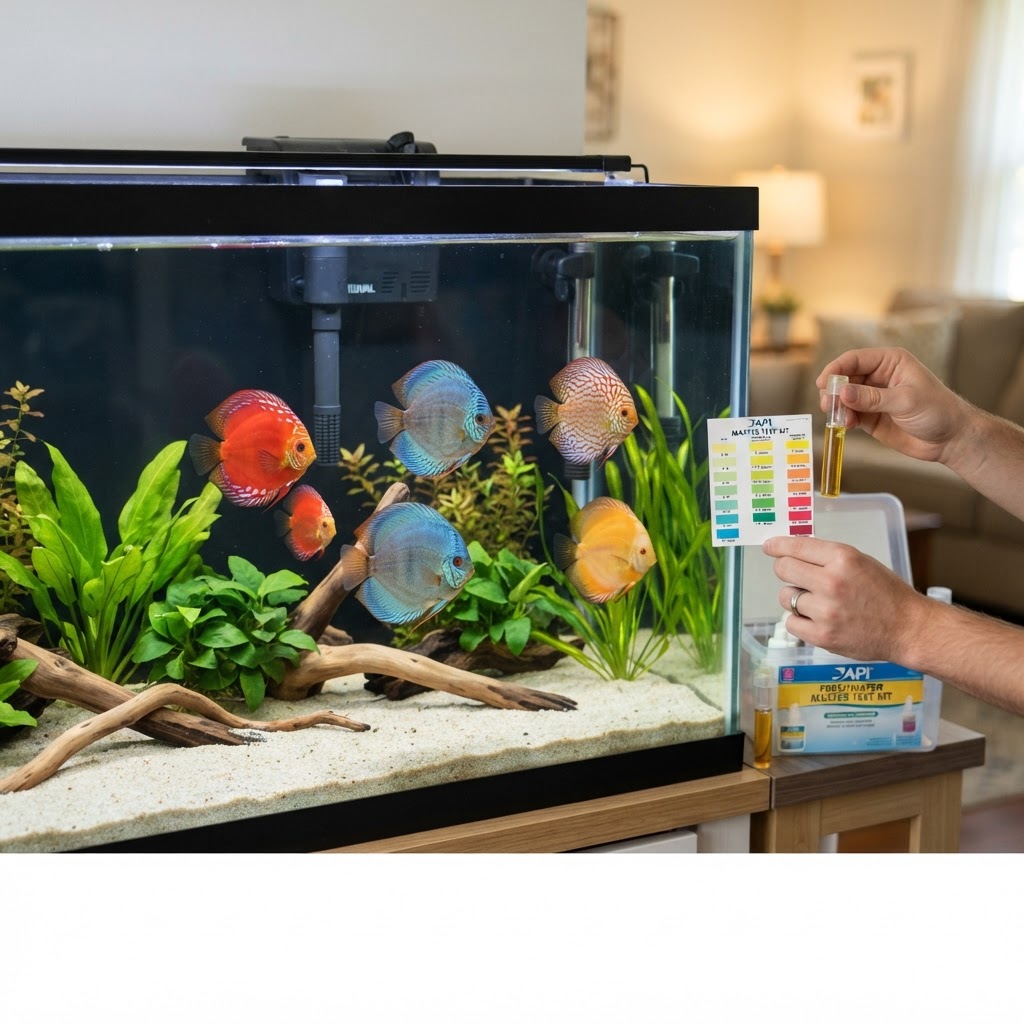
Are discus hard to keep? Top 6 myths debunked for beginners
Discus aren't hard to keep, they are just less forgiving of dirty, unstable water. Here are the myths that scare beginners for no reason.
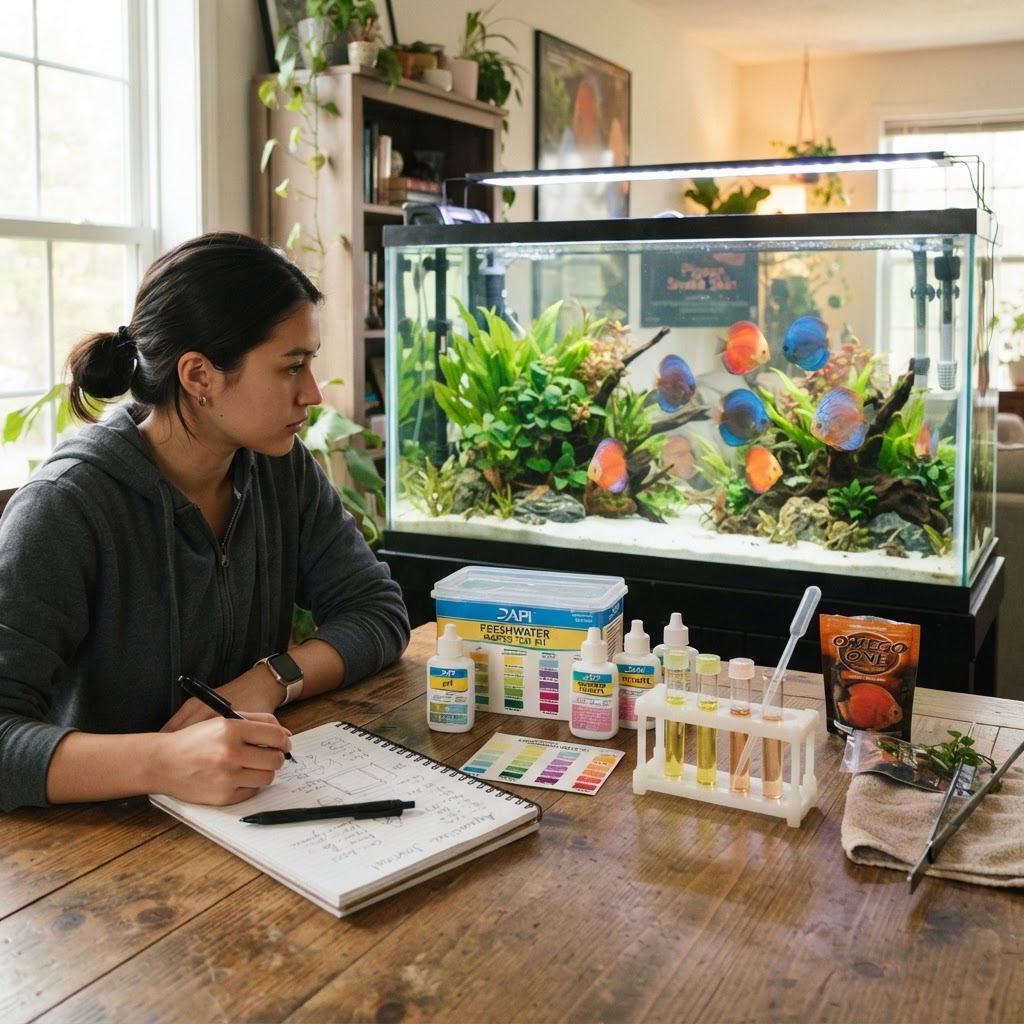
Top 12 Beginner FAQs About Discus Fish with Direct Answers
Discus are not impossible to keep—they just require discipline and routine. Find direct answers to common dilemmas for beginning hobbyists…
Frequently Asked Questions — Beginner Guide
Quick answers to the most common questions about this category
Before you buy
Are discus suitable for beginners?
Not for a first aquarium. Discus require a high temperature (29–30°C), stable parameters and frequent water changes. Recommended after at least 6–12 months of experience with tropical fish.
Read the full guideHow much does it cost per month to maintain a discus aquarium?
As a Romania estimate (2026), roughly €30–60/month (150–300 RON) for 6 discus in 250L: electricity (~€12–20), food (~€8–16), dechlorinator + tests (~€4–8), water changes (free if you have tap water). Costs vary a lot by country — see our calculator for an estimate based on your own tariffs.
Read the full guideWhat's the total budget to get started?
As a Romania estimate (2026), a complete setup for 6 discus runs roughly €500–1100 (2500–5500 RON): a 250L aquarium (~€200), an external filter (~€100–160), heaters (~€40), tests + accessories (~€60), plus 6 discus at ~€20–30 each (~€120–180). Prices vary widely by country and supplier.
Read the full guideWhat do I need to have ready before I buy discus?
An aquarium cycled for 4–6 weeks, stable parameters (ammonia + nitrite = 0), a temperature of 29–30°C, a working filter, dechlorinator, and a quarantine spot if you already have fish.
Read the full guideAquarium setup
What aquarium size do I need for discus?
Minimum 200L for 5–6 discus. 250–300L recommended for a healthy group with room for hierarchy. Below 150L = chronic stress, high mortality.
Read the full guideWhat filter is good for discus?
An external filter with a flow rate of 4–6× the volume/h. For 250L → 1000–1500 L/h. Trusted brands: Eheim Classic 600, Fluval 307, JBL CristalProfi e1502. Avoid small internal filters.
Read the full guideWhat is cycling and why is it mandatory?
Cycling = growing the beneficial bacteria that turn toxic ammonia into nitrite, then into less dangerous nitrate. It takes 4–6 weeks. Without it, discus die within 48–72h from poisoning.
Read the full guideHow do I speed up cycling?
Ask for filter sponges from a breeder with a mature aquarium — a ready-made bacterial colony, cycling in 3–7 days. Or use Seachem Stability/Tetra SafeStart according to the instructions.
Read the full guideDo I need substrate or a bare-bottom aquarium?
For beginners: bare-bottom (no substrate) is easier to clean and lets you spot health problems. Fine sand substrate (0.5–1mm, max 3cm layer) is fine for aesthetics, but needs weekly vacuuming. Avoid gravel — it traps waste.
Read the full guideWhat heater wattage do I need?
The rule is 1W/liter (1.2W/L in winter). For 200L → 200W total, ideally 2 heaters of 100W (safety against failures). Trusted brands: Eheim Jäger, Aquael Comfort Zone, JBL ProTemp, Fluval E. Add an external Inkbird thermostat for ±0.2°C precision.
Read the full guideWhich LED should I choose for a discus aquarium?
Power of 0.3–0.5 W/L for a moderately planted tank, 6500K full spectrum, 8–10 hours/day with a mandatory timer. RO 2026 models: Chihiros A2 Plus (350–550 RON), Aquael Leddy Slim Plant (250–450 RON), Twinstar S-Line premium (800–1200 RON). Discus prefer diffuse light.
Read the full guideWhich plants tolerate the high discus temperature (28–30°C)?
Top 4 'set-and-forget' plants: Anubias (any variety, on driftwood), Microsorum pteropus (Java Fern), Cryptocoryne wendtii, Ceratophyllum demersum (floating). All tolerate 30°C, need no CO2, low light. Avoid Glossostigma, HC Cuba, Cabomba — they die above 26°C.
Read the full guideSump or external filter for discus?
Below 300L → external filter (Eheim, Fluval, JBL, 300–1500 RON, plug & play). Above 400L → a sump becomes feasible (1500–5000 RON, more filter volume, hides equipment). Beginners and locations sensitive to flooding: the external filter is always the safe choice.
Read the full guideWhich catappa leaves should I add and how many?
1 Terminalia catappa leaf per 30L of water (200L → 6–8 leaves). Add gradually, 2–3/week, to avoid a sudden pH drop. Benefits: antibacterial tannins, natural pH 6.0–6.5, reduced stress, encourages breeding. Replace every 3–4 weeks.
Read the full guideBuying & bringing home
How do I recognize a healthy discus when buying?
7 signs: clear eyes with no cloudiness, vivid colors without paleness, fully spread fins, a round (not thin) body, calm breathing, eats actively when fed, doesn't rub against the décor.
Read the full guideHow many discus should I buy at once?
Minimum 5–6 fish of the same size, ideally from the same batch. 1–2 discus → stress + lethal bullying. Buy them all at once, don't add them later one by one.
Read the full guideHow do I acclimate new discus to the aquarium?
The drip method, 45–60 minutes: float the bag in the aquarium for 15 min to equalize temperature, then slowly drip aquarium water into the bag until you triple the volume. Transfer the fish with a net — do NOT pour the bag water into the aquarium.
Read the full guideDo I need to quarantine new discus?
Mandatory if you already have fish in the aquarium — 2–4 weeks in a separate 60–100L aquarium for observation. Optional if it's your first discus aquarium and they all arrive together from the same source.
Read the full guideWhat's normal in the first 72 hours after bringing them home?
Refusing food for 1–3 days, visible stress bars, sitting in a corner, pale colors. NORMAL. Abnormal = rapid breathing, swimming sideways, refusing food for over 5 days, visible lesions.
Read the full guideHow long should a proper quarantine for new discus last?
Minimum 4 weeks: week 1 — observation, week 2 — dual treatment Praziquantel + Metronidazole, week 3 — recovery, week 4 — check. For freshly imported Asians: 6–8 weeks. Below 4 weeks you miss the parasite cycles (Hexamita 14–28 days asymptomatic).
Read the full guideStendker, Asian or local breeders — which choice do I make?
Beginners: Stendker (hard European water, health, 150–450 RON/piece) or a verified local breeder (identical water). Advanced: Asians through an EU importer or premium local breeders. Breeding: locals or Asians (Stendker are difficult to breed as a hobbyist).
Read the full guideHow do I correctly transport discus from the breeder to my home?
DOUBLE polyethylene bags with a 1/3 water + 2/3 pure oxygen ratio, a 3cm polystyrene insulated box, a constant temperature of 28–30°C (heat pack in winter, cold gel in summer), total darkness. Stop feeding 24h before. Maximum 1 discus/bag for transport over 4h.
Read the full guideDo Asian discus adapt to the hard water in Romania?
Yes, but through a slow 6-week transition: steps of at most +25 ppm TDS/week and +0.2 pH/week. You start at TDS 130–150 ppm (Asia water) and reach your water (250–400 ppm). A sudden transition = lethal osmotic shock, 40–80% mortality. You need an RO unit + remineralizer (Sera Mineral Salt).
Read the full guideHow do I evaluate a discus remotely through photos and video?
Ask for 6 mandatory photo angles (left/right side, front, dorsal, ventral, head close-up) + 3 minutes of video (LIVE feeding, mid-water swimming, breathing close-up). 12 questions for the seller about water parameters, age, quarantine, DOA guarantee. For purchases >500 RON insist on a LIVE video call.
Read the full guideWhat are the most important red flags when buying?
Refusing food on LIVE video (the definitive test) · white stringy feces (Hexamita) · breathing over 120/min · permanently intense stress bars · visible lesions (ulcers, HITH, dropsy) · the seller refuses LIVE video or doesn't know the parameters exactly · price 40%+ below market.
Read the full guideWater parameters
Which water parameters are critical for discus?
Temperature 29–30°C, ammonia 0 ppm, nitrite 0 ppm, nitrate below 20 ppm, pH 6.0–7.5 (stability > exact value). KH ≥2 dKH (avoid pH crash). GH 3–8 dGH.
Read the full guideWhy must the temperature be 29–30°C and not 26°C?
Below 28°C the discus immune system collapses → Hexamita (internal parasites) and Ich (white spot) within 1–2 weeks. The high temperature is the definition of the species, not optional.
Read the full guideHow do I test the water and how often?
A liquid kit is mandatory (API Master Test Kit or JBL Test, NOT strips — ±20% error). Test ammonia + nitrite daily during cycling, then weekly. KH/GH monthly.
Read the full guideIs tap water good for discus?
Yes in about 80% of cases, but always test your own supply first — tap water varies enormously by region. A dechlorinator is mandatory (chloramine does NOT evaporate). Hard tap water (TDS 400+) → a 40-50% RO mix is recommended; soft tap water (TDS under 250) is often fine directly. Always dechlorinate (Seachem Prime).
Read the full guideDo I need an RO system at home?
It depends on your tap water. Very hard supply (TDS 400+) → YES, a home RO unit usually pays for itself within 3-6 months. Moderately soft supply → buying RO water by the bottle is often cheaper. For breeding → effectively MANDATORY. A small hobbyist with one tank → buy RO water rather than installing a unit.
Read the full guideWhat do I do with pure RO water? Is it good directly?
NO! Pure RO water (TDS 0, KH 0) = guaranteed pH crash. Mandatory: mix it with tap water (50/50 Bucharest) OR remineralize with Seachem Equilibrium + baking soda. RO water with no minerals = death within 24h.
Read the full guideWhat is a pH crash and how do I avoid it?
A sudden drop >1.0 pH within a few hours, fatal in 24–48h. It happens when KH is below 1 dKH — the water no longer buffers the acids from respiration. Prevention: KH minimum 2 dKH AT ALL TIMES, monthly testing, baking soda on hand (0.5g/10L = +1 dKH). 100% unmineralized RO water = the #1 cause.
Read the full guideHow do I lower the pH from 7.5 to 6.5 without stressing the fish?
3 safe methods: 1) RO water mixed 50/50 with tap (Bucharest) — the most stable. 2) Aquarium peat in the filter (JBL Tormec ~50g/100L) — lowers it gradually 0.3–0.8. 3) Catappa leaves + mopani wood — a 0.2–0.5 drop. Do NOT use chemical 'pH down' — it causes shocks and a pH crash when you stop.
Read the full guideI have NH₃ 0.5 ppm — what do I do NOW?
EMERGENCY: 1) 50% water change immediately with dechlorinated water at 29°C. 2) Seachem Prime double dose (5ml/100L) — neutralizes NH₃+NO₂ for 24-48h. 3) Turn on extra aeration. 4) Stop feeding for 48h. 5) Test again in 2 hours. Causes: filter cleaned in tap water, overpopulation, incomplete cycling.
Read the full guideWhat is the ideal TDS and how do I measure it?
Keeping Stendker/locals: 100–200 ppm. Breeding: 50–100 ppm. Wild (Heckel, Altum): below 50 ppm. Measure with a digital TDS meter (HM Digital TDS-3 ~60 RON, reliable for 3-5 years). Calibrate 1×/year with 342 ppm solution. Strips do NOT measure TDS correctly.
Read the full guideCan I use injected CO2 with discus?
Yes, but only for advanced keepers (NOT beginners). Strict rules: KH minimum 3–4 dKH, a solenoid on a timer (off at night), extra aeration at night, weekly pH monitoring. A complete JBL/Aquario system 300-500 €. For 90% of keepers: low-tech without CO2 is the correct choice with Anubias/Java Fern/Echinodorus plants.
Read the full guideDaily routine
How often should I change the water?
2–3 changes/week, 25–30% each. For fry: 50% daily. Don't change all the water at once. Use dechlorinated water at the aquarium temperature ±1°C.
Read the full guideHow many times a day do I feed discus?
Adults: 2 meals/day. Juveniles (under 10 cm): 3 meals/day. Fry: 4–5 meals/day. The 3-minute rule — as much as they eat without it falling to the bottom. One fasting day per week is recommended.
Read the full guideWhat do I feed discus at the start?
Beginners: premium discus pellets (Sera Discus, Tetra Discus) + frozen brine shrimp + frozen bloodworms. Avoid live food (parasite risk) and homemade beef heart in the first year (complicated).
Read the full guideMy discus refuse food — what do I do?
The first 3 days after bringing them home = NORMAL. Over 5 days = a problem. Check: temperature 29°C? ammonia/nitrite = 0? bullying? Change the type of food, try frozen. Don't insist with large amounts.
Read the full guideFood & nutrition
What is the best food for discus?
A combination of 40% premium pellets (Tropical D-50/D-Allio Plus, Hikari Discus Bio-Gold, Tetra Discus, Sera Discus Granules) + 30-40% homemade beef heart mix + 20-30% frozen food (brine shrimp, krill, bloodworms). No single product — variety makes the difference.
Read the full guideCan I feed beef heart to fry?
Under 5 weeks: NO. Only brine shrimp nauplii + micro-pellets. From 5-8 weeks: only a very fine paste, alongside brine shrimp. Normal-sized pieces = lethal intestinal blockage.
Read the full guideHow do I hatch brine shrimp at home for fry?
2L warm water (28°C) + 60g coarse non-iodized salt (30g/L) + 1 teaspoon of brine shrimp eggs, strong aeration + 24h light. Harvest with a 100 micron net. Cost ~3-5 €/month for 50 fry.
Read the full guideWhy should I avoid live tubifex?
Live tubifex = the #1 source of Hexamita outbreaks, flukes and heavy-metal contamination. 30-60% mortality within 2-4 weeks. Use frozen bloodworms or culture white worms (Enchytraeus) at home.
Read the full guideHow much does food cost per month for 6 adult discus?
~140 RON/month for a complete diet: premium pellets (~30), 1kg homemade beef heart (~40), 200g frozen brine shrimp (~25), 100g krill (~20), 100g bloodworms (~15), amortized supplements (~10).
Read the full guideHow do I intensify discus colors through food?
Natural astaxanthin from Antarctic krill (~300-500 mg/kg dry) + spirulina + carotenoids (paprika, red pepper). 1-2 meals/week with krill + spirulina integrated into the beef heart mix gives a visible boost in 4-6 weeks.
Read the full guideMy Stendker discus refuse pellets — what do I do?
Stendkers are used to Stendker Original Granulat + frozen GoodHeart at the farm. A 4-8 week protocol: order Stendker Original Granulat (~43-89 RON), then a slow transition to Tropical D-50 or Hikari. Tricks: soaking in beef heart juice, a 24h fast, 30°C temperature.
Read the full guideShould I fast my discus one day a week?
Yes, it's mandatory. A 24h fast (Sunday recommended) cleans the digestive tract, prevents fatty liver, stimulates autophagy. Strict — not a single cube. Exceptions: fry under 3 months, breeders in conditioning, sick fish.
Read the full guideCan I combine frozen food with live food or pellets?
Yes. The ideal weekly combination: 40% pellets + 30-40% beef heart mix + 20% frozen (brine shrimp, krill, mysis) + 10% live food occasionally. In the same meal: frozen + pellets OK. On different days: live food or beef heart. Avoid mixing multiple frozen types at once — discus become picky.
Read the full guideHow do I correctly thaw frozen food?
Put the cube in a glass of aquarium water (28-30°C), wait 3-5 min, drain the red liquid (it pollutes the water), then feed. NEVER: microwave, hot water, thawing on the counter, or refreezing.
Read the full guideHow long can I store discus food: pellets, beef heart, frozen?
Opened pellets: max 6 months cool + dry (then 40-60% vitamin oxidation). Frozen beef heart mix: max 3-6 months at -18°C airtight (beyond = rancid fats). Commercial frozen food (blisters): 12-18 months sealed, max 60 days after opening. Liquid supplements: 6 months refrigerated after opening. Optimal storage: airtight Tupperware containers, a cool dry place, darkness, date labeling.
Read the full guideWhat vitamins and supplements should I give discus?
MANDATORY with homemade beef heart: JBL Atvitol (~35-50 RON, 3-5 drops/100g, 2×/week) + spirulina powder (~50-120 RON/250g, 1 tablespoon/kg of mix). OPTIONAL: fresh garlic (appetite stimulant + antiparasitic), astaxanthin/krill (red intensification), vitamins D3+E (breeders). NEVER: human vitamins (Centrum etc.) — TOXIC copper/zinc. Budget: ~50-80 RON/year for a complete setup.
Read the full guideHow do I correctly store pellets and supplements to preserve the vitamins?
Pellets: airtight Tupperware container + silica gel, a cool place (15-22°C), DARKNESS, away from perfumes. NOT in the fridge (condensation). Liquid supplements: fridge at 4°C after opening, sealed lid, darkness. Powder supplements: airtight container, darkness, dry, cool place. Monthly check: smell (rancid = throw out), color (changed = throw out), visible mold (throw out). Oxidized vitamins (invisible) = zero effect on the fish.
Read the full guideBehavior & development
What are stress bars and when should I worry?
9 dark vertical bars on the body, NORMALLY present but temporarily visible under stress. A problem only if they stay dark for over 48h with no cause (new lights, moving, feeding).
Read the full guideWhy is one discus paler than the others?
Probably a subordinate (bullied). Check whether it eats, stays alone in a top corner, with clamped fins. Solution: rearrange the décor, more discus (dilutes aggression), or temporary separation.
Read the full guideWhat should I expect in the first 3 months?
Weeks 1–2: stress, partial refusal of food. Weeks 3–4: hierarchy + colors appearing. Month 2: stable routine. Month 3: fully normal behavior. See the detailed calendar.
Read the full guideAll the discus sit in one corner — is that a problem?
If it's temporary (someone walked through the room, lights just turned on): normal, they come back. If it's permanent: test the water immediately, check the temperature, watch the breathing.
Read the full guideMistakes to avoid
What are the most serious beginner mistakes?
Top 5 killers: an uncycled aquarium (70%), temperature below 28°C (50%), an undersized filter (40%), cheap sick fish (60%), preventive treatments without a diagnosis (30%).
Read the full guideCan I keep discus with other tropical fish?
The first year: discus ONLY. After 1 year, options: Corydoras sterbai, cardinal tetra (careful — they can be eaten). NEVER: angelfish (parasites), barbs (nip), guppies (different requirements).
Read the full guideShould I treat preventively with medication?
NO. Treatments with no symptom = they destroy the filter's bacterial colony → ammonia crisis. Treat only based on confirmed symptoms. At the first sign: test the water (90% of 'diseases' are bad parameters).
Read the full guideWhy was I losing discus even though I 'did everything right'?
Common invisible causes: ammonia below 0.25 ppm (undetectable with strips), temperature dropping at night, old oxidized food, a bad source (fish already sick at purchase).
Read the full guide