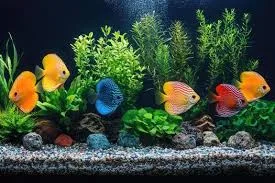
Complete Guide: The First 30 Days with New Discus
Just brought your first discus home? The first 30 days are critical. Here's a detailed day-by-day plan for acclimation, feeding and monitoring.
The first 30 days with new discus: the period that matters most
The first 30 days after you bring new discus home are, very often, the period that makes the difference between a successful settling-in and a chain of problems. Not because discus are impossible fish to keep, but because they react strongly to change: transport, water differences, light, noise, a new aquarium, a new hierarchy and a new feeding schedule.
In the first few days, your goal is not to see them perfectly colored, eating aggressively or behaving like in the videos online. The real goal is much simpler: to help them get through the stress, give them stable water, observe them closely and not intervene unnecessarily.
Many keepers lose fish in the first month not because "discus are too sensitive", but because they do too many things too fast: they change the pH, add preventive treatments, overfeed, turn on bright light, move the décor or introduce other fish before the group has stabilized.
This guide helps you have a clear plan for the first 30 days.
Before the discus arrive home
The best acclimation starts before the fish are even in the bag. The aquarium should already be prepared, cycled and stable. Discus are not suitable fish for a tank that has only been running "for a few days" or for a system whose biological filtration still can't keep up.
Before they arrive, check:
- the water temperature;
- that the filter is working properly;
- the ammonia and nitrite levels;
- the nitrates;
- the stability of the pH;
- the filter flow rate;
- the water oxygenation;
- the absence of large temperature swings between day and night.
Ideally, the aquarium should be calm, with no aggressive fish and no recent major changes. If you moved the décor, cleaned the filter aggressively or did a large water change the day before, you increased the risk of instability at exactly the worst moment.
For beginners, it helps to also read the basic guides in the Discus.ro Guides section, especially if this is your first dedicated discus aquarium.
Water parameters in the first month
In the first 30 days, stability is more important than perfection. Many beginners get stuck on the idea that they have to hit an exact pH or hardness value. In reality, for newly introduced fish, sudden swings are more dangerous than an imperfect but stable value.
As a general direction:
- temperature: 28–30°C (82–86°F);
- ammonia: 0;
- nitrite: 0;
- nitrate: as low as possible, ideally under 20 ppm;
- pH: stable, with no sudden changes;
- clean, well-oxygenated water.
Don't try to adjust the pH aggressively in the first week. Don't add chemicals just because "you read it somewhere". If the fish come from different water, they need gradual acclimation, not abrupt corrections.
A stable, clean and predictable aquarium is more valuable than one where you chase perfect values every single day.
Day 0 — Acclimation
The day the discus arrive is the day you should do the least, but do it correctly. The fish already arrive stressed from transport, vibrations, lack of light, temperature changes and a small space. Any extra action can add to the stress.
Preparation before opening the bag
Before you start acclimating:
- turn off the aquarium light;
- stop loud noises nearby;
- don't call the whole family to look at the fish;
- prepare a clean net;
- prepare a clean container if you're using the drip method;
- don't feed the other fish right before introducing the new ones.
Discus need quiet. As tempting as it is to photograph them right away, let them get through the first shock first.
The drip method, recommended
The drip method is one of the safest options for gradual acclimation.
Recommended steps:
- Let the closed bag float for 20–30 minutes to equalize the temperature.
- Open the bag and put the fish, together with the bag water, into a clean container.
- Start a thin tube running from the aquarium into the container, at a very low flow rate.
- Let the aquarium water drip in gradually for 40–60 minutes.
- When the water volume has doubled or tripled, move the fish into the aquarium with the net.
- Do not pour the bag or container water into the aquarium.
- Leave the light off for the rest of the day.
Don't rush. Fast acclimation may seem convenient, but discus react badly to sudden changes.
What not to do on day 0
On arrival day:
- don't feed;
- don't add preventive treatments;
- don't change water;
- don't adjust the pH;
- don't turn on bright light;
- don't tap on the glass;
- don't move the décor;
- don't introduce other fish.
It's normal for discus to stay in a corner, look pale, breathe faster or not explore right away. Don't confuse normal transport stress with an emergency just because they don't look spectacular in the first hours.
Days 1–3 — Observe, don't intervene
The first three days are for observation. During this period, you don't need to prove anything. You don't have to force them to eat and you don't have to look for solutions to every shy behavior.
Normal behaviors in the first days:
- staying grouped in a corner;
- hiding when you approach;
- having more faded colors;
- not eating right away;
- breathing slightly faster;
- getting startled by sudden movements.
What to watch closely:
- if the breathing is very rapid and doesn't calm down;
- if a fish stays permanently isolated;
- if spots, excess mucus or uncoordinated swimming appear;
- if all the fish are being chased by one dominant fish;
- if the water becomes cloudy or smells unpleasant.
On day 1 you can skip feeding entirely. On day 2 you can try a very small amount of food, but without pressure. If they don't eat, remove the leftovers and try again later or the next day.
The classic mistake is overfeeding. A stressed discus won't eat normally, and uneaten food fouls the water. Bad water is a bigger risk than the fish not eating for a day.
Days 4–7 — The first signs of settling in
Normally, towards the end of the first week, the discus start to become more curious. Some come out sooner, others more slowly. Not all fish settle in the same way.
At this stage you can start a light feeding schedule:
- 1–2 small meals per day;
- a little food, eaten quickly;
- removing the leftovers;
- watching each fish at feeding time.
It's important to see whether all of them get to the food. In discus groups, the hierarchy forms quickly, and a shyer specimen can be constantly pushed aside.
If one of the fish doesn't eat at all after 5–7 days, it needs to be watched more closely. It doesn't automatically mean disease, but it shouldn't be ignored either.
In the first week, avoid large water changes if the parameters are good. If you have to do a change, make it a small and careful one, with water at the same temperature.
Week 2 — Stabilization
In the second week, the fish should start to recognize the routine. They'll react to your presence, explore more and, in many cases, start coming towards the feeding area.
Now you can introduce a clearer routine:
- 2 meals per day;
- small portions;
- regular water changes;
- testing the water a few times per week;
- watching their behavior at feeding time;
- keeping the light on a consistent schedule.
A water change of around 20–25%, done with water close in temperature and with no sudden swings, can help a lot. The important thing is not to turn every water change into a shock.
If you notice aggression, don't panic immediately. Discus establish their hierarchy. A certain level of dominance is normal. It becomes a problem if a fish is permanently kept in a corner, can't eat or shows signs of constant stress.
Week 3 — The correct routine
By the third week, you should be getting close to a normal maintenance routine. The fish should have a better appetite, more stable colors and more relaxed behavior.
Now you can slightly diversify the food, but without overdoing it. A good diet can include quality pellets, suitable frozen food and, where appropriate, recipes used responsibly by breeders. The idea is not to give them as much as possible, but to give it consistently, cleanly and appropriately.
Be careful with food that fouls the water. Discus need clean water, and uneaten leftovers are one of the fastest paths to problems.
During this period:
- don't clean the filter aggressively;
- don't replace all the filter media;
- don't add new fish;
- don't change the décor massively;
- don't suddenly change the lighting schedule;
- don't test "preventive" treatments.
If the filter has a normal flow rate, leave it alone. Biological filtration is your ally. Many beginners ruin the aquarium's stability through overly aggressive cleaning, prompted by timid behavior.
Discus don't need a keeper who intervenes every hour. They need a keeper who observes, keeps the water stable and only intervenes when there's a real reason.
Checklist for the first 30 days
Use this list as a simple reference:
Day 0
- light off;
- slow acclimation;
- don't pour the bag water into the aquarium;
- don't feed;
- don't add treatments;
- leave the fish in peace.
Days 1–3
- observe their behavior;
- test the water if something looks suspicious;
- feed very little or not at all;
- remove leftovers;
- avoid unnecessary intervention.
Days 4–7
- start light feeding;
- watch whether all of them eat;
- keep the temperature constant;
- don't make big changes;
- note any abnormal behavior.
Week 2
- establish a feeding schedule;
- do small, regular water changes;
- check the nitrates;
- watch the group's hierarchy;
- avoid new fish.
Weeks 3–4
- keep the routine;
- diversify the food carefully;
- assess each fish;
- keep the filtration stable;
- don't change the system if it's working well.
Frequently asked questions
When do I first feed new discus?
Usually not on arrival day. You can try a very small amount on day 2, but if they don't eat, don't insist. Keeping the water clean is more important than forcing feeding.
Is it normal for them not to eat in the first days?
Yes, it can be normal. Many discus refuse food for 1–3 days after transport. If the refusal continues past a week or appears together with other symptoms, it needs to be investigated.
Should I use a preventive treatment?
We don't recommend preventive treatments without clear symptoms. Medications used unnecessarily can stress the fish, affect the biological filtration and mask the real problem.
Can I add other fish in the first month?
It's best not to add new fish in the first 30 days. Let the group stabilize and observe whether all the discus settle in well.
What do I do if one is being bullied?
Watch whether it can eat and whether it has space to retreat. A certain level of dominance is normal, but constant aggression may call for rearranging the décor, temporary separation or adjusting the group.
How often do I change the water?
It depends on the aquarium volume, the number of fish, the filtration and the feeding. In the first month, smaller and more regular changes are usually safer than large and infrequent ones. The new water should be close in temperature and parameters.
Conclusion
The first 30 days with new discus are not about perfection, they're about stability. If you manage to provide clean water, a constant temperature, food in the right amounts and a quiet environment, you already have the right foundation.
Don't rush to correct everything. Don't treat without a reason. Don't overfeed. Don't change the parameters abruptly. Observe the fish, note the changes and build a routine.
Discus need time to adapt. And in the first month, the best thing you can do is to be consistent, attentive and patient.