Best discus tank mates: top 7 compatible species at 29°C (84°F)
The best tank mates for discus — a pillar guide with 7 species that thrive at 28–30°C (82–86°F): cardinal tetra, rummynose, Corydoras sterbai, Ancistrus, ember tetra, lemon tetra, hatchetfish.

Quick summary
- Only 7 species are compatible long-term at 29°C (84°F).
- Top 3: cardinal tetra, rummynose tetra, Corydoras sterbai.
- Don't use common neon (Paracheirodon innesi) — it prefers 24°C (75°F).
- The only Corydoras for discus: sterbai (tolerates 30°C / 86°F).
- Bottom: Ancistrus (bristlenose), NOT a common pleco.
- At least 10 fish per school (cardinals, rummynose, ember).
In short
- Only 7 species are compatible with discus long-term at 29°C (84°F).
- Top 3: cardinal tetra (Paracheirodon axelrodi), rummynose tetra (Hemigrammus bleheri), Corydoras sterbai.
- NOT the common neon tetra (P. innesi) — it prefers 24°C (75°F) and dies at 29°C (84°F).
- The only Corydoras for discus: sterbai. Aeneus, paleatus and julii suffer at 29°C (84°F).
- Bottom: Ancistrus (bristlenose). NEVER a common pleco (40–50 cm / 16–20 in, attacks the slime coat).
- Schools of at least 10 for cardinals / rummynose / ember.
What you'll learn
Tank mates for discus (Symphysodon) must be picked against 3 strict criteria: tolerance of 28–30°C (82–86°F), pH 6.0–7.2 and a peaceful temperament (zero fin-nipping). This pillar guide shows you the 7 species that meet every condition, the recommended school size and what to avoid even when the shop tells you they "go together."
💱 The "EU price 2026" figures below are rough European retail references only — not verified global prices. Costs vary a lot by country, species quality and supplier, so always check your local market.
What makes an ideal discus tank mate
✅ Tolerates 28–30°C (82–86°F) long-term (not just "survives") ✅ Lives at pH 6.0–7.2 and moderate TDS (100–300 ppm) ✅ Peaceful — doesn't nip long fins (the fin-nipper test) ✅ Doesn't compete aggressively for food ✅ At most 8–10 cm (3–4 in) as an adult (in proportion with the discus) ✅ A schooling species (10+) or a solitary, peaceful pleco ✅ Compatible with the discus slime coat (doesn't eat it)
Top 7 verified tank mates
1. Cardinal tetra (Paracheirodon axelrodi) ⭐ #1
Native to the Rio Negro — the same biotope as wild discus. An electric-blue + bright-red stripe along the whole body.
| Parameter | Value |
|---|---|
| Temperature | 24–30°C (75–86°F) ✅ |
| pH | 4.5–7.0 |
| Adult size | 4–5 cm (1.6–2 in) |
| Minimum school | 10–15 fish |
| EU price 2026 | €2–4 each |
⚠️ Common confusion: the common neon tetra (P. innesi) is NOT a cardinal. Innesi prefers 22–26°C (72–79°F) and slowly dies at 29°C (84°F).
2. Rummynose tetra (Hemigrammus bleheri) ⭐
Silvery fish with an intense red nose. They move in tight schools — a spectacular visual effect.
| Parameter | Value |
|---|---|
| Temperature | 26–30°C (79–86°F) ✅ |
| pH | 5.5–7.0 |
| Adult size | 4–5 cm (1.6–2 in) |
| Minimum school | 10 fish |
| EU price 2026 | €3–5 each |
Bonus: the red nose becomes more intense when the water is good — a natural quality indicator.
3. Corydoras sterbai (Corydoras sterbai) ⭐
The only Corydoras species that thrives at 29–30°C (84–86°F) long-term. Golden-brown with white spots on the head.
| Parameter | Value |
|---|---|
| Temperature | 26–30°C (79–86°F) ✅ |
| pH | 6.0–7.6 |
| Adult size | 6–7 cm (2.4–2.8 in) |
| Minimum school | 6 fish (MANDATORY) |
| EU price 2026 | €8–15 each |
⚠️ NOT Cory aeneus, paleatus, julii or panda — all prefer 22–26°C (72–79°F) and get sick quickly at 29°C (84°F).
4. Ancistrus (Ancistrus sp.) — bristlenose pleco ⭐
The best pleco for discus: small, peaceful, eats algae without attacking the fish's slime coat.
| Parameter | Value |
|---|---|
| Temperature | 23–29°C (73–84°F) ✅ |
| pH | 6.0–7.5 |
| Adult size | 10–15 cm (4–6 in) |
| Number | 1–2 fish (males are territorial) |
| EU price 2026 | €10–25 each |
❌ NOT a common pleco (Pterygoplichthys) — it reaches 40–50 cm (16–20 in) and eats the discus slime coat at night → lesions + secondary infections.
5. Ember tetra (Hyphessobrycon amandae)
Tiny bright-orange fish. Very peaceful, perfect for planted tanks.
| Parameter | Value |
|---|---|
| Temperature | 24–29°C (75–84°F) ✅ |
| pH | 5.5–7.0 |
| Adult size | 2–2.5 cm (0.8–1 in) |
| Minimum school | 15–20 (for effect) |
| EU price 2026 | €2–3 each |
6. Lemon tetra (Hyphessobrycon pulchripinnis)
Golden-yellow, robust fish, ideal for beginners.
| Parameter | Value |
|---|---|
| Temperature | 23–28°C (73–82°F) ⚠️ (upper limit) |
| pH | 5.5–7.5 |
| Size | 4–5 cm (1.6–2 in) |
| Minimum school | 8–10 |
| EU price 2026 | €2–4 each |
⚠️ At a constant 29–30°C (84–86°F) they can be stressed long-term. Better suited to discus tanks kept at 28°C (82°F).
7. Marbled hatchetfish (Carnegiella strigata)
Surface fish — the one zone of the tank that discus don't occupy.
| Parameter | Value |
|---|---|
| Temperature | 24–30°C (75–86°F) ✅ |
| pH | 5.0–7.0 |
| Size | 3–4 cm (1.2–1.6 in) |
| Minimum school | 8–10 |
| EU price 2026 | €4–7 each |
⚠️ A tight-fitting lid is mandatory — they jump out of the tank instantly.
Comparison table — compatibility at 29°C (84°F)
| Species | Max temp | Zone | School | Recommendation |
|---|---|---|---|---|
| Cardinal tetra | 30°C (86°F) | Mid-top | 10–15 | ⭐⭐⭐⭐⭐ |
| Rummynose | 30°C (86°F) | Mid | 10+ | ⭐⭐⭐⭐⭐ |
| Cory sterbai | 30°C (86°F) | Bottom | 6+ | ⭐⭐⭐⭐⭐ |
| Ancistrus | 29°C (84°F) | Bottom/decor | 1–2 | ⭐⭐⭐⭐⭐ |
| Ember tetra | 29°C (84°F) | Mid-top | 15–20 | ⭐⭐⭐⭐ |
| Hatchetfish | 30°C (86°F) | Surface | 8+ | ⭐⭐⭐⭐ |
| Lemon tetra | 28°C (82°F) | Mid | 8+ | ⭐⭐⭐ |
| ❌ Common neon | 26°C (79°F) | — | — | NO |
| ❌ Cory paleatus | 26°C (79°F) | — | — | NO |
| ❌ Common pleco | 30°C (86°F) | — | — | NO (attacks slime coat) |
Golden rules for a community tank
- The discus comes first. Don't lower the temperature to keep fragile species — choose species that thrive at 29°C (84°F).
- Schools of at least 10 for cardinals / rummynose / ember — below 10 they're stressed and nip.
- Gradual introduction: cory + pleco weeks 1–2, tetra weeks 3–4, discus week 5+.
- 4-week quarantine for any new species (Hexamita, Camallanus from guppies/angelfish).
- Test nitrates weekly — keep below 20 ppm. Above = overstocked.
Example 300L (79 US gal) setup (recommended)
| Species | Number | Zone |
|---|---|---|
| Adult discus | 6 | Mid |
| Cardinal tetra | 15 | Mid-top |
| Rummynose tetra | 10 | Mid |
| Cory sterbai | 6 | Bottom |
| Ancistrus bristlenose | 1 | Bottom/decor |
Total: 38 fish — nitrates <10 ppm, zero aggression, spectacular visibility.
Common mistakes to avoid
❌ "The shop kept them together, so they're fine" — the shop keeps them at 24–25°C (75–77°F) temporarily. At home at 29°C (84°F), tiger barbs and common plecos show their true colors. ❌ "I'll get 3 cardinals and see how they do" — below 10 they're stressed and don't school. You pay more in losses than on the right group. ❌ "Cory paleatus is cheaper than sterbai" — at 29°C (84°F), paleatus dies in 3–6 months. Sterbai lives 5+ years. ❌ Adding angelfish — see discus + angelfish — Hexamita risk.
Checklist before buying tank mates
- ☐ The species' optimal temperature includes 29°C (84°F)
- ☐ Preferred pH 6.0–7.2
- ☐ Adult size under 10 cm (4 in)
- ☐ NOT a fin-nipper (check "does X nip fins")
- ☐ Tank large enough for the minimum school (10 cardinals = extra bioload)
- ☐ A 4-week quarantine available
- ☐ The discus are already settled (at least 4 weeks in the tank)
- ☐ Filtration handles the extra load (flow 4–6× volume/h)
What to do next
📚 Learn more:
- How many discus in an aquarium — table by volume
- Discus-only vs community aquarium
- Fish to avoid with discus — the blacklist
- Bottom feeders for discus — Cory + Ancistrus + L-numbers
- Discus + angelfish — why not
🧮 Calculate:
- Stocking calculator — how many fish fit in your volume
- Aquarium volume calculator — check the real capacity
🛒 Buy:
- Verified discus breeders — discus as the priority
- Food for tetra and cory
Recommended products
Picked from the shop based on what you just read
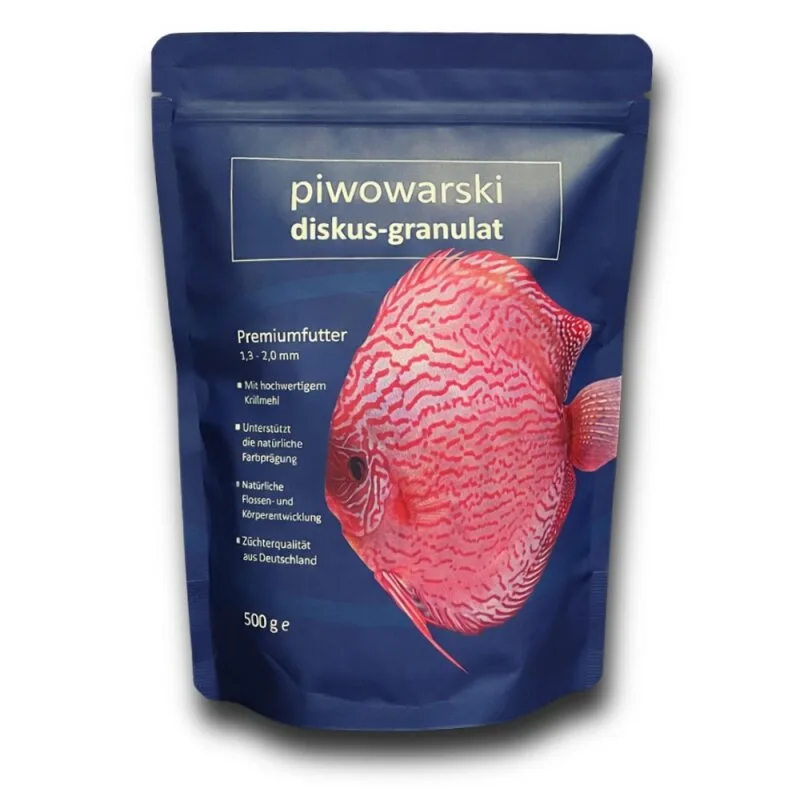
Recommendations are selected from the discus.ro shop based on this guide's topic. Availability and prices may vary.