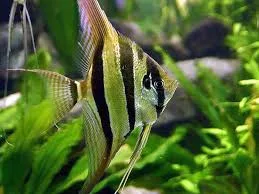
Angelfish
Pterophyllum scalare
Description
Angelfish (Pterophyllum scalare) are South American cichlids genetically related to discus, native to the same Amazon basin. They can coexist with discus under specific conditions: a spacious tank, young specimens raised together, and trustworthy sources (parasite-free). Their elegant vertical silhouette offers a spectacular visual contrast with the rounded shape of discus.
🌍 Origin
The Amazon basin — Rio Negro, Rio Solimões, Peru, Brazil, Colombia. The same natural habitat as discus.
Appearance
A tall, laterally compressed body with very long dorsal and anal fins. Colors: wild (silver with black vertical stripes), altum, black, marbled, koi, platinum, veil. 15 cm long + up to 20–25 cm tall including the fins.
Recommended water parameters
Compatibility with discus
CAUTION: Angelfish are frequent carriers of the flagellate Hexamita and other parasites dangerous to discus. MANDATORY rules: (1) tank min 300L, (2) young specimens raised together with the discus, (3) a verified source with strict 4–6 week quarantine, (4) AVOID breeding pairs, (5) do not mix ALTUM angelfish (wild) with domestic discus.
Care
Requires a TALL tank (min 50 cm) due to body height. Warm, clean, slightly acidic water. Tall plants (Vallisneria, Echinodorus) to mimic the natural habitat.
Feeding
Omnivore — premium pellets, bloodworms, brine shrimp, daphnia, shrimp. Feed 2x/day in small portions. Same diet as discus = easy to manage.
Behavior
Semi-aggressive. Establishes a clear hierarchy within the group. Breeding pairs become very territorial. In a group of 4–5+ the aggression dilutes.
💡 Practical tips
- →Tank MINIMUM 300L and 50+ cm tall
- →4–6 week quarantine mandatory — Hexamita risk
- →Only young specimens raised together with the discus
- →Avoid breeding pairs — they turn aggressive
- →Do NOT mix with Altum angelfish (wild)
Related guides
Articles relevant to you
Useful tools
Quick aquarium calculators