My Discus Aquarium — Setup Types, Benefits & Useful Guides
From the breeder's bare-bottom tank to a lush planted scape or an Amazonian biotope — discover which discus aquarium setup fits your style, with the pros and cons of each.
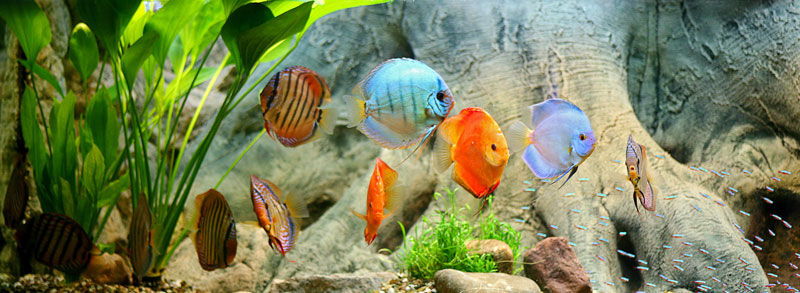
When we say "my discus aquarium", every keeper pictures something different: one imagines a completely sterile, white, spotless tank where every dropping can be monitored; another a green jungle full of Anubias and Echinodorus, with discus drifting between the leaves like living paintings; a third an Amazonian biotope, with mangrove wood, catappa leaves and amber-tinted water.
The truth is that there is no single "correct" aquarium for discus — there is only the right aquarium for your goals. In this guide we walk through the main setup types, the benefits and challenges of each, plus direct links to our detailed guides for every technical aspect.
Before you pick a style: what you need to know
Whatever tank type you choose, a few fundamentals are non-negotiable with discus:
- Minimum 150–200 L (≈40–53 US gallons) for a group of 4–6 fish. Full details in the ideal discus aquarium size.
- Strong filtration (4–6× the volume per hour). Read the best filtration for discus and compare options in sump vs external filter for discus.
- Stable parameters: 28–30 °C (≈82–86 °F), pH 6.0–6.8, TDS 100–200 ppm. More in the ideal water parameters for discus.
- A fully cycled tank before adding any fish. This step is covered in cycling the discus aquarium — the most important step.
If this is your first time with discus, we recommend starting with the complete beginner's guide.
1. The bare-bottom tank — the breeders' choice

The sterile tank, also known as "bare bottom", is the favourite of professional breeders and of anyone focused on fish health and fast growth. There's no substrate, plants or décor — just the glass, the filter, the heater and, optionally, a breeding cone or a few Anubias tied to a piece of wood.
Benefits
- Maximum hygiene — any dropping or leftover food is immediately visible and quickly siphoned out.
- Easy disease diagnosis — you can watch the discus' feces, an essential health indicator. If white feces appear, you react immediately.
- Faster fry growth — with no organic build-up, fry get only clean water and fresh food. Essential for raising discus fry.
- Fast water changes — siphoning takes just minutes, ideal for a routine of frequent water changes.
- Lower costs — no need for expensive substrate, plants, CO2 or strong lighting.
- Total parameter control — with no substrate leaching anything, pH and TDS are easier to keep stable.
Drawbacks
- A less natural look — in a living room, it can feel like a "fish hospital".
- Bottom reflections — discus can stress at their own reflection. Solved with a black or matte background applied externally.
- No natural nitrate reduction — without plants, you compensate with regular water changes.
Who is it for?
If you want to breed discus, grow large healthy specimens, or simply prefer absolute control, the bare-bottom tank is the optimal choice. Read more about discus aquarium substrate for comparison.
2. The planted tank — aesthetics and biological balance

The planted tank turns the aquarium into a living picture. Done right, it offers a stunning look and a more stable ecosystem — but it asks for more knowledge and work.
Benefits
- Spectacular aesthetics — a well-planted tank with discus is breathtaking.
- Natural nitrate reduction — plants consume nitrates, easing the water-change load.
- More oxygen and stability — a healthy planted tank buffers parameters better.
- Algae competition — healthy plants compete for nutrients and reduce algae outbreaks.
- Natural behaviour — pairs can lay eggs on large leaves, and fry have places to hide.
Drawbacks
- The temperature challenge — at 28–30 °C (≈82–86 °F), many popular plants struggle. Species choice is critical. See our full list of discus-compatible plants.
- Needs strong lighting and, ideally, CO2 — an extra investment of roughly $100–450.
- More complex maintenance — trimming, fertilizing, careful siphoning between plants.
- Harder problem diagnosis — droppings and food scraps get lost among the plants.
- Active substrate that depletes in 1–2 years (Amazonia, Fluval Stratum), or compromises with fine sand.
Who is it for?
For hobbyists who prioritize aesthetics, already have aquarium experience and are willing to invest time and money in plants. Not recommended as a first discus tank.
3. The Amazonian biotope — nature recreated

The Amazonian biotope is for purists who want to recreate the natural habitat of discus: dark, amber-tinted water, submerged wood, catappa leaves and minimal but authentic vegetation.
Benefits
- Total authenticity — it's the closest to the natural environment of the Symphysodon genus.
- Naturally high-quality water — tannins from leaves and wood have antibacterial and antifungal properties, a natural aid in maintaining the ideal pH for discus.
- Authentic behaviour — discus show behaviours you won't see in other setups (surface feeding, exploring among roots).
- Intense colours — slightly tinted water and a dark substrate bring out the reds, blues and greens of discus.
- Reduced stress — a natural environment drastically reduces issues like colour change / darkening or refusing food.
Drawbacks
- Tinted (amber) water — beautiful to some, "dirty-looking" to others.
- Sourcing authentic materials — Manzanita wood, catappa leaves and fine bluish sand can be hard to find.
- More demanding parameters — an authentic biotope wants pH 5.5–6.5 and low TDS, which often means RO water.
- Limited vegetation — only a few species are genuinely Amazonian (Echinodorus, some mosses).
Who is it for?
For experienced keepers who want to recreate wild conditions, or who keep special discus varieties (Heckel, Altum, wilds). An excellent choice for photography and artistic projects.
4. The "living-room-friendly" tank — the balanced compromise
Many hobbyists want a beautiful tank in the living room that isn't too complicated to maintain. This is the perfect compromise: fine sand on the bottom, a few hardy plants (Anubias, Java Fern, Vallisneria), one or two pieces of wood and, optionally, a few dried leaves.
Benefits
- Natural, welcoming look — suited to a living room or office.
- Reasonable maintenance — simpler than a fully planted tank, more attractive than a sterile one.
- Hardy plants — Anubias and Java Fern need no CO2, complex fertilization or strong lighting. Details in discus-compatible plants.
- Good biological balance — plants help parameter stability without big demands.
- Moderate costs — a reasonable investment, with no specialized equipment.
Drawbacks
- It's not "Amano-style" — if you want flawless aesthetics, you'll be disappointed.
- Slightly harder siphoning than bare bottom.
- Algae risk — if the lighting isn't dialed in correctly.
Who is it for?
For most discus hobbyists — a good balance between aesthetics, maintenance and fish welfare. Our recommendation for beginners who have moved past the initial phase.
5. The quarantine / hospital tank — a must for every serious keeper
Although it's not a "style" as such, we can't talk about the discus aquarium without mentioning quarantine. Every serious keeper has a second, smaller tank (80–100 L / ≈20–26 gal), bare, with no substrate, used for:
- Quarantining new discus — a minimum of 4 weeks before introduction into the main tank. Details in acclimating new discus.
- Medication treatments — without affecting the biological bacteria in the main tank.
- Separating stressed or aggressive specimens.
- Raising fry away from the parents.
This "second tank" saves you a lot of drama. It's the best insurance against disease.
How to choose the right type for you
Before deciding, answer these questions honestly:
- How much time do you have for maintenance? Bare bottom = quick. Planted = demanding.
- What is your main goal? Breeding/growth = bare bottom. Aesthetics = planted or biotope.
- How much can you invest up front? Bare bottom = cheaper. Planted = more expensive.
- Do you already have aquarium experience? Beginners should avoid authentic biotopes.
- Where will the tank sit? Living room = aesthetic compromise. Fish room = bare bottom.
Don't forget: you can always evolve. Many keepers start with a "living-room-friendly" tank, move on to a complex planted system, then return to bare bottom once they discover a passion for breeding.
Essential equipment — whatever the style
Whatever your choice, you'll need:
- A strong external filter — see our filter recommendations
- A quality heater + digital thermometer — 1 W/L, ±0.5 °C precision
- A water test kit — API Freshwater Master Test Kit
- A TDS meter — especially for planted tanks and biotopes
- A water-change pump — hose + gravel cleaner
The full list, with price estimates, is in essential equipment for a discus aquarium.
💡 Did you know?
The "best" discus aquarium isn't the most expensive one — it's the one you can keep stable. A simple bare-bottom tank, maintained consistently, will grow healthier discus than an elaborate planted scape that you can't keep up with. Match the style to the time you realistically have, not to the photos you admire online.
❓ Frequently asked questions
What's the best aquarium setup for beginners with discus?
A "living-room-friendly" tank — fine sand, a few hardy plants (Anubias, Java Fern) and one or two pieces of wood — offers the best balance of looks, easy maintenance and fish welfare. Avoid full planted scapes and authentic biotopes until you have more experience.
Do discus need a planted tank?
No. Discus thrive in bare-bottom tanks, which many breeders prefer for hygiene and fast growth. Plants are an aesthetic choice, not a requirement — and they add maintenance and cost.
Why do breeders keep discus in bare-bottom tanks?
Because hygiene is maximal: waste is instantly visible and siphoned out, water changes are fast, parameters stay stable, and you can monitor each fish's feces as a health indicator — all of which speeds up healthy growth.
Is a quarantine tank really necessary?
Yes. A small bare quarantine tank (80–100 L / ≈20–26 gal) lets you isolate new fish for at least 4 weeks and treat illness without harming the biology of your main tank. It's the single best insurance against disease wiping out your stock.
Recommended reading
- 📘 The complete beginner's guide
- 🏠 Discus aquarium setup — all guides
- 💧 Water parameters for discus
- 🍽️ Discus food
- ⚠️ Common beginner mistakes
Good luck with your tank and, as we say on discus.ro: clean water and healthy fish! 🐟