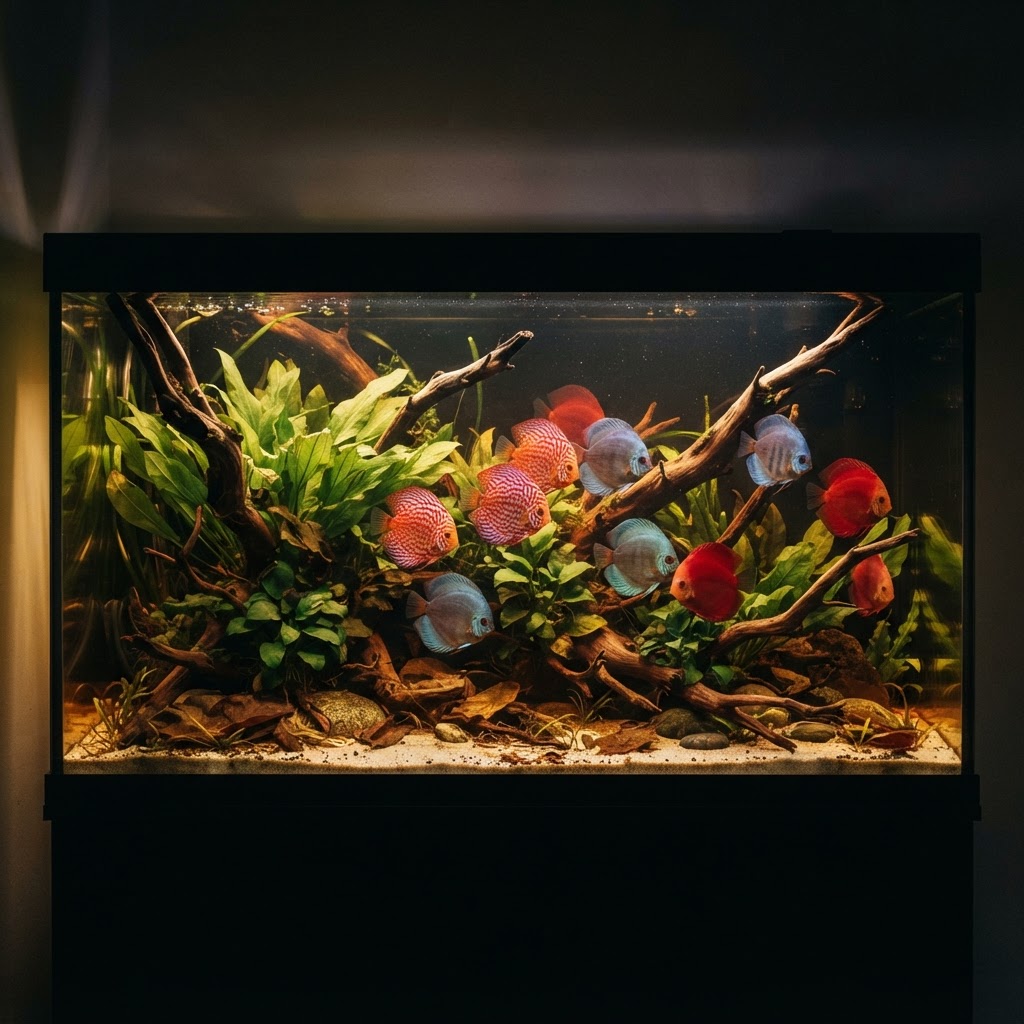
Two Real Discus Aquariums, 400L and 450L, Broken Down by the Numbers
Two community discus aquariums — 450 L and 400 L, both sump filtered — compared number by number: 6 and 8 discus at 14–18 cm, litres per fish, heating, and what is worth copying.
A discus aquarium is not judged by how spectacular it looks in a photo. It is judged by numbers that never make it into the picture: litres of water per fish, filtration that actually carries the volume, how easily the temperature holds in winter, and how often water gets changed. I took the two aquariums published in the discus.ro community gallery and put them side by side, using the exact data their owners entered.
These are not “perfect setups”. They are two working aquariums with different compromises — which is exactly what makes them useful.
Where the numbers come from
All figures were entered by the owners in the My Aquarium journal and published by them in the community aquarium gallery: volume, filtration, inhabitants, equipment. Only pseudonyms and technical figures are kept. Public pages never show costs, addresses or contact details.
Aquarium 1: 450 litres on a sump, 6 discus
| Parameter | Value |
|---|---|
| Volume | 450 L (119 US gal) |
| Filtration | sump |
| Started | 28 June 2026 |
| Discus | 6 |
| Sizes | 14–18 cm (average 16.3 cm) |
| Litres of water per discus | 75 L (about 20 US gal) |
| Heating | 1 × 250 W |
| RO water | no |
| Tank mates | 2 ancistrus, 4 albino corydoras |
The stocking list says it all: Red Melon female 16 cm, Red Melon male 18 cm, Leopard Snake 18 cm, Leopard 14 cm and two Blue Cobalt at 16 cm. A hierarchy is already in place, with two large males sharing the space, in a tank wide enough for six big fish.
At 75 litres per discus the aquarium sits comfortably above the 50 L per adult fish reference point. The sump explains why it works: water passes through large filter compartments, and the biological surface area does not depend on a canister hanging on the glass. Worth reading the discus filtration guide before copying the model.
The weak point is heating: 250 W for 450 litres means 1.8 litres for every watt. In a 21–22°C room a 250 W heater struggles to hold 450 L at 28–29°C and has essentially no reserve for winter or a cold snap. I would go 300 W minimum, ideally two elements.

Aquarium page: Display mare jos, 450 L.
Aquarium 2: 400 litres, 8 discus and a breeding section
| Parameter | Value |
|---|---|
| Volume | 400 L (106 US gal) |
| Filtration | sump |
| Started | 28 October 2026 |
| Discus | 8 |
| Sizes | 15–17 cm (average 15.5 cm) |
| Litres of water per discus | 50 L (about 13 US gal) |
| Heating | 2 × 300 W |
| Pump | Oase 500 |
| RO water | no |
| Breeding | active pair |
The list: four Blue Heckel Cross at 15 cm, two Leopard SS at 16 cm, one Red Marlboro at 17 cm and one Super Red Melon at 15 cm. The page name — “Perechi”, meaning pairs — tells you what happens there: this tank is organised for pairs, not as a mixed display, and the breeding section is active.
Here is the important difference from the first aquarium. 50 litres per fish is a dense tank. Dense does not mean wrong, but it means filtration and water changes cannot slip: at 50 L per discus the margin for error is small, and two mature males in one tank need daily attention. To size your own stock, use the stocking calculator rather than someone else's fish count.
Heating, on the other hand, is textbook: two 300 W heaters. If one fails, the other carries the tank. That is the pattern I recommend to anyone above 300 litres.
One necessary note: the tank was started in October 2026, so it is young. Anyone starting from scratch cannot copy the stocking list straight away — cycling first, fish second. There is a cycling calculator and a beginner's cycling guide.

Aquarium page: Perechi, 400 L.
The short comparison
| 450 L aquarium | 400 L aquarium | |
|---|---|---|
| Discus | 6 | 8 |
| Litres per discus | 75 L | 50 L |
| Average size | 16.3 cm | 15.5 cm |
| Filtration | sump | sump |
| Heating | 1 × 250 W (0.56 W/L) | 2 × 300 W (1.5 W/L) |
| RO water | no | no |
| Breeding | no | yes |
Two tanks of similar volume with opposite philosophies: one runs on space and big fish, the other on density, equipment redundancy and breeding. Both work because filtration is oversized. Neither works because of luck.
5 things worth copying
1. A sump above 400 litres. Both aquariums use one. At this volume a hang-on or canister filter becomes a compromise, while a sump gives real filter volume and keeps equipment out of the tank.
2. Two heaters instead of one bigger one. The 400 L tank shows why: 2 × 300 W costs roughly as much as one large heater and gives you redundancy. Details in the discus aquarium heating guide.
3. 50 litres per discus only works with discipline. With 8 fish in 400 L, every skipped water change shows. See how often and how much water to change.
4. Tap water can be enough. Both aquariums declare no reverse osmosis. If your tap water is stable and properly conditioned, stability beats perfect numbers: why stability matters more than ideal parameters.
5. Fish count is relative to size. Six fish at 16–18 cm eat more and pollute more than eight fish at 10 cm. The how many discus in an aquarium guide explains the thresholds.
What the numbers do not show
No table shows the routine: how often water is changed, at what temperature, what the fish eat, and how quickly the owner reacts when something shifts for better or worse. That is where a discus aquarium is won or lost. Start with weekly maintenance.
Publish your aquarium to the community
The gallery grows with every aquarium published, and those public pages are exactly what someone wants to see before buying their first tank.
- Open My Aquarium and add the tank with volume, filtration and inhabitants.
- Open the aquarium's publishing settings and pick a pseudonym.
- Tick only the sections you want public (photos, inhabitants, equipment, water, routine).
- Save and share the link from the community gallery.
Costs, private notes and contact details never appear on the public page.
Frequently asked questions
How many discus fit in a 400 litre aquarium?
At the 50 litres per adult reference, 8 discus — exactly like the second setup. The condition is oversized filtration and consistent water changes. Below 50 L per fish the tank demands a routine few people sustain for months.
Is a 250 W heater enough for 450 litres?
Only marginally. 250 W means 1.8 litres per watt, enough in a warm room but with no reserve in winter. For 450 L, 300 W is the sensible minimum, and two elements are the safe option.
Do discus need reverse osmosis water?
Not necessarily. Both aquariums in this article run on conditioned tap water. RO makes sense when tap water is very hard or when you want to reproduce a specific biotope. Stability matters more than a perfect parameter value.
Is sump filtration worth it for discus?
Yes, above 400 litres. A sump gives you filter volume, easy maintenance access and somewhere to keep heaters and the pump outside the tank.
Keep reading
Recommended products based on this article
Mentioned equipment, available in the discus.ro shop



The selection is automatic, based on the equipment and products mentioned in the article. Prices and availability may vary.