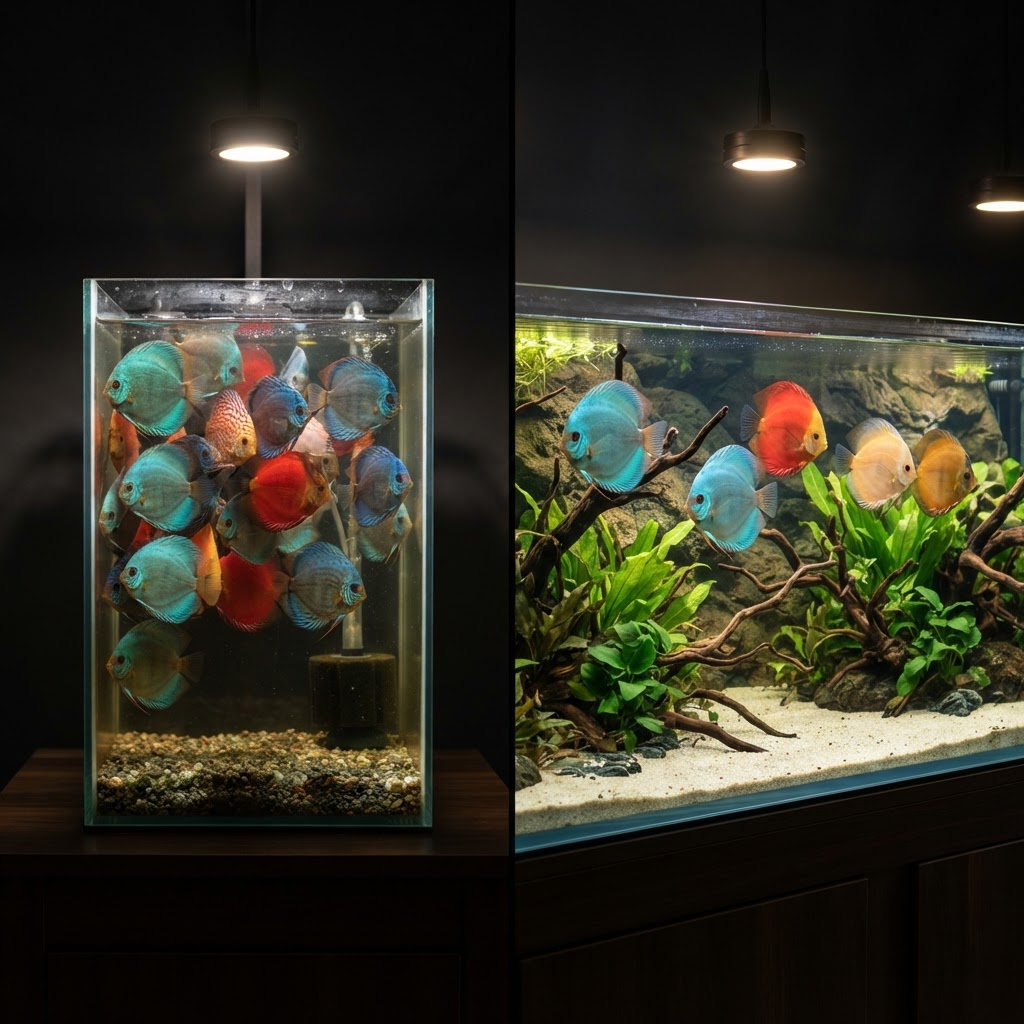
How Many Discus in How Many Litres: The Concrete Table, 5 Myths and a Starting Budget
A table by actual water volume (200 L = 4–5 discus, 300 L = 6–7, 400 L = 8–10), the 40–50 L per adult rule, five expensive myths and a realistic starting budget.
The most expensive thing you can buy at the start of a discus aquarium is not the tank: it is the tank that is too small, bought first. Here is the table that answers the question directly, the myths that cost money, and a realistic starting budget for 2026.
In short
- 1 adult discus (12–18 cm) per 40–50 L of actual water. 50 L is the recommendation for beginners.
- Under 200 L is not recommended. 150 L is the absolute floor and only works temporarily.
- 200 L = 4–5 discus | 300 L = 6–7 | 400 L = 8–10 | 500 L = 10–12.
- At least 6 discus per group, otherwise bullying concentrates on one fish. Exception: a proven breeding pair.
- Minimum height 45 cm, ideally 50 cm. Discus are tall-bodied fish.
- Actual water is 10–20% less than the number on the label.
The full table by volume
All volumes below are actual water (after substrate and hardscape), not the gross tank size.
| Actual volume | Dimensions (L×W×H cm) | Max discus | Ideal discus | Tank budget, EUR (2026) |
|---|---|---|---|---|
| 100 L (26 gal) | 80×35×40 | ❌ 0 | ❌ 0 | — |
| 150 L (40 gal) | 80×40×45 | ⚠️ 3 | ❌ not recommended | €95–170 |
| 200 L (53 gal) | 100×40×50 | 5 | 4 | €110–190 |
| 250 L (66 gal) | 100×50×50 | 6 | 5–6 | €130–245 |
| 300 L (79 gal) | 120×50×50 | 7 | 6 | €225–375 |
| 350 L (92 gal) | 120×50×60 | 8 | 7 | €205–335 |
| 400 L (106 gal) | 150×60×50 | 10 | 8 | €280–450 |
| 500 L (132 gal) | 150×60×60 | 12 | 10 | €375–655 |
| 600 L+ (159 gal) | 180×60×60 | 15 | 12 | €655+ |
The rule is simple: maximum = volume ÷ 40 L, ideal = volume ÷ 50 L, rounded down. A real 300 L tank holds 7 discus at the upper limit and 6 comfortably.
For your own number in seconds, use the stocking calculator. If you only have dimensions in cm, start with the volume calculator.
Why 40–50 litres, not 10 litres per centimetre
The “10 litres per centimetre of fish” rule has been circulating for decades and looks like real maths. Applied to discus it produces absurd results: a 15 cm discus would “fit” in 150 L, so ten discus in a 150 L tank. It fails for four reasons.
1. A hierarchy needs physical space. Each discus claims a territory of 20–30 cm. Below six fish in a group, aggression concentrates on a single victim. The smaller the tank, the less the dominated fish can disappear from the dominant fish's line of sight.
2. Waste scales with mass, not length. An adult discus produces a lot of organic matter. In 150 L nitrates climb within days; in 400 L you have time to react.
3. Water changes have to stay sustainable. 50% of 200 L means 100 L of prepared water twice a week. 50% of 500 L means 250 L. A bigger volume asks for more water but forgives more mistakes.
4. Height matters as much as volume. A 100×40×70 cm tank holds 280 L but offers little swimming length and a wasted water column. Prefer long and wide over tall and narrow. Under 45 cm of height, discus are squeezed vertically.
Adjusting for age: a juvenile is not an adult
The table above is for adults. If you buy juveniles the numbers change — but not in your favour.
| Stage | Size | Litres per fish | Minimum volume |
|---|---|---|---|
| Fry | 3–5 cm | 8–12 L | 80 L |
| Juvenile | 5–10 cm | 20–30 L | 150 L |
| Adult | 12+ cm | 40–50 L | 200 L |
The temptation is to buy ten 4 cm fry for a 100 L tank because “they fit”. They do, for now. Eight to ten months later they are 10–12 cm and the problem is no longer space — it is that you have to sell exactly when the fish are hardest to move. Plan for the final size, not the size in the transport bag.
There is one case where the numbers relax: a breeding pair, which is fine in 100–150 L with no other fish in the tank. See the breeding tank setup.
Actual water vs gross water
A tank sold as “250 L” holds 250 L only when empty. With 3–5 cm of substrate, wood and stones, about 210–220 L of actual water remain. At 250 L gross:
- 250 ÷ 50 = 5 discus (wrong calculation, on the label volume)
- 215 ÷ 50 = 4 discus (correct calculation)
- 215 ÷ 40 = 5 discus at the absolute limit, with strong filtration and frequent changes
The difference between 4 and 5 fish does not look like much. The difference between a tank that survives a year and one that needs weekly intervention is exactly that margin.
5 myths that cost money
Myth 1: “Fish only grow as big as the tank.” False. In insufficient space and high nitrate water a discus does not adapt — it becomes stunted: growth stops, the body is disproportionate, immunity drops. It is not a miniature variety, it is a fish with problems.
Myth 2: “A big tank is more work.” More water to change, fewer emergencies. 20% of 400 L is 80 L once a week with nitrates staying safe. A 150 L tank needs almost daily attention to look the same.
Myth 3: “I'll buy 8 juveniles now and sell whatever doesn't fit.” Selling grown discus is not instant, and meanwhile the eight keep growing in the same tank. If the plan is eight adults, buy the 400 L from the start.
Myth 4: “One discus alone is fine, I'll keep it with other fish.” Discus are gregarious. Below five or six specimens bullying appears, and a lone discus lives stressed even if it eats. The minimum group is six, not one.
Myth 5: “The label volume is the real volume.” See above. It is the cheapest mistake to avoid: calculate with 10–20% less and buy one size up.
The starting budget, by scenario
The figures below are estimates for 2026 with a new tank, converted from RON at ≈5.35 RON/EUR. The full component-by-component breakdown is in the article on how much it costs to keep discus.
| Scenario | Tank | Fish | Initial investment | Monthly cost |
|---|---|---|---|---|
| Minimal | 200 L | 4 juveniles | €280–470 | €15–22 |
| Balanced | 300 L | 6 adults | €655–1,030 | €28–41 |
| Premium | 450–500 L, sump | 8–10 adults | €1,310–2,240 | €47–75 |
The order you spend in matters more than the amount: tank and filtration first, then heating (ideally two elements, see the heating guide), then a lid, then the fish. A 300 L tank with mediocre filtration costs more over time than a 300 L tank with a sump.
To see exactly what electricity, food and conditioner cost per month, use the monthly cost calculator.
Pre-calculated setups
You do not have to start from a blank page — there are equipment lists by volume, linked to products.
- 200 L aquarium setup — for 4 discus
- 300 L aquarium setup — for 6 discus
- 450 L aquarium setup — for 8–10 discus
- Beginner kit — the bare essentials
What a correct calculation looks like, step by step
Example for 6 adult discus:
- 6 × 50 L = 300 L of actual water.
- Add 15% for substrate and hardscape: 350 L gross → choose 350 L or 400 L.
- Check dimensions: minimum 120×50×50 cm, ideal 150×60×50 cm.
- Check height: minimum 45 cm, ideally 50 cm.
- Filtration rated for 400 L, not 300 L.
- Heating: 2 × 200–300 W for 350–400 L.
The result is a tank that looks “too big” in year one and exactly right in year two. That is the sign you calculated correctly.
Related guides and articles
- How many discus in an aquarium — full guide
- Discus aquarium size
- Discus filtration
- How often to change water
- Two real 400 L and 450 L aquariums, analysed
- Stocking calculator and volume calculator
- Discus available in the shop
Frequently asked questions
How many discus fit in a 200 litre aquarium?
Four comfortably, five at the limit. At 200 L of actual water, five adult discus means 40 L per fish — the maximum acceptable density, with strong filtration and two water changes per week. For a beginner, four is the right choice.
Can I keep 6 discus in a 250 litre aquarium?
Yes, if you have 250 L of actual water, at least 45 cm of height and correctly sized filtration. 6 × 50 L = 300 L would be the comfortable version, so 250 L is the lower limit with frequent water changes.
What is the minimum number of discus?
Six. Below five, aggression concentrates on one or two fish and the dominated fish gets sick. The only exception is a breeding pair kept alone in a separate tank.
Does volume or height matter more?
Both, in this order: actual volume first, then height (minimum 45 cm), then shape — long and wide beats tall and narrow. A tall, narrow 300 L tank is worse for discus than a long, wide 250 L one.
Recommended products based on this article
Mentioned equipment, available in the discus.ro shop



The selection is automatic, based on the equipment and products mentioned in the article. Prices and availability may vary.