Stability vs "perfect" water parameters for discus: why consistency beats ideal numbers
Tank-bred discus tolerate a wide range of parameters, but not swings. Guide: the mandatory low-pH myth, daily variation limits and how to keep your water consistent.
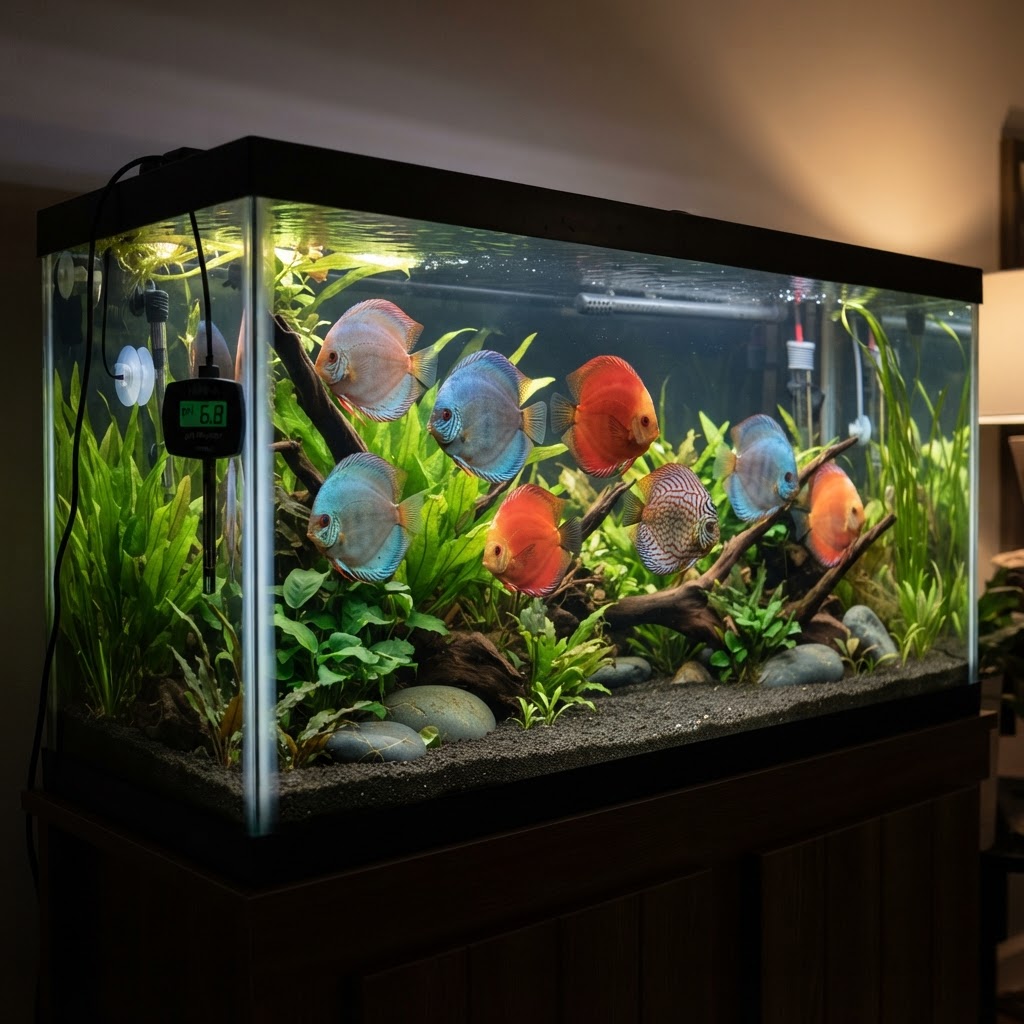
Quick summary
- Consistency matters more than the "ideal" value
- Tank-bred discus do well at pH 6.5–7.8
- Max variation: pH ±0.3/day, temperature ±1°C
- KH above 2 dKH = buffer against pH crash
- New water identical to tank water
- Don't correct chemically up and down every day
In short
- Tank-bred discus have been raised for generations in tap water or mixes — they tolerate a wide range of parameters.
- What they don't tolerate is sudden swings in pH, temperature and TDS.
- A stable pH of 7.5 is better than a pH of 6.5 that goes up and down every day.
- The key: new water identical to tank water and enough KH.
What you'll learn
- Where the mandatory low-pH myth comes from
- Which ranges modern discus tolerate
- Daily variation limits
- What causes instability
- How to keep your water consistent
The mandatory low-pH myth
Wild discus live in very soft, acidic Amazon waters (pH 4.5–6.5, TDS under 50 ppm). That's where the idea came from that every discus needs pH 6.0. But most discus in the trade are tank-bred, raised in Germany, Asia or locally in water with pH 6.8–7.8.
When you bring home such a fish and aggressively "correct" the water towards pH 6.0, you stress it more than if you had left it in the water it's used to.
Ranges tolerated by modern discus
| Parameter | Tolerated range (tank-bred) | Ideal for breeding |
|---|---|---|
| pH | 6.5–7.8 | 6.0–6.5 |
| TDS | 100–300 ppm | 50–100 ppm |
| GH | 3–12 dGH | 2–4 dGH |
| KH | 2–6 dKH | 1–2 dKH |
| Temperature | 28–30°C (82–86°F) | 29–30°C |
| Ammonia / nitrite | 0 ppm — no tolerance here | 0 ppm |
| Nitrate | under 20–25 ppm | under 10 ppm |
Daily variation limits
| Parameter | Max variation in 24h |
|---|---|
| pH | ±0.3 |
| Temperature | ±1°C |
| TDS | ±50 ppm (or 20–25%) |
| GH / KH | ±1–2 degrees |
Beyond these limits you'll see dark colors, fast breathing, loss of appetite and fish sitting in a corner — stress signs that open the door to disease.
What causes instability
- KH too low (below 2 dKH) → overnight pH crash.
- New water different from tank water (temperature, pH, TDS).
- "pH down / pH up" added directly to the tank.
- CO2 in a planted tank → pH swinging day/night.
- Rare, large changes after a long period without changes (big jump in nitrate and TDS).
- New driftwood or peat suddenly releasing tannins.
How to keep your water consistent
- Test your tap water a few times a month — learn how much it varies on its own.
- Pick a recipe (tap, RO or a mix) and keep it identical.
- Prepare water in a barrel with aeration and heating (see storing and preparing water).
- Keep KH at 2–4 dKH as a buffer.
- Regular changes: same days, same percentage.
- Log your readings in My Aquarium to spot trends.
Common mistakes
- Chasing a number seen online instead of watching the fish's behavior.
- Changing your water recipe every few weeks.
- Chemically correcting a "too high" pH with fish in the tank.
- Using pure RO water with no buffer.
Stability checklist
- ☐ Fixed water recipe, written down
- ☐ KH 2–4 dKH
- ☐ New water at the same temperature and pH
- ☐ Changes at regular intervals
- ☐ No "pH down/up" straight into the tank
- ☐ Readings logged weekly
What to do next
📚 Learn more:
- Discus water parameters
- The ideal pH for discus
- KH and GH for discus
- Lowering pH in hard tap water
- Acclimating Asian discus to hard water
🧮 Calculate:
🛒 Shop: