What makes a show discus: judging criteria and photography tips
The same criteria used to judge discus at shows help you choose a quality fish and photograph it well for a listing.
Quick summary
- Criteria: eyes, shape, body, color, fins, defects, behavior
- Small eye relative to body = quality
- A curious fish scores better than a shy one
- Rules differ between the US, Europe and Asia
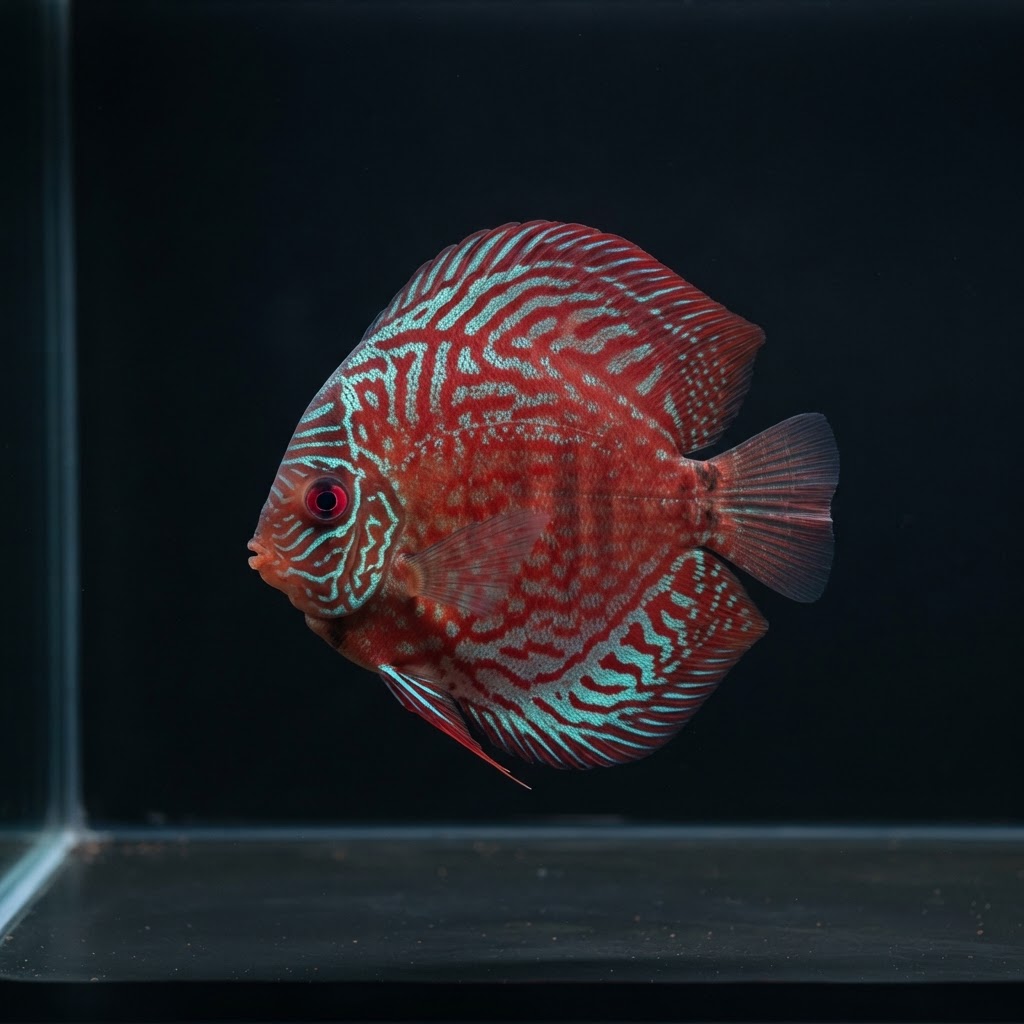
- Shoot side-on, on a dark background, in clean water
In short
At discus shows, fish are judged on 7 criteria: eyes, shape, body, color, fins, defects and behavior. You can also use them as a buying guide – and to take good photos for listings.
Judging criteria
1. Eyes
The eye should be small relative to the body. Jack Wattley set an ideal ratio: the body measured vertically should be about 9–9½ times the eye in modern strains and about 7½ times in wild discus. Eye color should match the strain (usually bright red). Big eyes on a small body indicate stunting.
2. Shape
A perfectly round, smooth disc, with no dents on the forehead or back, no deformed mouth or crooked spine.
3. Body
Consistent roundness, thickness and size. A well-fed fish, neither thin ("knife-edge") nor bloated.
4. Color
The strain's typical shade and its uniformity across the body.
5. Fins
Shape, size and symmetry, with no tears or frayed edges.
6. Defects and spots
Signs of disease (wounds, mucus, holes) or unwanted natural spots. In Pigeon Blood and its derivatives, "peppering" (black dots) is largely genetic and lowers the score.
7. Behavior
An alert, curious fish that comes to the front scores better than a shy, hiding one.
Differences between countries
Rules aren't identical: for example, American judges penalize a "weak chin", while Asian and European judges generally don't. Check the show's rules.
Using the criteria when buying
| Check | Good sign | Red flag |
|---|---|---|
| Eye | Small, red | Big on a small body (stunted) |
| Shape | Round, smooth | Dented forehead, crooked spine |
| Behavior | Comes to the glass, eats | Hides, stays dark |
How to photograph a discus
- Very clean water and glass cleaned inside and out.
- Dark background (black or dark blue) – brings out color and calms the fish.
- Shoot side-on, perpendicular to the glass, so the shape isn't distorted.
- Light from above or the side, no direct flash on the glass.
- A small photo tank (bare-bottom) limits the fish's movement.
- Let the fish calm down for a few minutes: a stressed discus shows its bars.
- No color filters – buyers want to see the real fish.