Cloudy water in a discus aquarium: white, green or brown – causes and fixes
White, green or brown water have completely different causes. Learn how to recognize each, which mistakes make it worse and when it is dangerous for discus.
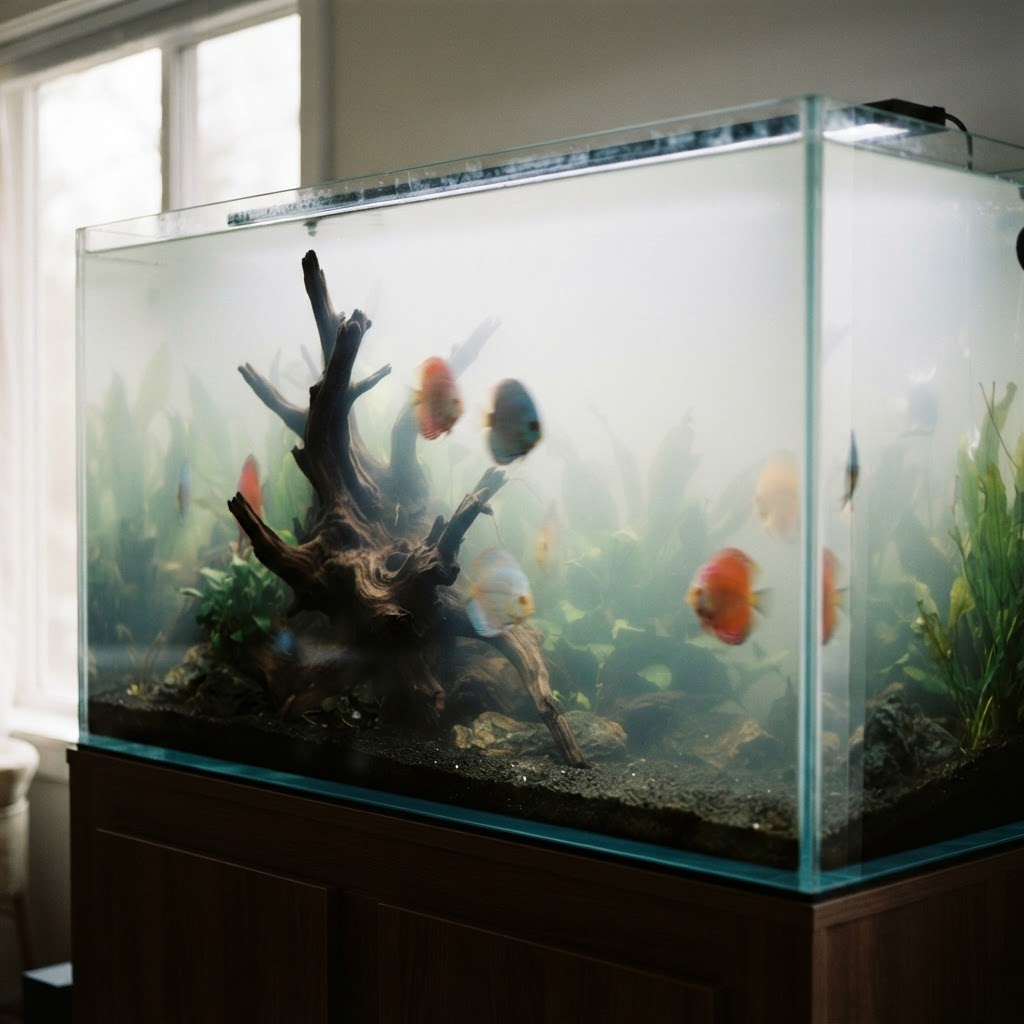
Quick summary
- White/milky = bacterial bloom, usually harmless
- Green = free-floating algae (too much light/nutrients)
- Brown/yellow = driftwood tannins, harmless
- Don't do repeated water changes for white water
- Test ammonia if the water is cloudy and fish breathe fast
In short
- The water color tells you the cause: white (bacteria), green (algae), brown (tannins), grey with particles (substrate or weak filtration).
- Milky white water in a new tank or after aggressive cleaning is usually a temporary bacterial bloom.
- Repeated water changes don't clear a bacterial bloom – they often make it come back.
- Cloudy water becomes dangerous when it comes with ammonia/nitrite or fish breathing fast.
1. White, milky water – bacterial bloom
Cause: heterotrophic bacteria multiply explosively on organic matter in the water. It typically appears:
- in the first 1–3 weeks after starting the tank;
- after rinsing the filter under the tap or replacing all the media;
- after overfeeding (beef heart left on the bottom);
- after an undiscovered dead fish.
What to do:
- Test ammonia and nitrite. If both are 0, the bloom is purely cosmetic.
- Cut feeding in half for a few days and siphon leftovers.
- Keep the filter running non-stop and don't clean it.
- Be patient: it usually clears on its own in 3–14 days.
What NOT to do: daily 50% changes just to clear the water, chemical clarifiers, replacing filter media or medications. Each one resets the bacterial balance.
An old, stable tank suddenly turned cloudy? That is no longer a start-up bloom but a warning sign: overfeeding, a clogged filter or disturbed substrate. Find and remove the cause.
Exception: if ammonia or nitrite is above 0, water changes are necessary – to protect the fish, not to clear the water.
2. Green water – free-floating algae
Cause: single-celled algae in suspension, fed by too much light (over 8–10 hours/day or direct sun) and high nitrate/phosphate.
Fixes:
- Cut the photoperiod to 6–8 hours and remove direct sunlight.
- Increase water changes and reduce feeding – heavily fed discus produce lots of nutrients.
- Add fast-growing or floating plants (Amazon Frogbit) to outcompete algae.
- A UV sterilizer clears green water within days and is safe for discus.
3. Brown or yellow water – tannins
Cause: driftwood, Indian almond (catappa) leaves, alder cones or peat release tannins.
For discus it is harmless and even beneficial – it mimics Amazon blackwater and slightly lowers pH. If you dislike the look, use activated carbon or Purigen in the filter and boil/soak new wood before adding it.
4. Grey water with particles
Cause: unwashed substrate, overly aggressive siphoning or an undersized filter. Rinse new substrate well, add fine filter floss (replace it often) and check flow: for discus, the filter should turn over 4–6 times the tank volume per hour.
Quick diagnostic table
| Color | Likely cause | Dangerous? | Main action |
|---|---|---|---|
| White/milky | Bacterial bloom | Usually not | Test NH3/NO2, feed less, wait |
| Green | Floating algae | Not directly | Less light, UV, water changes |
| Brown | Tannins | No | Activated carbon if it bothers you |
| Grey | Particles/substrate | No | Filter floss, better filtration |
When it is an emergency
If the water is cloudy and the discus breathe fast, hang at the surface or suddenly darken, assume a water-quality problem: test immediately, do a 30–50% change with dechlorinated, temperature-matched water and check aeration.