Constipation and Swim Bladder Disorder in discus: step-by-step treatment
Constipation and Swim Bladder Disorder (swimming/buoyancy trouble) in discus are common and easy to treat if you act fast. A guide with causes, symptoms, treatment with Epsom salt, boiled peas, a 48h fast and how to tell it from serious diseases.

Quick summary
- Common causes: overfeeding, dry food (pellets), beef heart too fatty, lack of fiber, low temperature (<27°C / 81°F).
- Constipation symptoms: no feces for 2+ days, short white feces (NOT stringy = Hexamita), a slightly swollen belly.
- Swim Bladder symptoms: floating on one side, sitting head-up / head-down, swimming off-balance, sitting on the bottom.
- Main treatment: a 48h fast + Epsom salt 1 g/L + shelled boiled peas.
- Do NOT confuse it with Hexamita (stringy white feces + food refusal) or Dropsy (hard belly, raised scales).
- Prevention: feed 2× / day with breaks, a varied diet with fiber, a stable temperature of 29°C (84°F).
In short
- Common causes: overfeeding, dry food (pellets), beef heart too fatty, lack of fiber, low temperature (<27°C / 81°F).
- Constipation symptoms: no feces for 2+ days, short white feces (NOT stringy = Hexamita), a slightly swollen belly.
- Swim Bladder symptoms: floating on one side, sitting head-up / head-down, swimming off-balance, sitting on the bottom.
- Main treatment: a 48h fast + Epsom salt 1 g/L + shelled boiled peas.
- Do NOT confuse it with Hexamita (stringy white feces + food refusal) or Dropsy (hard belly, raised scales).
- Prevention: feed 2× / day with breaks, a varied diet with fiber, a stable temperature of 29°C (84°F).
What you'll learn from this guide
Constipation and Swim Bladder Disorder in discus are among the most common and most easily treatable problems — but also the most confused with serious diseases. Simple constipation produces short white feces and a slightly swollen belly, symptoms that look almost identical to Hexamita or early Dropsy — and the treatment is completely different. This guide shows you how to clearly tell simple constipation from serious illness, how to treat with Epsom salt, boiled peas and a 48h fast, and how to recognize the signs of Swim Bladder Disorder (off-balance buoyancy, sitting on one side) — both the chronic type (incurable, lifelong management) and the acute type (treatable).
What constipation is — quick biology
| Aspect | Detail |
|---|---|
| Cause | Slowed gut transit, accumulated feces |
| Trigger #1 | Overfeeding with dry pellets |
| Trigger #2 | Fiber-free food (beef heart only) |
| Trigger #3 | Temperature <27°C (81°F) (slowed digestion) |
| Common in | Obese adult discus, fed 3+ times/day |
| Lethality | <5% if you treat it; 20-30% if it leads to Dropsy |
| Typical | "Swollen belly" + no feces for 2+ days |
| Confusion #1 | Hexamita (STRINGY white feces, total food refusal) |
| Confusion #2 | Dropsy (hard belly, raised "pine cone" scales) |
Key idea: constipation is common and benign if you treat it fast. But if you ignore it, the pressure on the organs can lead to Dropsy (lethal). Act in the first 3-5 days.
Triggers — what causes constipation in discus
| Trigger | Frequency | Mechanism |
|---|---|---|
| Overfeeding (3+ meals / day) | ⭐⭐⭐⭐⭐ | The digestive system is overloaded |
| Excessive dry food (pellets) | ⭐⭐⭐⭐⭐ | Swells in the gut, blockage |
| Fatty beef heart (over 50% of the diet) | ⭐⭐⭐⭐ | Hard to digest, slowed transit |
| Lack of fiber (no peas / spirulina) | ⭐⭐⭐⭐ | Deficient transit |
| Temperature <27°C (81°F) | ⭐⭐⭐ | Slowed metabolism |
| Swallowing air (floating pellets) | ⭐⭐⭐ | Swim bladder dysfunction |
| Chronic stress | ⭐⭐ | Digestive inhibition |
| Genetic constipation (certain lines) | ⭐⭐ | Predisposition |
⚠️ 80% of constipation cases in discus come from overfeeding with pellets or pure beef heart. A varied diet with breaks fixes the problem in 90% of cases without treatment.
Symptoms — visual diagnosis
Mild constipation (days 1-3)
- ✅ No feces or very rare (once / 2-3 days vs normal 1-2× / day)
- ✅ Short, segmented feces, passed with effort
- ✅ Slightly swollen belly (visible from above)
- ✅ Normal or slightly reduced appetite
- ✅ Normal behavior
Moderate constipation (days 4-7)
- ❌ Clearly swollen belly, symmetric (NOT asymmetric like Dropsy)
- ❌ Short white feces or "plugs" stuck at the vent
- ❌ Reduced appetite
- ❌ Less active fish
- ❌ Starts sitting on the bottom more
Severe constipation (days 7+) — EMERGENCY
- ❌ Very swollen belly, visible pressure
- ❌ Total food refusal
- ❌ Swimming imbalance (pressure on the swim bladder)
- ❌ Floating on one side or head-down
- ❌ Risk of progressing to Dropsy
What Swim Bladder Disorder is
The swim bladder is the organ that lets a fish stay in the water at any depth without effort. Disorders of it produce visible swimming imbalances.
The ACUTE form (treatable)
Causes:
- Severe constipation (compression on the bladder) — 60% of cases
- Swallowing air (floating pellets) — 20%
- A sudden temperature change — 10%
- Acute transport stress — 10%
Symptoms:
- ❌ Floating on one side at the surface
- ❌ Sitting head-up or head-down
- ❌ Swimming off-balance, "struggling"
- ❌ Sits on the bottom when not swimming
- ❌ Alert fish, still eating (sometimes)
The CHRONIC form (incurable, management)
Causes:
- Genetics (inbred lines) — "tank-bred" discus with defects
- An unresponsive internal bacterial infection
- Internal tumors
- A congenital bladder defect
Symptoms:
- ❌ Permanent imbalance (months-years)
- ❌ The fish adapts its swimming style
- ❌ Can survive years with correct management
- ❌ Does NOT heal — management only eases its life
Differentiation — constipation vs serious diseases
The most important diagnosis in the guide — the wrong treatment can be lethal.
| Aspect | Constipation | Hexamita | Dropsy | Chronic Swim Bladder |
|---|---|---|---|---|
| Feces | Absent / short | STRINGY white | Normal / absent | Variable |
| Belly | Swollen symmetric | Sunken! (weight loss) | Asymmetric, hard | Normal |
| Scales | Normal | Normal | Raised "pine cone" | Normal |
| Appetite | Normal or reduced | Total refusal | Total refusal | Variable |
| Swimming | Normal initially | Lethargic | Off-balance | Permanently off-balance |
| Progress | Slow (days) | Fast (days-weeks) | Very fast | Chronic, years |
| Treatment | Epsom salt + fast | Metronidazole | Antibiotic + support | Diet management |
| Lethality | <5% | 40-80% | 70-95% | 0% (with management) |
🎯 Quick diagnostic test: drop a shelled boiled pea (1/4 of a pea) into the aquarium. If the fish eats it → 95% mild constipation (the pea will fix 80% of cases). If it REFUSES → suspect serious illness (Hexamita, Dropsy, internal infection).
Constipation treatment — step by step
Step 1 — A 48h fast (the FIRST step, MANDATORY)
- Do NOT feed for 48 hours — the digestive system empties
- The water stays clean (no leftover food)
- The fish does NOT starve — adult discus can go 1-2 weeks without food
- Watch the feces — if normal feces appear → the constipation is resolving
Step 2 — Epsom salt (a gentle laxative)
Epsom salt (magnesium sulfate — NOT table salt!) is the standard laxative for fish.
| Detail | Value |
|---|---|
| Substance | Magnesium sulfate (MgSO₄·7H₂O) |
| Source | Human pharmacies (approx. €2–4 / 200g (RO estimate)) |
| Dosage | 1 g / L of water (1 level teaspoon / 7 L / 1.8 US gal) |
| Availability | Pharmacies, drugstores — everywhere |
| Duration | 3-5 days maximum |
| Do NOT confuse | With table salt (NaCl) — toxic at this dose! |
Procedure:
- Calculate the dose for your volume (e.g. a 250L / 66 US gal tank → 250 g of Epsom salt)
- Dissolve it in warm water in a separate container (4-6L)
- Add GRADUALLY to the aquarium — 1L of solution / 30 min (over 2-4 hours)
- Do NOT change water for the first 24h (maintain the concentration)
- After 24h — watch the feces
- If normal feces appear → 25% water change (lowers the concentration)
- After 3 days — 50% water change
⚠️ Epsom salt affects plants minimally (less than regular salt), but over 3 days they may suffer. For prolonged treatment → a hospital tank.
Step 3 — Shelled boiled peas ⭐ THE CLASSIC REMEDY
Boiled green peas are the most effective natural laxative for fish — used globally for decades.
Procedure:
- Boil 5-10 green peas (NOT frozen straight in — boil them!)
- Shell each pea (light pressure with your fingers)
- Cut in half or quarters (depending on the fish's size)
- Drop into the aquarium near the fish (NOT on the substrate)
- Repeat 1-2× / day, 3-5 days (or until normal feces appear)
Why it works: peas contain fiber + water that regulate transit. Unlike pellets, they do NOT swell in the gut — they slide through naturally.
Alternative: finely boiled spinach, finely boiled zucchini, decapsulated artemia (fiber).
Step 4 — Correct food reintroduction (after normal feces appear)
| Action | Detail |
|---|---|
| Break between meals | At least 8-12 hours between portions |
| Frequency | 2 meals / day (NOT 3-4!) |
| Amount | Food eaten in 2-3 min |
| Variety | Beef heart + bloodworms + artemia + spirulina alternating |
| Weekly fiber | Peas 1× / week + spirulina pellets 2× / week |
| AVOID | Floating pellets (air swallowing) |
Swim Bladder Disorder treatment
The ACUTE form (from constipation)
Treatment identical to constipation + additions:
- Reduce lights — an off-balance fish gets stressed by bright light
- Reduce water current — a weakened fish can't swim against it
- Rounded decor — avoid injuries from imbalance
- A hospital tank with shallower water (15-25 cm / 6-10 in) — reduces pressure
Recovery: 3-7 days after the constipation resolves.
The CHRONIC form (lifelong management)
There is no cure — but the fish can live normally with adaptations:
| Adaptation | Benefit |
|---|---|
| Reduced water depth (20-30 cm / 8-12 in) | Less pressure on the bladder |
| Sinking food | No more air swallowing |
| Hand-feeding near the fish | Compensates for the disadvantage in competition |
| Weak current | The fish doesn't struggle |
| Straight and flat decor | It doesn't get stuck off-balance |
| Check wounds daily | Sitting on the substrate → possible wounds |
The ethical decision: if the fish is clearly suffering (food refusal, constant lesions, low quality of life) → humane euthanasia with clove oil (see the Mycobacterium guide — euthanasia section).
Common mistakes
❌ Confusing it with Hexamita → you treat simple constipation with Metronidazole → 10 days lost + bacterial stress. Check the shape of the feces (short vs STRINGY).
❌ Confusing it with Dropsy → panic, pointless aggressive treatment. Check the scales (raised in Dropsy, normal in constipation).
❌ Table salt (NaCl) at 1 g/L for constipation → it does NOT work as a laxative + osmotic stress. Use Epsom salt (MgSO₄)!
❌ Feeding during the fast → "it's hungry, poor thing" → the constipation continues. The 48h fast is ESSENTIAL.
❌ Unshelled peas → the skin is indigestible, it worsens the constipation.
❌ Chronic overfeeding → permanent relapses. Only 2 meals / day.
❌ Antibiotic at the first sign → you treat something that isn't bacterial + stress the system. The antibiotic comes in ONLY if you confirm an internal infection.
❌ Ignoring it for 7+ days → internal pressure leads to Dropsy, very lethal.
❌ Prolonged Epsom salt (>5 days) → harms the liver long-term.
Prevention — how to avoid constipation
| Action | Frequency | Benefit |
|---|---|---|
| 2 meals / day strictly (NOT 3-4) | always | A rested digestive system |
| 8-12h break between meals | always | Complete transit |
| Varied diet (beef heart + bloodworms + artemia + spirulina) | weekly | Fiber + varied proteins |
| Boiled peas | 1× / week | Natural fiber |
| Spirulina pellets | 2× / week | Fiber + vitamins |
| Sinking food | always | Avoids air swallowing |
| Temperature 29°C (84°F) stable | always | Active metabolism |
| Fast 1 day / week | weekly | Gut "detox" |
| Small pellet size | always | Easy digestion |
| Soak pellets 1 min in water | before feeding | Reduces gut swelling |
See also Feeding for beginners.
When to consult a specialist
- The constipation doesn't resolve in 7 days with the complete protocol
- Frequent relapses (monthly) — possibly an internal defect
- The belly becomes HARD or asymmetric → suspect imminent Dropsy
- Scales raise ("pine cone") → confirmed Dropsy, emergency
- Several fish affected at once → a systemic cause (water? food?)
- Chronic swim bladder with low quality of life → an ethical decision
Post on dedicated forums with photos from above (the belly) + side photos (the swimming) + water parameters + the feeding schedule — or contact breeders from the Discus.ro directory.
Final checklist — managing constipation
- ☐ Symptoms identified (no feces for 2+ days, symmetric swollen belly)
- ☐ Differentiated from Hexamita (NOT stringy feces), Dropsy (NOT raised scales)
- ☐ Diagnostic test — drop a pea, does the fish eat? = constipation
- ☐ 48-hour FAST (no feeding at all)
- ☐ Epsom salt 1 g/L (calculated for the volume)
- ☐ Shelled boiled peas 1-2× / day
- ☐ Stable temperature 29°C (84°F)
- ☐ Watched the feces daily
- ☐ Normal feces appear → 25% water change
- ☐ Reintroduced food with 2 meals / day (no more)
- ☐ Varied diet with fiber weekly
- ☐ Checked other affected fish
- ☐ Investigated the cause (overfeeding? pellets?)
What to do next
📚 Continue learning:
- Hexamita and HITH in discus — telling it from stringy white feces
- Dropsy — the risk of ignored constipation progressing
- Feeding for beginners — prevention #1
- Discus not eating — differentiation
- The essential aquarist's pharmacy — Epsom salt in the kit
🔧 Practical resources:
- Treatment dosage calculator — exact Epsom salt for your volume
- Visual diagnosis — at the first signs
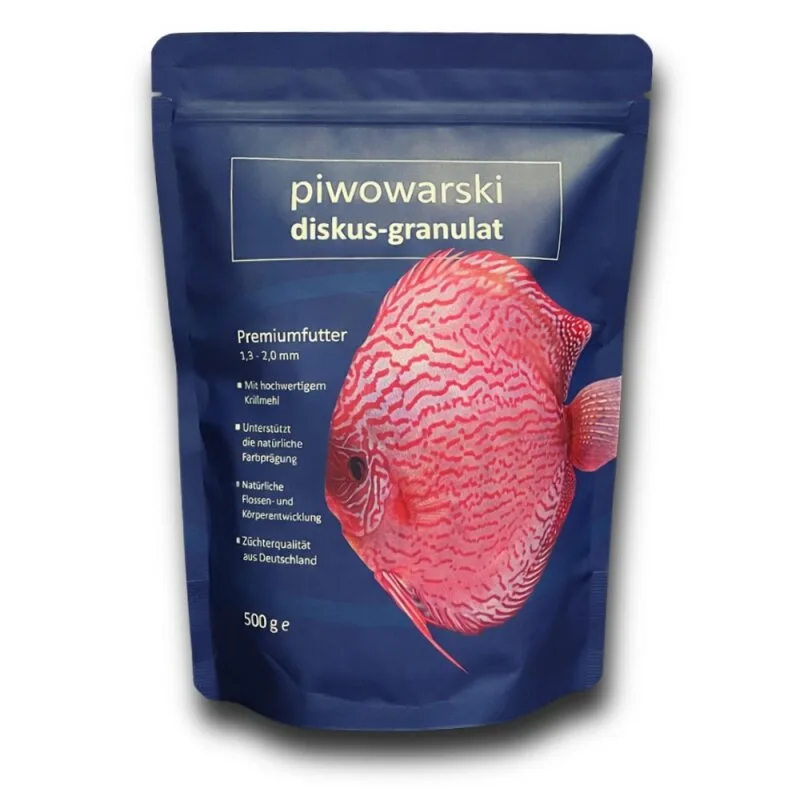
- Discus food — shop — sinking pellets, spirulina
🐠 Final tip: Constipation is the most over-rated disease in fishkeeping — in 90% of cases it resolves with a fast + Epsom salt + peas, no antibiotic. But it's also the most underestimated as a risk — ignored for 1-2 weeks, the internal pressure triggers lethal Dropsy. Golden rules: 2 meals/day, a varied diet, a weekly fast, Epsom salt always in the house. It saves you from 90% of your discus's digestive problems.
Want a clear schedule for your tank?
Generate a personalized plan for water changes, feeding, testing and maintenance — in just 2-3 minutes.
Generate care planSave your tank, log water parameters and get email reminders for care tasks — for free.
Recommended products
Picked from the shop based on what you just read
Recommendations are selected from the discus.ro shop based on this guide's topic. Availability and prices may vary.