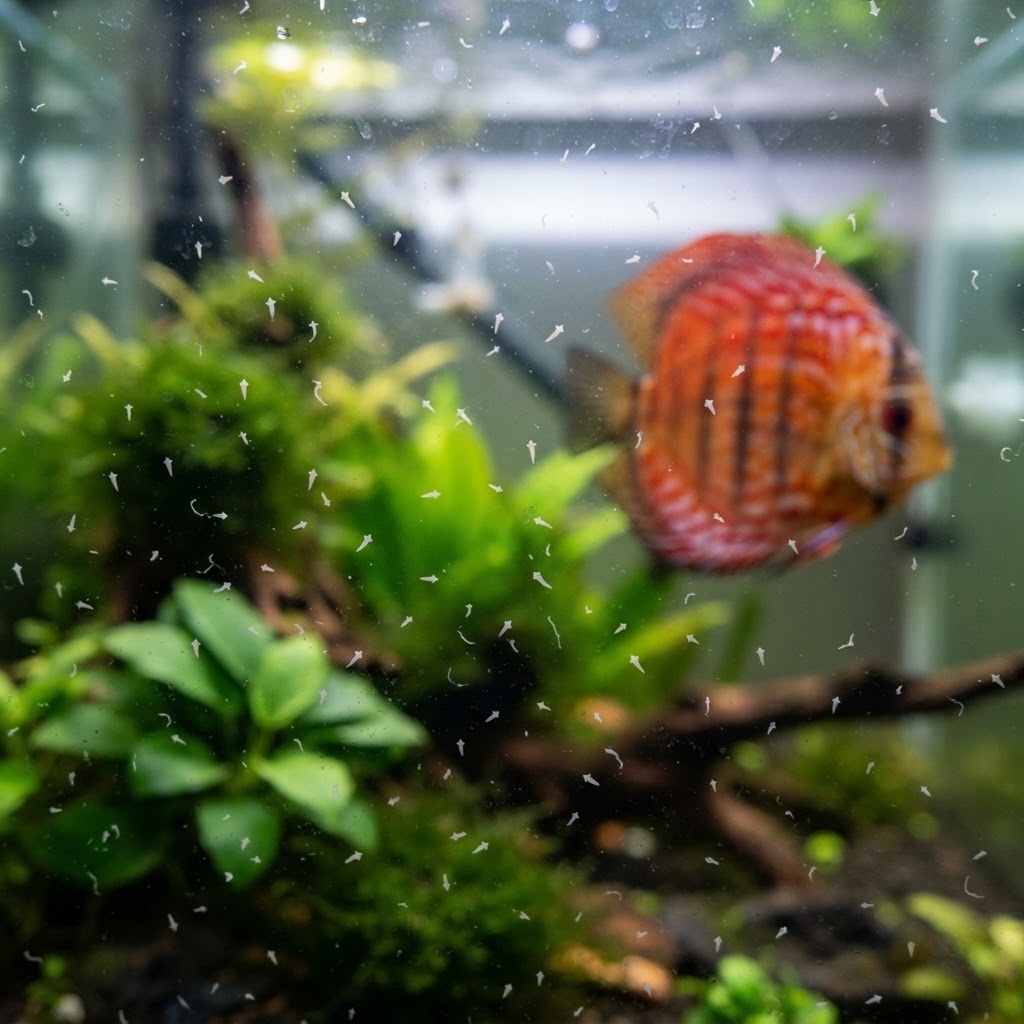
Planaria and tiny white worms on the glass of a discus aquarium: causes and removal
Tiny white worms on the glass almost always come from excess food. Learn which ones are harmless, when it is planaria and how to remove them without harming discus.
D
The Discus.ro Team Verified
Published Oct 10, 2026· 2 min read
Tiny white worms on the glass are usually a sign of excess food, not disease.
Quick summary
Tiny white worms come from overfeeding
Nematodes (thin wriggling threads) are harmless
Planaria: triangular head, glides smoothly on glass
Core fix: less food + siphoning
Fenbendazole kills planaria but also snails
In short
Tiny white worms on the glass are not discus parasites – they live on leftover food.
The cause is almost always overfeeding, especially with beef heart and frozen food.
You need to tell nematodes (harmless) from planaria (a nuisance that can attack eggs).
Main fix: less food, daily siphoning and, only if needed, fenbendazole treatment.
How to identify them
Nematodes (thread worms)
Planaria
Detritus worms (annelids)
Shape
Very thin white thread, 1–5 mm
Flat, triangular head with "eyes"
Segmented, reddish/white, in substrate
Movement
Wriggle in an "S" shape in the water
Glide smoothly on glass, like a snail
Come out of substrate at night
Dangerous?
No
Can eat eggs and tiny fry
No
For adult discus none of these organisms is directly dangerous. The problem is in breeding tanks (planaria can attack eggs and newly hatched fry) and as a sign of water loaded with organics.
Why they appear
Excess food: beef heart or frozen worms left on the bottom feed the population.
Infrequent siphoning or deep substrate where mulm builds up.
A dirty filter full of sludge and debris.
Brought in with plants, fish or live food.
How to get rid of them, step by step
Feed less – only what discus eat in 2–3 minutes. Remove leftovers after every beef heart feeding.
Siphon the bottom daily for several days, including behind decor.
Do a large water change (30–50%) and clean the filter of sludge (rinsed in tank water, not under the tap).
For planaria, use a trap baited with a piece of meat overnight and remove it in the morning with the worms on it.
If the population stays high, treat.
Treatment (persistent planaria only)
Fenbendazole or praziquantel (dewormers) wipe them all out at once. Fenbendazole (the active ingredient in veterinary dewormers like Panacur, or dedicated products such as No Planaria/Planaria Zero) kills planaria and hydra.
It is generally safe for discus and plants.
It kills snails and shrimp – remove them first.
Dead worms decompose: siphon and do a 30–50% water change 24–48 hours later so ammonia doesn't spike.
Follow the manufacturer's dose exactly.
Avoid improvised salt treatments or strong medications just for worms – the stress for discus is worse than the problem.
Prevention
Feed small portions several times a day instead of one large meal.
Siphon at every water change (for discus, ideally weekly or more often).
A bare-bottom tank for fry and breeding – leftovers are visible and removed immediately.
Quarantine new plants and fish.
5 views
Frequently asked questions
Generally no. Nematodes and annelids are harmless. Planaria can eat eggs and fry, so they matter in breeding tanks.