Costia (Ichthyobodo), Trichodina and Chilodonella in Discus: Signs, Diagnosis and Treatment
Costia (Ichthyobodo), Trichodina and Chilodonella are microscopic protozoa of the skin and gills. Learn how they differ, why they cannot be identified by eye and which treatment options veterinary sources describe.
In short
- Costia (Ichthyobodo) is an external flagellate, while Trichodina and Chilodonella are external ciliates. All three are microscopic protozoa living on the skin, fins and gills, not bacteria, fungi or worms.
- Shared signs are excess mucus, flashing, rapid breathing, clamped fins, refusing food and loss of condition. The same signs can also come from water problems or other parasites.
- They cannot be told apart by eye. Confirmation requires microscopic examination of skin mucus and, when justified, the gills.
- Water quality matters directly: Trichodina infestations often point to poor sanitation or overcrowding, and chemical treatment alone may not be enough.
- Veterinary sources list formalin and copper sulfate and, for Ichthyobodo, potassium permanganate and salt as options. Praziquantel does not treat these protozoa.
What are these parasites?
- Costia is the traditional name for Ichthyobodo, a genus of external flagellates (protozoa with flagella).
- Trichodina is a genus of ciliates in the trichodinid group, together with Trichodinella, Tripartiella and Vauchomia.
- Chilodonella is a genus of motile external ciliates.
All of them are found on the skin, fins and gills. When they affect the gills, they can cause breathing difficulty.
Costia (Ichthyobodo)
- Size: one of the smallest external parasites, about 5–18 × 3–8 µm (Merck gives about 15 × 5 µm).
- Shape: teardrop or pear-shaped, flattened, with two flagella of unequal length.
- Movement: jerky, spiral swimming. Once attached it is hard to see, but at 400× it may show a characteristic movement "like a flickering flame".
- Mucus: affected fish produce copious mucus. The skin may turn steel grey ("blue slime disease") and the gills may look swollen.
- Signs: lethargy, refusing food, piping at the surface, flashing.
- Diagnostic difficulty: because it is so small, it can be missed at low magnification.
Do not confuse Ichthyobodo with Ichthyophthirius multifiliis (Ich, white spot), a much larger ciliate, or with Spironucleus (Hexamita), an intestinal flagellate.
Trichodina
- Shape: round, like a "flying saucer" seen from above and a "bubble" from the side. It has an attachment disc with a crown of denticles.
- Size: about 35–135 µm in diameter. Easily seen under a light microscope at 40×–100×.
- Movement: whirls and glides over the tissue surface.
- Site: skin, fins, gills.
- Link with water quality: common in water with a high organic load. Merck notes that infestations often indicate poor sanitation or overcrowding.
- Signs: similar to Chilodonella, but mucus is usually less noticeable.
Finding a few Trichodina on a fish does not automatically mean clinical disease. What matters is how many there are, the signs in the fish and the conditions in the tank. A survey of apparently healthy ornamental fish reported Trichodina reticulata without obvious lesions.
Chilodonella
- Shape: oval or kidney-shaped, flattened top to bottom, translucent, with parallel bands of cilia along its length.
- Size: about 30–80 × 20–60 µm.
- Movement: slow and spiral.
- Mucus: often causes heavy mucus, especially where the infestation is worst.
- Gills: heavy infestations cause rapid breathing, "coughing" and swollen, mucoid gills.
- Other signs: loss of condition, flashing, reduced appetite.
Chilodonella is a facultative parasite (it can survive without a living host), which must be considered when it is found on a dead fish.
Shared signs
- excess mucus;
- a grey or milky look to the skin;
- flashing against decor, substrate or glass;
- clamped fins;
- rapid breathing, hanging at the surface;
- refusing food;
- lethargy;
- loss of body condition.
All of these can have other causes: ammonia or nitrite, low oxygen, stress, gill flukes or bacterial infections. See also Discus breathing fast.
Comparison table
| Criterion | Ichthyobodo (Costia) | Trichodina | Chilodonella |
|---|---|---|---|
| Group | External flagellate | Ciliate (trichodinid) | Ciliate |
| Site | Skin, fins, gills | Skin, fins, gills | Skin, fins, gills |
| Size | 5–18 × 3–8 µm | 35–135 µm diameter | 30–80 × 20–60 µm |
| Appearance | Teardrop, two flagella | Disc with denticle crown | Oval-kidney, bands of cilia |
| Movement | Jerky spiral; "flame" when attached | Whirling, gliding | Slow, spiral |
| Suggestive signs | Heavy mucus, greyish sheen | Flashing; less obvious mucus | Heavy mucus, laboured breathing |
| Confirmation | High-power microscopy | Microscopy at 40×–100× | Fresh wet mount |
| Options described | Formalin, CuSO₄, KMnO₄, salt | Formalin, CuSO₄ + sanitation | Formalin, CuSO₄ |
Sizes are taken from the UF/IFAS pictorial guides; treatment options from Merck's table for freshwater fish.
Differential diagnosis
- Ich: visible white spots, a large parasite (0.5–1 mm) with a horseshoe-shaped nucleus. It can be on the gills only.
- Velvet (Piscinoodinium): fine golden dust on the skin, absent if the parasite is only on the gills.
- Monogeneans: flatworms with a haptor and hooks, much larger than protozoa.
- Bacterial infections: lesions, altered gills; confirmed by a vet.
- Stress mucus: after transport, handling or sudden water changes, with no parasites under the microscope.
- Ammonia or nitrite: several fish affected at once; a water test shows the cause.
White mucus is not proof of Costia. It is a general sign of skin irritation.
Microscopic confirmation
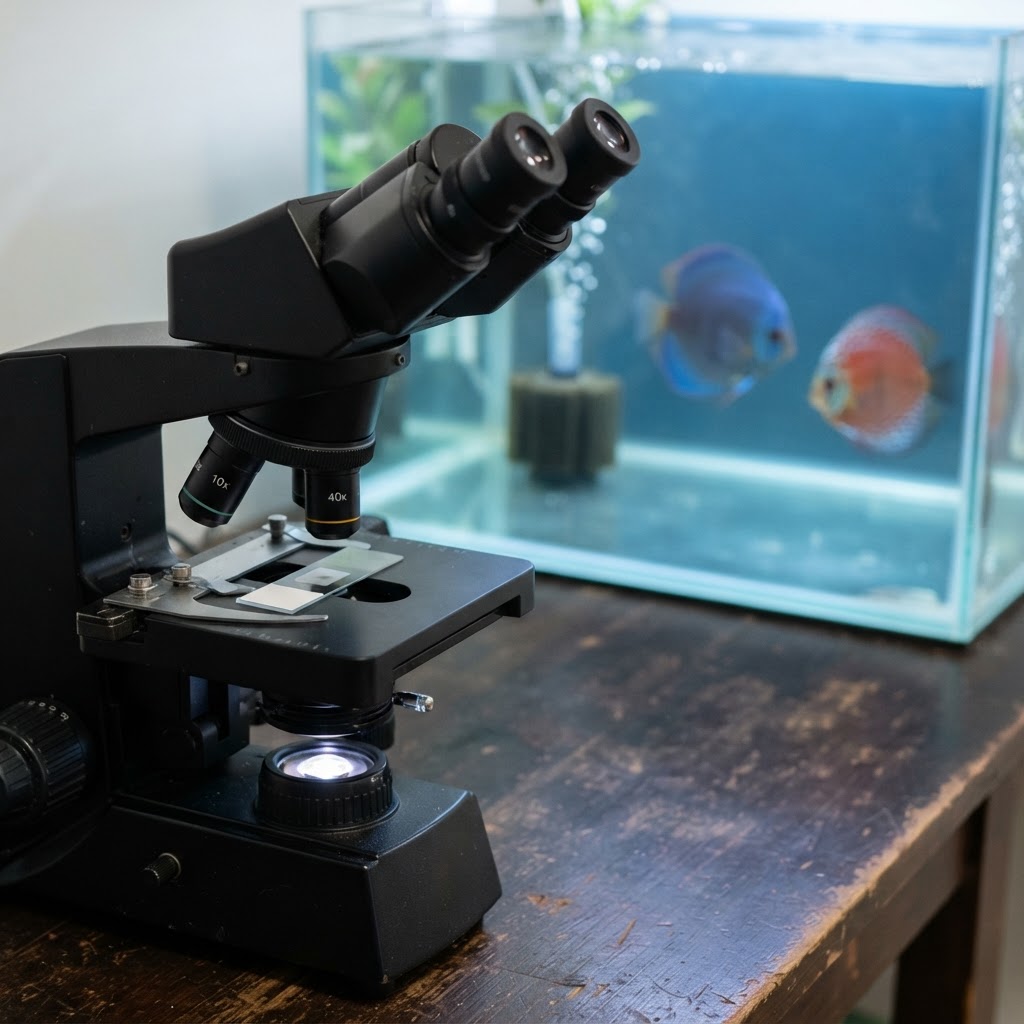
Fresh wet mounts of skin mucus, fin and, when justified, gill tissue are examined right after sampling. Trichodina and Chilodonella are fairly easy to see. Ichthyobodo is very small and almost still once attached; it can be missed unless the slide is examined at high magnification.
Results must be read in context: parasite numbers, the fish's signs, water quality and how many fish are affected. A few organisms on a fish without signs do not automatically justify treatment.
Gill sampling should be done by a vet or a trained person. Handling a discus that is already struggling to breathe can make it worse.
What to do right away
- Check water and oxygen: ammonia, nitrite, nitrate, temperature; increase aeration.
- Assess how many fish are affected and how badly.
- Reduce stress: dimmer light, no unnecessary moves, less food.
- Improve hygiene: siphon debris and change water using water at the same temperature and similar parameters. Do not clean the whole filter at once, so you keep the nitrifying bacteria. See weekly maintenance.
- Get microscopic confirmation before treating. The diagnostic tool can help you start.
- Call a vet if fish are gasping at the surface or getting worse within hours.
Treatment options
Treatment is justified for a confirmed external infestation with clinical signs. Veterinary sources describe these options for freshwater fish:
- Ichthyobodo: formalin, copper sulfate or potassium permanganate baths; salt is also listed. Because the parasite has a direct life cycle, a single treatment should be adequate. If it returns, sanitation and quarantine should be reviewed.
- Trichodina: formalin or copper sulfate, together with correcting sanitation and overcrowding. Chemical treatment alone may not be enough.
- Chilodonella: formalin or copper sulfate.
These options come from general sources on freshwater fish. The sources consulted contain no dose or safety studies in discus.
Formalin (37% formaldehyde, not the 10% lab fixative) is used as a prolonged bath at 15–25 mg/L, and vigorous aeration is essential. Formalin lowers available oxygen, and at 28–30 °C water already holds less oxygen. Parasite-damaged gills reduce respiratory reserve too. It is toxic to people: wear gloves and work in a ventilated space. Do not use it on fish in severe respiratory distress without veterinary advice.
Copper and potassium permanganate have a narrow safety margin, are toxic to invertebrates and can harm biological filtration. The sources consulted give no validated discus doses. Use them only as a commercial product of known concentration, by the label, with a copper test where relevant, or on veterinary advice.
Salt is listed for Ichthyobodo, but the sources consulted give no validated protocol for discus. Do not improvise concentrations.
General rules:
- Follow the product label and dose by the actual water volume. Commercial products differ in active ingredient and concentration.
- Remove activated carbon during treatment, because it binds medicines.
- Monitor breathing, behaviour, ammonia and nitrite.
- Do not combine products.
Not recommended:
- Praziquantel for these protozoa. It acts on flatworms, not on flagellates or ciliates.
- Metronidazole for body mucus. It is described for intestinal flagellates (Spironucleus), not for skin parasites.
- Raising the temperature to 32–34 °C as a universal cure. The sources consulted do not describe it for these parasites, and it lowers dissolved oxygen even further.
- Salt, copper, permanganate or formalin without a diagnosis and without monitoring.
Why do these parasites come back?
- Water quality: heavy organic load, infrequent water changes.
- High stocking density.
- New fish added without quarantine.
- Mixed infestations treated only in part.
- Incomplete diagnosis: only one parasite was treated when several were present.
- Shared equipment between tanks.
Prevention
- Quarantine new fish for at least 30 days. See the discus quarantine protocol.
- Stable water, regular changes, siphoning debris.
- Correct feeding, with no leftovers in the tank.
- Appropriate stocking.
- Dedicated equipment for each tank, especially in multi-tank setups.
- No preventive treatments. Merck strongly discourages prophylactic medication without diagnostic testing.
Common mistakes
- Treating based only on the colour of the mucus.
- Confusing these parasites with Ich or gill flukes.
- Using wormers against protozoa.
- Combining products.
- Ignoring oxygen levels during treatment.
- Treating healthy fish "preventively" with no clinical reason.
Quick checklist
- I tested ammonia, nitrite and temperature.
- I increased aeration.
- I siphoned and changed water without cleaning the whole filter.
- I obtained a microscopic exam.
- I treat only a confirmed infestation, by the label.
- I corrected the cause: hygiene, stocking, quarantine.
Conclusion
Costia, Trichodina and Chilodonella are common protozoa, but they cannot be told apart by eye. Test the water, oxygenate, confirm under the microscope and treat in a targeted way while correcting the underlying cause. For other medicines, see the aquarist's pharmacy.
Sources
- Merck Veterinary Manual – Parasitic Diseases of Fish
- Merck Veterinary Manual – Management of Aquarium Fish
- UF/IFAS – Common Freshwater Fish Parasites Pictorial Guide: Motile Ciliates (FA108)
- UF/IFAS – Common Freshwater Fish Parasites Pictorial Guide: Flagellates (FA109)
- Adel M. et al. (2015). Survey of parasitic fauna of different ornamental freshwater fish species in Iran. Vet Res Forum 6(1):75–78
Save your tank, log water parameters and get email reminders for care tasks — for free.
Recommended products
Picked from the shop based on what you just read
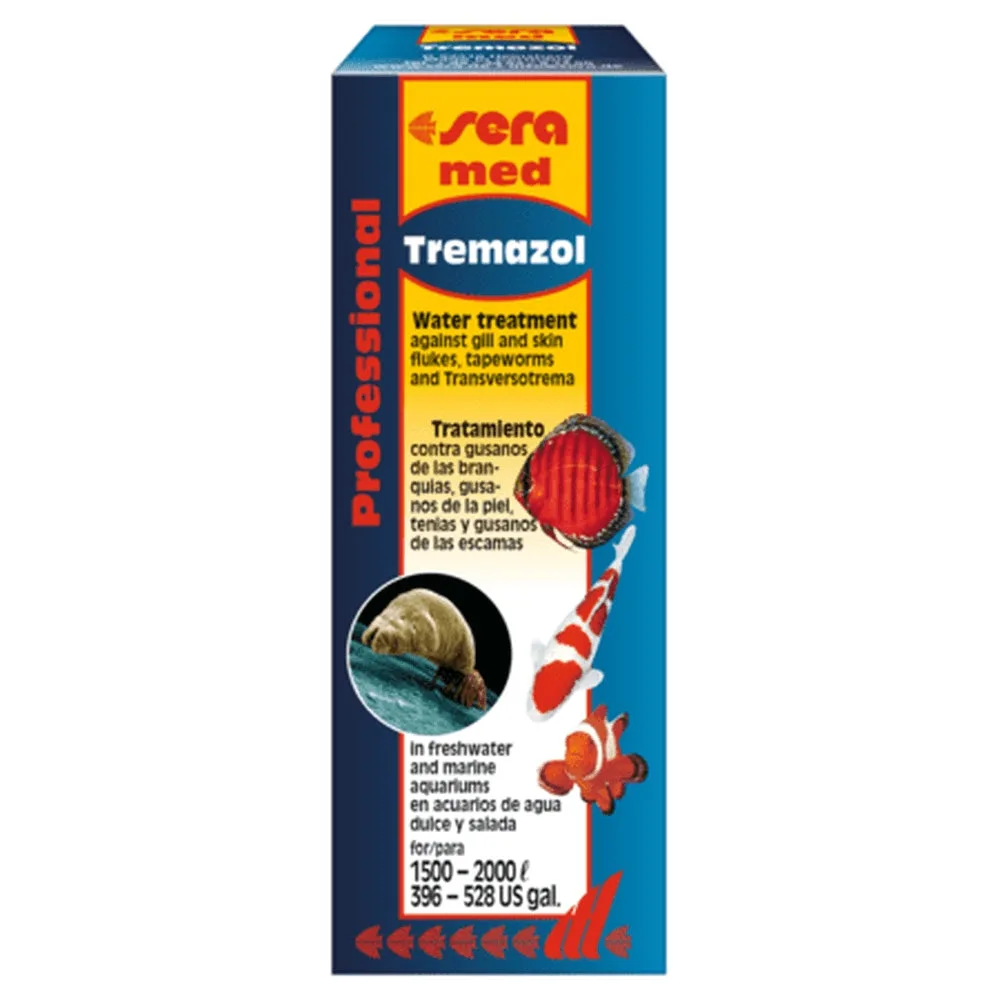
Recommendations are selected from the discus.ro shop based on this guide's topic. Availability and prices may vary.
Frequently asked questions
Put what you just read into practice
One account brings together everything you need to keep your tank on track:
Water parameters, inhabitants, photos and the full history of every change — our most used tool.
Water changes, cleaning and feeding, on your own dates.
See at a glance which values fall outside the safe discus range.
The guides, products and listings you follow, saved in one place.