How to lower pH in hard tap water for discus: RO, peat or acid
Hard, alkaline tap water (pH 7.8–8.5) can be corrected safely: reverse osmosis, peat, catappa or controlled acidification in the barrel. Method comparison, doses and safety rules.
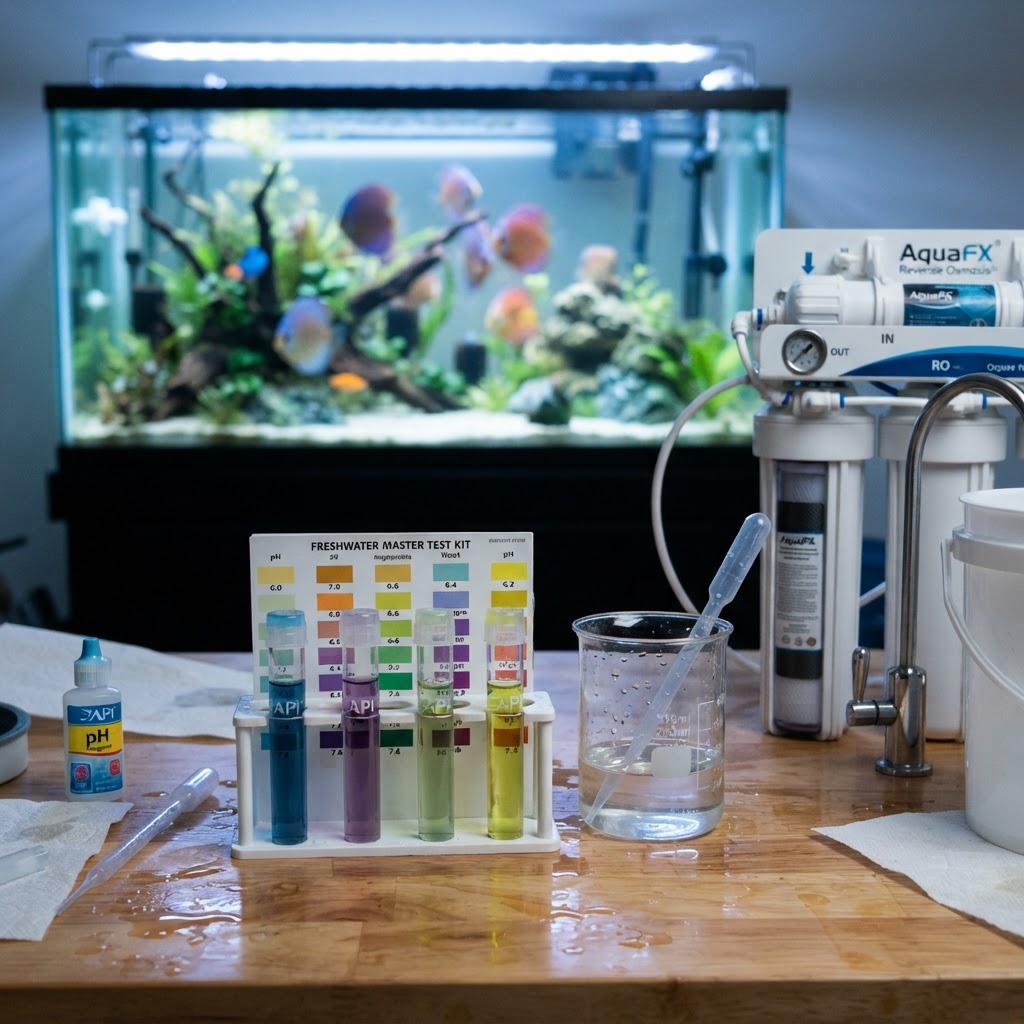
Quick summary
- Tank-bred discus tolerate pH 7.0–7.8 if it is STABLE
- Low pH (6.0–6.5) is only needed for breeding and wild discus
- Safest method: reverse osmosis + remineralization
- Peat and catappa lower pH slightly (0.2–0.5)
- Acid is used ONLY in the barrel, never in the tank
- Without KH (below 2 dKH) pH becomes unstable
In short
- In many areas tap water has pH 7.5–8.5 and high hardness.
- You don't have to lower pH: tank-bred discus do well at pH 7.0–7.8 as long as it stays stable.
- You need low pH (6.0–6.5) mainly for breeding and wild discus.
- The safest method is reverse osmosis (RO); acidification is only done in the preparation barrel, never in the tank.
What you'll learn
- When you really need to lower pH
- Why KH "holds" your pH up
- Method comparison: RO, peat, catappa, CO2, acid
- The acid hack used by Jack Wattley and its safety rules
- What never to do
When you need to lower pH
| Situation | Target pH | Lower it? |
|---|---|---|
| Tank-bred discus, maintenance | 6.5–7.8 | Only if tap goes above ~8.0 |
| Breeding | 6.0–6.5 | Yes |
| Wild discus (Heckel, Altum) | 5.0–6.5 | Yes |
| Discus imported from Asia (hard water) | 7.0–7.5 at first | Not suddenly — slow acclimation |
Why pH "refuses" to drop
The pH of hard water is held up by KH (carbonates). As long as KH is high (8–15 dKH), any acid added is neutralized and pH bounces back. That is why "pH down" poured into the tank works for a few hours, then pH climbs again — exactly the swing that stresses discus.
Bottom line: to lower pH permanently, first lower KH (by diluting with RO) or consume carbonates in a controlled way, outside the tank.
Method comparison
| Method | How much pH drops | Stability | For whom |
|---|---|---|---|
| Reverse osmosis + mixing | A lot (down to 6.0–6.5) | Very good | Recommended for everyone |
| Peat in filter or barrel | 0.2–0.5 | Good | Moderately hard water |
| Catappa leaves, alder cones | 0.1–0.3 | Good | Supplement, blackwater effect |
| CO2 (planted tank) | 0.5–1.0, daytime only | Swings day/night | Not for pH purposes |
| Acid (hydrochloric/phosphoric) in barrel | A lot | Good if done correctly | Advanced, no RO access |
| "pH down" straight into the tank | Temporary | Poor | Avoid |
Recommended method: RO + remineralization
- Produce RO water (TDS about 0–10 ppm).
- Mix with tap water or remineralize up to KH 2–4 dKH.
- pH settles on its own around 6.5–7.2, stable.
Details: Mixing RO and tap water and Remineralizing RO water.
The acid hack (Wattley method) — advanced only
For years Jack Wattley used hydrochloric (muriatic) acid for very alkaline water (pH 8.4–8.9) where RO was not an option. Mandatory rules:
- Only in the preparation barrel, never in the tank with fish.
- Add a few drops, mix, aerate and measure after 1–2 hours. Repeat until you reach the target pH.
- Don't lower KH below 2 dKH — otherwise pH becomes unstable.
- Wear gloves and goggles; add acid to water, never the other way round.
- Record the exact dose per volume so you can repeat it identically at every change.
What never to do
- Pour acid or "pH down" directly into the aquarium.
- Lower pH by more than 0.3 units per day with fish in the water.
- Use pure RO water without remineralization (KH 0 = pH crash).
- "Correct" pH up and down every day.
Checklist
- ☐ Measured tap pH, KH, GH and TDS
- ☐ Decided whether you really need low pH
- ☐ Chose a method (RO recommended)
- ☐ Correction done in the barrel, with 12–24h aeration
- ☐ KH kept above 2 dKH
- ☐ pH checked before every change
What to do next
📚 Learn more:
- The ideal pH for discus
- KH and GH for discus
- Reverse osmosis for discus
- Blackwater for discus
- Stability vs perfect parameters
🧮 Calculate:
🛒 Shop: