Color-enhancing food for discus (carotenoids, krill, astaxanthin)
Color-enhancing food for discus — natural carotenoids (krill, astaxanthin, paprika), commercial color enhancers, an 8-week intensive diet and common mistakes.

Quick summary
- Discus DON'T make their own carotenoids — they must get them FROM THE DIET. Without dietary carotenoids, red/orange/yellow FADE over 2–3 months.
- Top carotenoids: astaxanthin (the strongest, from krill + brine shrimp), canthaxanthin (in shrimp shells), lutein (spirulina, egg yolk), zeaxanthin (corn, yolk), beta-carotene (carrot, paprika).
- Natural sources: Antarctic krill, brine shrimp, paprika, red pepper, spirulina, egg yolk.
- Commercial color enhancers: astaxanthin/carotenoid discus formulas (e.g. Tropical D-Red Astacolor, Sera Premium Color, Hikari Discus Color).
- 'Color boost' protocol: 8 intensive weeks with 40–50% carotenoid-rich food + good light (8 h/day, 5500–6500 K) + stable water parameters.
- Stendker, Snake Skin, Pigeon Blood, Red Melon = the most responsive to a carotenoid diet.
- The #1 mistake: 'color food daily' = an overworked liver + stalled growth. Max 30–40% of the diet.
In short
- Discus DON'T make their own carotenoids — they must get them FROM THE DIET. Without dietary carotenoids, red/orange/yellow FADE over 2–3 months.
- Top carotenoids: astaxanthin (the strongest, krill + brine shrimp), canthaxanthin (in shrimp shells), lutein (spirulina, yolk), zeaxanthin (corn, yolk), beta-carotene (carrot, paprika).
- Natural sources: Antarctic krill, brine shrimp, paprika, red pepper, spirulina, egg yolk.
- Commercial color enhancers: astaxanthin/carotenoid discus formulas (examples: Tropical D-Red Astacolor, Sera Premium Color, NLS Discus Color, Hikari Discus Color).
- "Color boost" protocol: 8 intensive weeks with 40–50% carotenoid-rich food + good light (8 h/day, LED 5500–6500 K) + stable water parameters.
- Stendker, Snake Skin, Pigeon Blood, Red Melon = the most responsive to a carotenoid diet.
- The #1 mistake: "color food daily" = an overworked liver + stalled growth. Max 30–40% of the diet.
💱 Prices vary a lot by country. Where figures appear, they're labelled as a RO estimate (2026) in approximate EUR — use your local market and the products available where you live.
What you'll learn
Enhancing discus (Symphysodon) colors through diet is one of the most rewarding arts of premium fishkeeping. Unlike plants and some bacteria, fish (including discus) CANNOT SYNTHESIZE carotenoids — the pigments responsible for red, orange and yellow — and MUST get them through food. A Pigeon Blood, Red Turquoise or Snake Skin discus fed incorrectly loses much of its color intensity over 2–3 months, while one fed correctly with astaxanthin + krill + specific supplements becomes strikingly red and vibrant orange. This guide shows you the biological mechanism, natural carotenoid sources, available color enhancer products, the 8-week protocol for maximum impact and the common mistakes that cancel out results.
How it works biologically — carotenoids
The mechanism
- Discus eat food rich in carotenoids (astaxanthin from krill/brine shrimp, lutein from spirulina, etc.).
- The carotenoids are absorbed through the gut (with the help of dietary fats — fat-soluble vitamins A, D, E, K).
- Transported through the blood (bound to lipoproteins) to the skin and scales.
- Stored in pigment cells (xanthophores = yellow/orange; erythrophores = red).
- Appear VISIBLY on the body in 4–8 weeks with the right diet.
Why colors fade without carotenoids
- Carotenoids in the pigment cells degrade over time (oxidation, light exposure).
- Without new dietary sources = not replenished.
- After 2–3 months: red turns pale orange, orange turns yellow, yellow disappears.
- The discus become "washed-out," with "dead" colors.
Which discus respond best
| Variety | Response to carotenoids | Notes |
|---|---|---|
| Pigeon Blood | ⭐⭐⭐⭐⭐ Maximum | Solid red pigment, astaxanthin critical |
| Red Turquoise | ⭐⭐⭐⭐⭐ Maximum | Red-turquoise pattern is diet-dependent |
| Snake Skin | ⭐⭐⭐⭐⭐ Maximum | Vivid red-orange lines |
| Red Melon / Red Solid | ⭐⭐⭐⭐⭐ Maximum | Solid red, fully dependent |
| Yellow / Golden | ⭐⭐⭐⭐ High | Yellow from lutein + zeaxanthin |
| Leopard Snake Skin | ⭐⭐⭐⭐ High | Red spots on a white body |
| Checkerboard | ⭐⭐⭐⭐ High | Mixed colors |
| Blue Diamond / Cobalt | ⭐⭐ Low | Structural pigment (refraction), not carotenoids |
| Wild Heckel | ⭐⭐⭐ Medium | Natural red/orange |
| Pure white (White Butterfly) | ⭐ Very low | Lacks pigments, only sheen |
Top carotenoids and sources
1. Astaxanthin ⭐⭐⭐⭐⭐ (the strongest)
An intense RED-ORANGE pigment, a strong antioxidant, a vitamin A precursor.
Natural sources (astaxanthin concentration in dry weight):
- Antarctic krill (Euphausia superba) — ~300–500 mg/kg dry (40–70 mg/kg wet) — the richest marine source for fish
- Adult brine shrimp — ~50–200 mg/kg
- Marine shrimp (Pandalus) — ~80–150 mg/kg
- Wild salmon — ~30–50 mg/kg (not fed directly to fish)
- Haematococcus pluvialis (green alga) — the pure industrial source, 1.5–5% astaxanthin = a highly concentrated powder
Commercial sources (product types): pure food-grade astaxanthin powder; spirulina + astaxanthin premium blends; frozen krill. Available as branded color enhancers internationally.
Recommended dose: ~50–150 mg pure astaxanthin/kg of food (or the equivalent via 200–400 g krill/kg of beef heart mix).
🇷🇴 RO estimate (2026): pure food-grade astaxanthin powder ~€38–94/100 g (5–10% concentrated, lasts years); frozen krill ~€3–4/100 g.
2. Canthaxanthin ⭐⭐⭐⭐ (an intense RED pigment)
Used industrially to enhance red (poultry, fish, farmed salmon).
Sources:
- Shrimp and krill shells (carapace)
- Commercial supplements (red-enhancing discus formulas)
- Caution: large doses may affect the liver. Use moderately.
Dose: ~30–50 mg/kg of food.
3. Lutein + zeaxanthin ⭐⭐⭐⭐ (YELLOW-ORANGE pigments)
For enhancing YELLOW and reinforcing RED.
Natural sources:
- Spirulina powder (blue-green alga), food grade
- Hard-boiled egg yolk
- Yellow corn (traces, very weak)
- Marigold flower (Calendula) — the source for industrial extracts
Spirulina dose: 1 teaspoon/kg of beef heart mix, or 2–3% of total pellet weight.
🇷🇴 RO estimate (2026): food-grade spirulina powder ~€9–23/250 g.
4. Beta-carotene ⭐⭐⭐ (an ORANGE pigment, a vitamin A precursor)
Sources:
- Red paprika (capsicum) — ~50–100 µg β-carotene/g
- Carrot — ~8–10 µg/g (weak)
- Sweet potato — ~8–9 µg/g
- Roasted red pepper — concentrated
In fishkeeping: rarely used alone, more as part of mixes.
5. Carotenoids in eggs (yolk)
A complete natural mix: lutein (~50%) + zeaxanthin (~30%) + other carotenoids (~20%).
Use: 1 hard-boiled yolk, finely mashed, in 1 kg of beef heart mix. Also for very small fry.
Commercial color enhancers
These come as branded discus color formulas. Pick by composition rather than name:
Astaxanthin + canthaxanthin + krill formula (e.g. Tropical D-Red Astacolor) ⭐⭐⭐⭐⭐
- Composition: astaxanthin + canthaxanthin + spirulina + krill
- Format: sinking pellets, 1–2 mm for juveniles, 2–3 mm for adults
- Use: 30–40% of the diet (alternated with normal pellets)
- Visible result: 4–6 weeks
Natural-astaxanthin premium formula (e.g. Sera Premium Color) ⭐⭐⭐⭐⭐
- Composition: natural astaxanthin (Haematococcus) + mixed carotenoids
- Format: premium pellets, multivitamin + minerals included
- Use: 40–50% of the diet during the "color boost" period
Concentrated-astaxanthin formula (e.g. Hikari Discus Color) ⭐⭐⭐⭐⭐
- Composition: concentrated astaxanthin + special vitamin E + spirulina
- Format: 1–2 mm pellets
- Use: 30–40% of the diet, alternated
- Result: the most striking colors, but also the most expensive
High-protein color formula (e.g. NLS Discus Color) ⭐⭐⭐⭐
- Composition: astaxanthin + krill + mixed carotenoids
- Use: 30–40% of the diet
For Stendker discus (Stendker Color Granulat) ⭐⭐⭐⭐
- Composition: astaxanthin + carotenoids for the Pigeon Blood pigment
- Use: 40–50% of the diet to maintain the "Stendker" look
🇷🇴 RO estimate (2026): commercial color enhancers ~€6–34 per pack depending on brand and size.
"Color boost" protocol — 8 weeks
Weeks 1–2: Acclimation + optimal parameters
Goal: prepare the fish for maximum carotenoid uptake.
Actions:
- Perfect water parameters: pH 6.0–6.8, TDS 100–200 ppm, T 28–30 °C (82–86 °F), NH3=0, NO2=0, NO3<10 ppm.
- Optimal lighting: LED 5500–6500 K full spectrum, 8 h/day.
- Current diet (don't change it yet) — relaxed discus.
- Vitamin supplements — a fish multivitamin 2×/week in the food.
Weeks 3–4: Introduce carotenoids
Goal: the discus start absorbing carotenoids.
Diet:
- Morning: 70% normal pellets + 30% color enhancer
- Evening: Beef heart mix + frozen krill (1–2 cubes/meal)
- Supplements: spirulina 1 teaspoon/day in the beef heart mix
- Krill frequency: at least 2×/week (Tue + Fri)
Weeks 5–6: High concentration
Goal: carotenoids start being deposited in the skin = visibly more vivid colors.
Diet:
- Morning: 50% color enhancer + 50% normal pellets
- Evening: Beef heart with spirulina + 1 g astaxanthin powder/kg mix + krill 3×/week
- You can alternate color enhancers between the different formulas
- Frozen food: Krill 3×/week, brine shrimp 2×/week, mysis 1×/week
Weeks 7–8: Maximum + maintenance
Goal: vibrant colors, full carotenoid deposit.
Diet:
- Morning: 60% color enhancer + 40% premium pellets
- Evening: "Premium" beef heart (spirulina + astaxanthin + supplements) + krill 3×/week
- OBSERVE: the most vivid colors appear in weeks 6–8. The result is impressive.
After week 8: Maintenance
To keep the look:
- 30–40% color enhancer permanently
- Beef heart mix with spirulina + astaxanthin (1 g/kg)
- Krill 2×/week
- Continuous optimal lighting
Don't feed color food at 100% daily — it overworks the liver. Balance is key.
Food combinations for maximum impact
"Color premium" beef heart mix (recipe)
For 1 kg of homemade mix:
- 500 g finely grated beef heart
- 200 g frozen shrimp (shell-on, a natural astaxanthin source)
- 100 g fresh spinach + 50 g carrot (vitamins A, K)
- 1–2 g pure food-grade astaxanthin powder — KEY for red
- 2 teaspoons food-grade spirulina powder — lutein + zeaxanthin
- 1 teaspoon sweet red paprika (beta-carotene + capsanthin)
- 1 hard-boiled yolk (natural carotenoid mix)
- 1 teaspoon fish multivitamin
- 2 crushed garlic cloves (appetite + anti-parasite aid)
Processing: mince finely → spread on film → freeze → 5 g pieces per meal.
Result: after 6–8 weeks, Pigeon Blood/Red Turquoise/Snake Skin discus become striking.
"Color intensive" weekly diet
| Day | Morning | Evening |
|---|---|---|
| Mon | 50% color enhancer + 50% normal pellets | "Color premium" beef heart + krill |
| Tue | 40% color enhancer + 60% pellets | Frozen brine shrimp with astaxanthin juice |
| Wed | 50% color enhancer + 50% pellets | Beef heart + extra spirulina |
| Thu | 40% color enhancer + 60% pellets | Krill 3× cubes + mysis |
| Fri | 50% color enhancer + 50% pellets | "Color premium" beef heart + brine shrimp |
| Sat | 40% color enhancer mix + 60% pellets | Krill + occasional bloodworms |
| Sun | FAST | FAST |
Adjacent factors that influence colors
Lighting
- LED 5500–6500 K full spectrum = the best for showing colors
- Weak lighting (under ~0.08 W/L / 0.3 W/gal) = visually faded colors even with healthy fish
- Excessive lighting (over ~0.13 W/L / 0.5 W/gal) = stress + algae + darkened colors (stressed fish)
- "Aquatic plant grow" LEDs that lean toward red = can visually intensify colors
Substrate and background
- DARK substrate (black sand, basaltic) = fish show colors more intensely (contrast)
- WHITE substrate = fish become paler (unconscious mimicry)
- Bare-bottom + black background = the combination preferred by professional breeders for maximum visual contrast
Water parameters
- pH 6.0–6.5 slightly acidic = ideal for carotenoid absorption
- Soft water (TDS 100–150 ppm) = easier on the digestive system
- Temperature 28–29 °C (82–84 °F) = optimal metabolism + intense colors
Stress
- CHRONIC stress = permanently darkened colors (a biological response)
- ACUTE stress = temporarily faded colors (transport, changes)
- No stress = maximum natural color potential
Common mistakes
❌ "Color food 100% daily" — an overworked liver, vitamin A toxicity, stalled growth. Max 30–40% of the diet.
❌ "The more krill, the better" — the chitinous shell = constipation + fatty liver. Max 2–3 meals/week.
❌ RAW astaxanthin powder straight into the water — not absorbed without fats. Always with food (beef heart, pellets with fish oil).
❌ "Color food + stress" = pointless — stressed discus do NOT take up carotenoids. First perfect parameters, only then a color diet.
❌ WHITE substrate + weak lighting = even a perfect diet doesn't make up for the lack of visual contrast.
❌ Expecting results in 7 days — at least 4–6 weeks for visible results. Patience.
❌ Combining with medications — antibiotics affect absorption. Wait until treatments end.
❌ Carotenoids with too little protein — a protein base (40%+) is mandatory. Color food without beef heart/premium pellets = only pigment, not structure.
Benefits beyond color
Carotenoids (especially astaxanthin) are reported to have multiple benefits:
- A strong antioxidant — cell protection
- Immune system ↑ — fewer bacterial infections
- Fertility ↑ for breeders
- Faster recovery after illness
- Longevity — discus on carotenoid-rich diets are often reported to live longer than those on poor diets (figures vary; treat as indicative)
Color protocol checklist
- ☐ Healthy discus, optimal water parameters (pH, TDS, T, NH3=0)
- ☐ LED 5500–6500 K lighting, 8 h/day
- ☐ Dark substrate or bare-bottom + black background
- ☐ 30–40% commercial color enhancer
- ☐ "Color premium" beef heart with spirulina + astaxanthin + paprika
- ☐ Frozen krill 2–3 meals/week
- ☐ Frozen/live brine shrimp 2×/week
- ☐ Astaxanthin powder 1 g/kg beef heart mix
- ☐ Vitamin supplements 2×/week
- ☐ A weekly fasting day
- ☐ Patience for 6–8 weeks for visible results
- ☐ NOT 100% color food — max 40% of the diet
🇷🇴 RO estimate (2026): a full 8-week color protocol for 6–10 discus runs roughly
€108 total (€11–17/discus), with maintenance at ~€15–23/month afterward. A DIY route (shell-on shrimp + spirulina + paprika + yolk + frozen krill) costs less but gives ~60–70% of the commercial result.
What to do next
🥘 The best food: Top 5 types and the ideal diet.
💊 Complete supplements: Vitamins and supplements for discus.
📖 Beef heart recipe: Homemade discus food recipe.
🐠 Discus varieties: Varieties encyclopedia.
📅 Food storage: Storage and freshness.
Want a clear schedule for your tank?
Generate a personalized plan for water changes, feeding, testing and maintenance — in just 2-3 minutes.
Generate care planSave your tank, log water parameters and get email reminders for care tasks — for free.
Recommended products
Picked from the shop based on what you just read
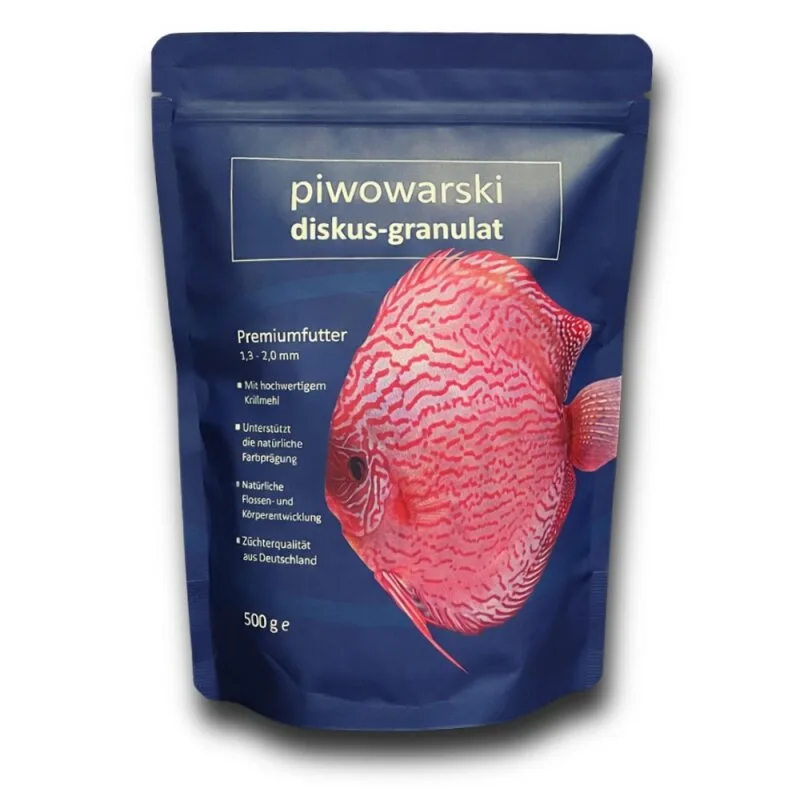
Recommendations are selected from the discus.ro shop based on this guide's topic. Availability and prices may vary.