Frozen food for discus — brands, storage, thawing
Frozen food for discus — top brands, how to thaw safely, correct storage and common mistakes to avoid.

Quick summary
- Frozen food = a safe middle ground between live food (parasite risk) and pellets (less natural). Sterilized by industrial flash-freezing.
- Best types for discus: brine shrimp, bloodworms (Chironomus), krill, mysis, daphnia, white/black mosquito larvae.
- CORRECT thawing: in a cup of tank water, 3–5 minutes, drain the red liquid (it pollutes the water), feed the pulp.
- NEVER: microwave, hot water, counter-top thawing, refreezing.
- Storage: freezer at -18 °C (0 °F), max ~6 months after opening a blister, labeled with the date.
- A 100 g blister is enough for 6–10 discus for 4–7 days.
In short
- Frozen food = a safe solution between live food (parasite risk) and pellets (less natural). Sterilized by industrial freezing.
- Best types for discus: brine shrimp, bloodworms (Chironomus), krill, mysis, daphnia, white/black mosquito larvae.
- CORRECT thawing: in a cup of tank water, 3–5 minutes, drain the red liquid (it pollutes the water), feed the pulp.
- NEVER: microwave, hot water, counter-top thawing, refreezing.
- Storage: freezer at -18 °C (0 °F), max ~6 months after opening a blister, labeled with the date.
- A 100 g blister is enough for 6–10 discus for 4–7 days.
💱 Prices vary a lot by country. Where figures appear, they're labelled as a RO estimate (2026) in approximate EUR — use your local market and the products available where you live.
What you'll learn
Frozen food for discus (Symphysodon) is the perfect compromise between the risks of live food (parasites, bacteria from tubifex/larvae) and the convenience of pellets. The industrial ultra-fast freezing process (typically around -30 °C / -22 °F) sterilizes the product (killing parasites and most bacteria) while preserving most of the nutritional value of live food. It's sold internationally in 100 g blisters (typically 60–100 g square pulps or cubes), produced by specialized European brands with high quality standards. This guide shows you the best brands, the essential types (brine shrimp, bloodworms, krill, mysis, daphnia), the correct thawing technique, optimal storage and the common mistakes that cancel out the benefits.
Why frozen food for discus
| Advantage | Detail |
|---|---|
| Sterilized | Freezing kills Hexamita, Camallanus, planaria, pathogenic bacteria |
| Nutritional value | ~90–95% preserved versus live food |
| Availability | Year-round (vs. seasonal live food) |
| Storage | 12–18 months in a closed freezer |
| Convenient | Portioned in cubes, precise dosing |
| Safe for fry | Bloodworms, brine shrimp, mysis = OK with no outbreak risk |
| Easy variety | Different types/day from the freezer |
Top frozen brands — a ranking
Premium frozen fish food is sold internationally by several established brands (well-known examples include Ruto from the Netherlands, Ocean Nutrition from Belgium/USA, Sera FrikaDelta and JBL from Germany, and budget Tropical FD from Poland). Quality and availability vary by country — use whichever quality brand is stocked where you live.
1. The European gold standard (e.g. Ruto) ⭐⭐⭐⭐⭐
A full line for discus: brine shrimp, bloodworms (red Chironomus), krill Pacifica, mysis, a discus special protein mix.
Characteristics:
- Frozen immediately after collection/culture (within a few hours)
- Flat 100 g blisters — easy to snap into cubes
- Clear origin + production-date labeling
2. A premium tropical-fish specialist (e.g. Ocean Nutrition) ⭐⭐⭐⭐⭐
Key products: brine shrimp, bloodworms, a discus formula (special mix), whole krill Pacifica.
Characteristics:
- Premium marine sources
- Mixes formulated specifically for tropical cichlids
3. Accessible German quality (e.g. Sera FrikaDelta) ⭐⭐⭐⭐
Products: brine shrimp, bloodworms, mysis, krill.
Characteristics:
- Wide availability, consistent quality, a sturdy blister pack
4. An accessible wide-range German brand (e.g. JBL NovoFil) ⭐⭐⭐⭐
Products: bloodworms, brine shrimp, a discus mix.
Characteristics:
- Very widely stocked, a good price, medium-to-high quality
5. A budget-friendly option (e.g. Tropical FD) ⭐⭐⭐
Products: brine shrimp, bloodworms, a discus frozen blend.
Characteristics:
- The most accessible price; variable quality (check batches)
🇷🇴 RO estimate (2026): ~€1.5–5/100 g depending on brand and type — premium brands ~€2.5–5, budget ~€1–3.
The best frozen types for discus
Brine shrimp (frozen) ⭐⭐⭐⭐⭐
A universal, risk-free food for all discus.
- Protein: ~47%
- Carotenoids (astaxanthin): intensify the colors
- For: adults, juveniles (NOT fry under 4 weeks — too big)
- Frequency: 2–3×/week
Bloodworms (Chironomus, red mosquito larvae) ⭐⭐⭐⭐
Loved by discus, but limited to 1–2×/week (constipation).
- Protein: ~60%
- Hemoglobin → colors
- For: adults (NOT fry under 6 weeks)
- Frequency: max 1–2×/week
- ⚠️ The chitinous shell constipates if overfed
Krill (marine shrimp) ⭐⭐⭐⭐⭐
A MAXIMUM color boost (the richest in astaxanthin).
- Protein: ~60%
- Astaxanthin: much higher than brine shrimp
- For: adults only (a large chitinous shell)
- Frequency: 1–2×/week
Mysis (small marine shrimp) ⭐⭐⭐⭐
An excellent omega-3 nutritional profile.
- Protein: ~60%
- High omega-3 fatty acids
- For: adults, juveniles
- Frequency: 1–2×/week
Daphnia (water fleas) ⭐⭐⭐⭐
For digestion and constipation prevention.
- Protein: ~50%
- A mild laxative effect (fiber)
- For: all discus (especially after bloodworm meals)
- Frequency: 1×/week
White/black mosquito larvae ⭐⭐⭐⭐
Less available, but nutritionally excellent.
- Protein: ~55–60%
- A pleasant variety in the diet
- For: adults
- Frequency: 1×/week
CORRECT thawing — step by step
The recommended method (thawing in water)
- Remove the cube from the freezer with a clean hand or a cup.
- Put it in a small cup (50–100 ml) with tank water (at tank temperature = 28–30 °C / 82–86 °F). Cold tap water = thermal shock + chlorine.
- Wait 3–5 minutes until it fully melts. The cube becomes a reddish fluid.
- Drain the red liquid through a fine sieve (a tea strainer) or with a syringe/spoon. The liquid = water + dissolved proteins that POLLUTE the tank water = ammonia.
- Rinse the pulp once with clean water (optional — reduces pollution by 20–30%).
- Feed directly into the tank or with a pipette for precise delivery.
Amount per meal
- 6–10 adult discus: 1 cube of 5 g (1/20 of a 100 g blister) per meal.
- Fry and juveniles: 1/4 – 1/2 cube.
- The general rule: as much as they eat in 3–5 minutes.
Feeding time
Thawing + feeding = max 10 minutes. Thawed food stays max 30 min in the tank — net out the rest (pollution).
Common thawing mistakes
❌ MICROWAVE — destroys vitamins + proteins, "cooks" the food. NEVER.
❌ HOT water (over 35 °C / 95 °F) — the same effect as a microwave.
❌ Counter-top thawing (at room temperature) — bacteria start proliferating after 30 min. Digestive-infection risk.
❌ Dumping DIRECTLY into the tank (no thawing/draining) — the red liquid with dissolved proteins = an ammonia spike + the water turns pink/brown cloudy for 1–2 h.
❌ REFREEZING — never. Bacteria proliferate during thawing. Discard the rest.
❌ Using a blister with cubes STUCK together — a sign it partly thawed and refroze. Discard the blister.
❌ OVERFEEDING "so it's not wasted" — 1 cube of 5 g = ~10 g live food equivalent. 6 discus eat it in 3–5 min. The rest = ammonia.
Correct storage
In the freezer (at home)
- Temperature: -18 °C (0 °F) constant (check a thermometer).
- Location: A dedicated freezer drawer (NOT next to raw meat — cross-contamination).
- A secondary container: A Ziploc bag + a label with the date and type (e.g. "Brine shrimp — 14.05.2026").
- Maximum duration after PURCHASE: 6 months (even if the pack says 12–18 months; the quality drops).
- An opened blister: use within 30–60 days.
Transport from the store
- An insulated bag is mandatory + 1–2 ice packs, especially in summer.
- Max 30 minutes from purchase to the freezer at home.
- If the blisters have started to soften (cubes stuck together) = partial thawing = risky. Ask the store for a refund or discard.
Quality check
Problem signals (discard the blister):
- Cubes stuck in blocks (thawed-refrozen)
- Large ice crystals inside (temperature swings)
- A strong smell on thawing (rancid, putrid)
- A dark brown or black color (oxidized)
- White foam in the thawing water (bacteria)
A weekly diet with frozen food
An example for 6–10 adult discus
| Day | Morning | Evening |
|---|---|---|
| Mon | Premium pellets | Frozen brine shrimp |
| Tue | Pellets | Beef heart mix |
| Wed | Pellets | Frozen bloodworms |
| Thu | Pellets | Frozen krill (color boost) |
| Fri | Pellets | Beef heart mix |
| Sat | Pellets | Mysis or mosquito larvae |
| Sun | FAST | FAST |
Total frozen food/week: ~4–5 cubes = ~20–25 g.
🇷🇴 RO estimate (2026): ~€13–21/month of frozen food for 6–10 discus; combined with pellets + homemade beef heart, a complete diet runs ~€28–38/month.
Where to buy
Online (recommended)
Look for specialized aquatics shops that ship frozen food in an insulated package with ice packs (2–3 day delivery). Several discus-focused online stores carry the premium brands.
In person
- Large specialized aquatics stores in major cities
- Generic pet shops — variable availability, uneven quality
Buying tips
- Buy 5–10 blisters at once for economy (shipping amortized).
- The cold season is safer for transport (summer carries a thaw-in-transit risk).
- Check the production date on arrival — choose the most recent batches.
Frozen vs live vs pellets
| Aspect | Frozen | Live | Pellets |
|---|---|---|---|
| Parasite risk | Zero | High (tubifex) – Low (home-hatched brine shrimp) | Zero |
| Nutritional value | ~90–95% of live | ~100% | ~85–95% |
| Convenience | Medium | Low | High |
| Storage | 6 months freezer | 1–7 days | 6–12 months |
| Availability | Excellent | Variable | Excellent |
| Appetite stimulation | Good | Excellent | Good (with brine shrimp/krill scent) |
The ideal combination: 40% pellets + 30% beef heart + 20% frozen + 10% live occasionally.
Frozen-feeding checklist
- ☐ Verified brands (use a quality brand stocked locally)
- ☐ Check the production date + blister integrity at purchase
- ☐ Transport in an insulated bag <30 min
- ☐ Storage in the freezer at -18 °C (0 °F) constant
- ☐ Thaw in a cup of tank water (3–5 min)
- ☐ Drain the red liquid before feeding
- ☐ Feed the exact amount (as much as in 3–5 min)
- ☐ Net out leftovers after 30 min
- ☐ NEVER microwave, hot water, counter-top thawing
- ☐ NEVER refreeze partly-thawed cubes
- ☐ Vary the frozen types (brine shrimp, bloodworms, krill, mysis, daphnia)
- ☐ Adjusted frequency (bloodworms max 1–2×/week, brine shrimp 2–3×/week)
What to do next
🥘 The best food: Top 5 types and the ideal diet.
🪱 Safe live food: Black worms vs tubifex vs white worms.
📅 Food storage: Discus food storage and freshness.
🦐 Brine shrimp hatching: DIY home brine shrimp hatching.
🍽️ Feeding schedule: How many meals per age.
Want a clear schedule for your tank?
Generate a personalized plan for water changes, feeding, testing and maintenance — in just 2-3 minutes.
Generate care planSave your tank, log water parameters and get email reminders for care tasks — for free.
Recommended products
Picked from the shop based on what you just read
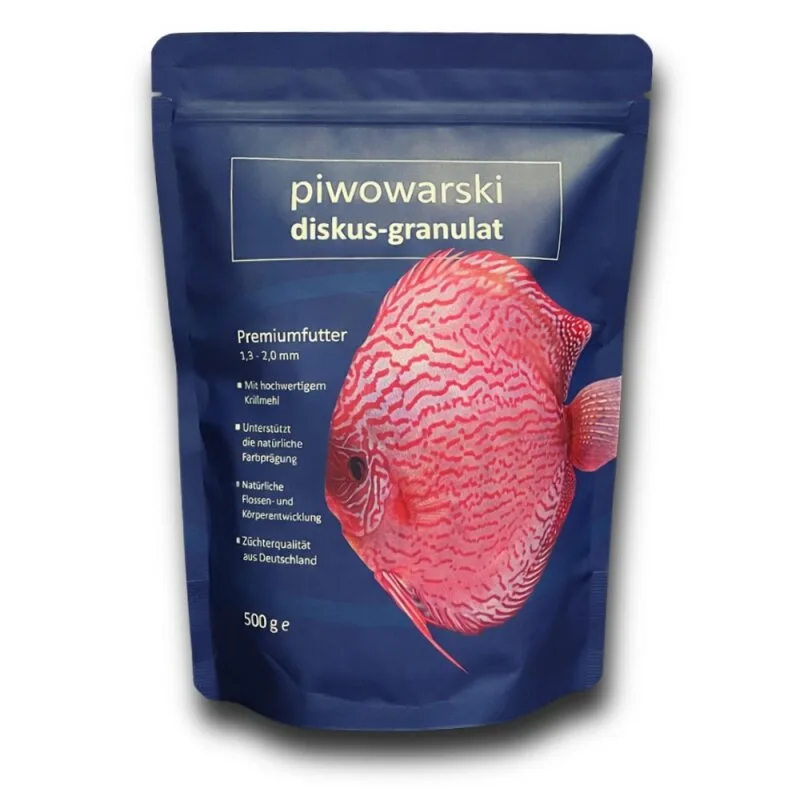
Recommendations are selected from the discus.ro shop based on this guide's topic. Availability and prices may vary.