Discus water changes for beginners (how, when, how much)
Water changes for beginners — how to do them (gravel vacuum + dechlorinator), when (2–3×/week) and how much (20–30%), plus the 5 mistakes that can kill discus.

Quick summary
- Frequency: 2–3 changes/week, 20–30% of the volume.
- Temperature rule: new water = tank temperature ±1°C (±~2°F).
- Dechlorinator is non-negotiable (e.g. Seachem Prime — a 250 ml bottle lasts months).
- Kit (one-time): a gravel-vacuum siphon, a dedicated 10 L (~2.6 US gal) bucket, a dechlorinator.
- Hands-on time: about 15–20 min per change.
- Don't change more than 50% at once — it can swing parameters too fast.
- Mistake #1: cold, chlorinated water straight from the tap = thermal shock + gill damage.
In Brief
- Frequency: 2–3 water changes/week, 20–30% of volume.
- Temperature: new water = tank temperature ±1°C.
- Dechlorinator required: Seachem Prime (~€13, 250ml lasts 6 months).
- Supplies (~€28, one-time purchase): siphon hose with pump, dedicated 10L bucket, dechlorinator.
- Time: 15–20 min/change.
- DO NOT change over 50% at once — causes sudden parameter swings.
- Mistake #1: cold tap water, unchlorinated = temperature shock + burned gills.
What You'll Learn From This Guide
Water changes are the most important routine for discus health — neither your filter nor your food can compensate for old water with high nitrates. This guide shows you what supplies you need, how to do your first water change correctly, and how to avoid mistakes that can kill fish within 24 hours. For advanced details see How Often to Change Water.
Supplies Needed (One-Time Purchase)
| Product | Price (EUR) | Notes |
|---|---|---|
| Siphon hose with manual pump + gravel cleaner | €9–15 | Gravel cleaner — essential |
| Dedicated aquarium bucket 10L | €3.7–6 | DO NOT use buckets that have held detergent or mop water |
| Seachem Prime 250ml ⭐ | €11–15 | Dechlorinator + neutralizes ammonia |
| Digital pocket thermometer | €6–9 | Check new water temp |
| Total | ~€28–45 | Lasts for years |
💡 Dechlorinator alternatives: Tetra AquaSafe (€11), JBL Biotopol (€15), Sera Aquatan (€9). All work — Prime is the most concentrated (1ml/40L).
Frequency — Simple Table
| Situation | Frequency | Volume |
|---|---|---|
| ✅ Stable tank, normal stocking | 2×/week | 25–30% |
| 🟡 New tank (month 1) | 3×/week | 20% |
| 🩹 Sick fish (during treatment) | Every 2 days | 25% |
| 🐣 Juveniles under 8 cm | Daily | 30–50% |
| ❌ "Once a month is fine" | NO | — |
🧮 See Water Change Calculator — automatically calculates the exact volume based on your tank dimensions.
Step by Step — Your First Water Change
Step 1: Preparation (5 min)
- ☐ Turn off the filter and heater
- ☐ Get your dedicated bucket ready
- ☐ Note the tank temperature — e.g. 29°C
Step 2: Siphon Out the Old Water (5–7 min)
- ☐ Vacuum through the substrate with the siphon — remove detritus
- ☐ Remove 20–30% of volume (for a 200L tank → 40–60L, i.e. 2–3 buckets)
- ☐ The old water makes great fertilizer for houseplants
Step 3: Prepare New Water (5 min)
- ☐ Fill the bucket with warm tap water — same temperature as the tank (±1°C)
- ☐ Check with the thermometer
- ☐ Add Seachem Prime — 1ml per 40L of new water
- ☐ Let it mix for 1 minute
🚿 Tip: blend hot and cold tap water until you reach ~29°C. DO NOT add cold water directly (below 27°C) — temperature shock = pneumonia.
Step 4: Add the New Water (3 min)
The first 30 days with discus calendar
One day per row: what to do, what to check and what to avoid in the first month. No theory, just the right order.
- ☐ Pour slowly (use a net or a plate to avoid disturbing the substrate)
- ☐ Check the tank temperature — it should be within ±1°C of where it was before
Step 5: Restart (1 min)
- ☐ Turn the heater and filter back on
- ☐ Watch your discus for 5 minutes — are they behaving normally?
Top 5 Mistakes to Avoid
| Mistake | Consequence | How to Avoid |
|---|---|---|
| 🚨 Cold water straight from the tap | Temperature shock, pneumonia, Ich | Check temperature first |
| 🚨 No dechlorinator | Chloramine burns gills + kills filter colony | Add Prime BEFORE pouring |
| 🚨 Bucket with detergent residue | Chemical poisoning | Use a DEDICATED, labeled bucket |
| 🚨 Panicked 80–100% water change | Destroys the biological cycle | Maximum 50% per change |
| 🚨 Filter rinsed under tap water | Kills nitrifying bacteria | Rinse sponge in water removed from the tank |
Tap Water in Romania — Is It Safe?
YES for 80% of cities. Full details in Water Parameters for Beginners.
- ✅ București, Cluj, Timișoara, Brașov: tap water is fine as-is (with dechlorinator)
- 🟡 Iași, Constanța, hard-water areas: dechlorinator + possibly blend with RO water
- ❌ Water with visible iron or sulfur: DO NOT use — get an RO unit
When Should You Change More Than 30%?
| Situation | Action |
|---|---|
| Ammonia or nitrite above 0 | 50% change urgently + double dose of Prime |
| After medication treatment | 30–50% change for 3–4 consecutive days |
| Water smells bad / white foam | 50% change + check the filter |
| All fish gasping at the surface | EMERGENCY: 50% change + air stone |
First Water Change Checklist
Before:
- ☐ Siphon hose with pump, dedicated bucket, dechlorinator, thermometer
- ☐ I know my tank volume (L)
During:
- ☐ Filter turned off
- ☐ New water at tank temperature (±1°C)
- ☐ Dechlorinator added BEFORE pouring
- ☐ Maximum 30% removed, poured in slowly
After:
- ☐ Filter + heater turned back on
- ☐ Temperature confirmed at 29°C
- ☐ Discus observed for 5 min — behaving normally?
What to Do Next
📚 Go deeper: How Often to Change Water — Advanced Guide
🧪 Test weekly: Water Parameters for Beginners
📅 Plan your routine: First 3 Months Calendar
Save your tank, log water parameters and get email reminders for care tasks — for free.
Water-change equipment
Picked from the shop based on what you just read

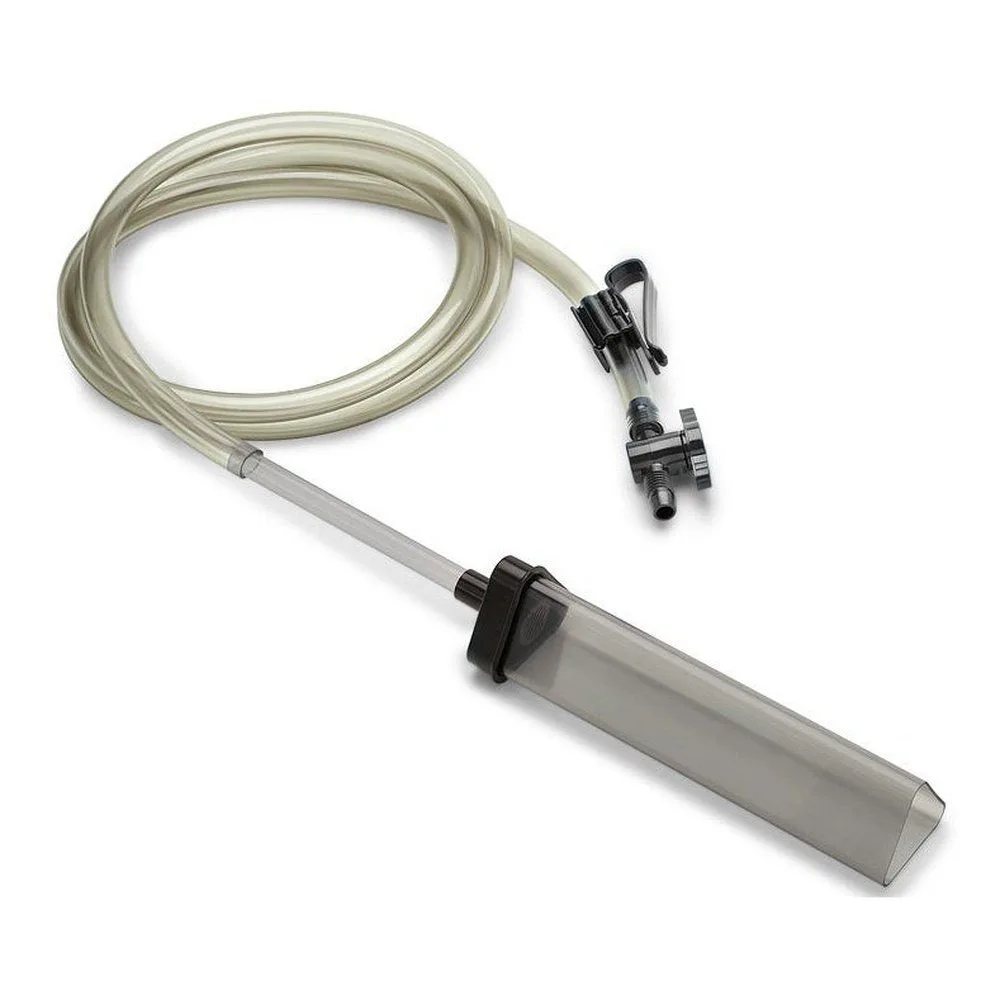

Recommendations are selected from the discus.ro shop based on this guide's topic. Availability and prices may vary.
Frequently asked questions
Put what you just read into practice
One account brings together everything you need to keep your tank on track:
Water parameters, inhabitants, photos and the full history of every change — our most used tool.
Water changes, cleaning and feeding, on your own dates.
See at a glance which values fall outside the safe discus range.
The guides, products and listings you follow, saved in one place.