Cloudy water in a discus aquarium: white, green, brown or grey – likely causes and what to do
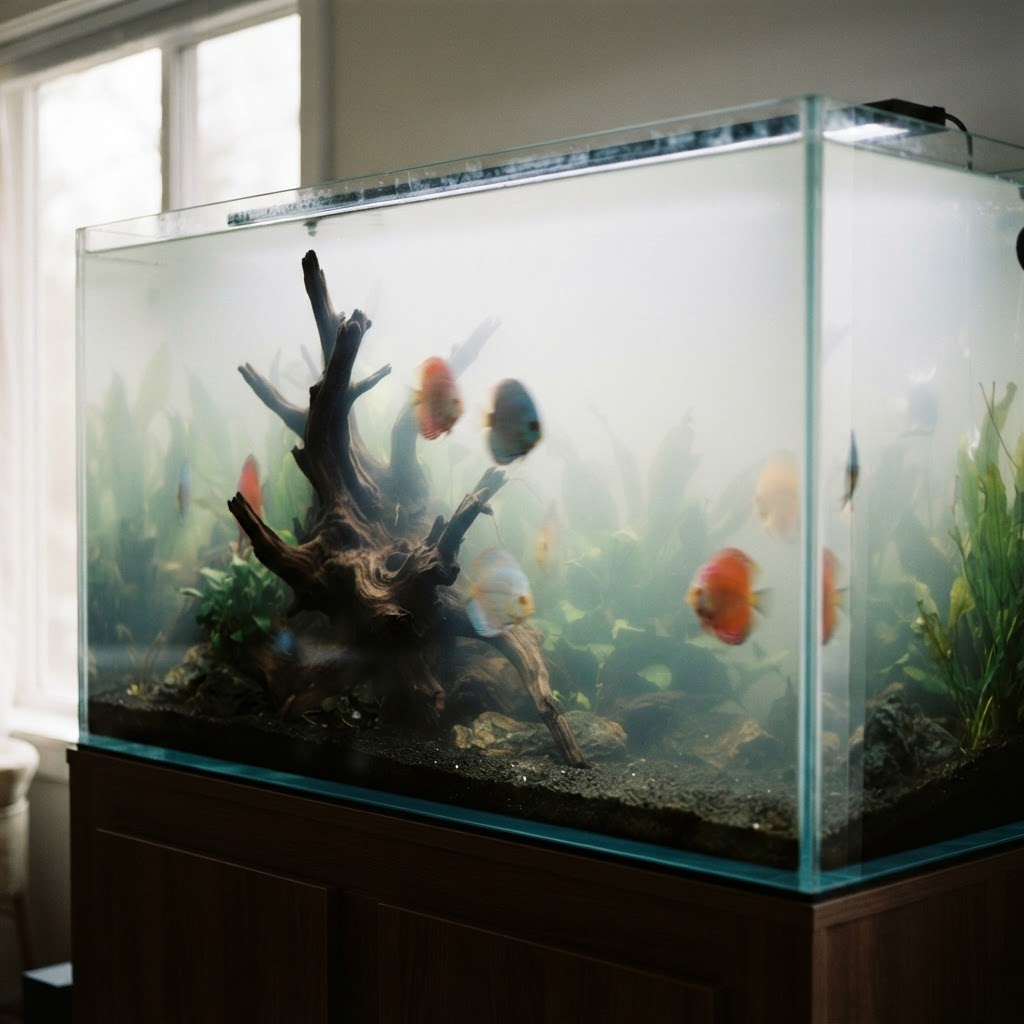
White, green, brown or grey water usually point to different causes, but color is only a clue. Learn how to check the likely cause, which mistakes make it worse and when cloudy water becomes a real concern for discus.
In short
- Water color is a useful clue, not a definite diagnosis: white (usually bacteria), green (algae), brown (tannins), grey with particles (substrate or weak filtration). Confirm the cause with water tests and a filter check.
- Milky white water in a new tank or after aggressive cleaning is usually a temporary bacterial bloom.
- Repeated water changes done only for looks rarely clear a bacterial bloom. They can make it come back because they disturb the balance that is still forming.
- Cloudy water becomes a concern when it comes with detectable ammonia or nitrite or with fish breathing fast.
- Water quality is the foundation of fish health. Prevention (good water, correct feeding, hygiene, quarantine) matters more than treatment.
What to check first
- Discus behaviour: breathing, position in the water (at the surface or on the bottom), colour, appetite.
- Ammonia (NH3/NH4) and nitrite (NO2) with a reliable test kit. Note nitrate as well.
- Temperature (for discus usually 28–30 °C), pH and, if you measure it, TDS, to see whether anything changed suddenly.
- The filter: is it running with normal flow? Was it cleaned or replaced recently?
- Leftover food or a dead fish hidden in decor, plants or behind the filter.
- What changed recently: new tank, new wood, new substrate, more light, a different food.
1. White, milky water – bacterial bloom
Likely cause: heterotrophic bacteria multiply quickly on organic matter in the water. It typically appears:
- in the first 1–3 weeks after starting the tank, while cycling is not yet complete;
- after rinsing the filter under the tap or replacing all the media;
- after overfeeding (for example beef heart left on the bottom);
- after an undiscovered dead fish.
What to do:
- Test ammonia and nitrite. If both are 0 and the fish behave normally, the problem is usually mostly cosmetic.
- Cut feeding in half for a few days and siphon leftovers.
- Keep the filter running non-stop and don't clean it during this period.
- Make sure aeration is good. A lot of bacteria in the water also means higher oxygen consumption.
- Be patient. Hobby observation: the water often clears on its own within a few days to two weeks.
What NOT to do:
- large daily water changes just to clear the water;
- chemical clarifiers added "just in case";
- replacing all the filter media at once;
- medications or antibiotics. Cloudy water is not a fish disease, and antibiotics must not be used preventively.
Each of these can disturb the bacterial balance in the filter again.
An old, stable tank suddenly turned cloudy? That is no longer a start-up bloom but a warning sign: overfeeding, a clogged filter, disturbed substrate or something dead in the tank. Find the cause and remove it.
Exception: if ammonia or nitrite is above 0, water changes are necessary. Their job is to protect the fish, not to clear the water.
2. Green water – free-floating algae
Cause: single-celled algae in suspension, fed by too much light (over 8–10 hours/day or direct sun) and high nitrate and phosphate.
Fixes:
- Cut the photoperiod to 6–8 hours and remove direct sunlight.
- Increase water changes and reduce feeding. Heavy feeding puts a lot of nutrients into the water.
- Add fast-growing or floating plants (Amazon Frogbit), which compete with algae for nutrients.
- A correctly installed UV sterilizer usually clears green water within days and is widely used on discus tanks. It doesn't remove the cause (excess light or nutrients), so correct that at the same time.
3. Brown or yellow water – tannins
Cause: driftwood, Indian almond (catappa) leaves, alder cones or peat release tannins.
For discus, tannin-stained water is generally harmless. Many breeders like it because it resembles Amazon blackwater, and it can lower pH slightly. If you use wood or leaves, keep an eye on pH, especially in very soft water, where it can drop more than you expect.
If you dislike the look, use activated carbon or Purigen in the filter. Boil or soak new wood before adding it to the tank.
4. Grey water with particles
Cause: unwashed substrate, overly aggressive siphoning or an undersized filter.
Fixes:
- Rinse new substrate well before adding it.
- Add fine filter floss and replace it often.
- Check the filter flow. As a hobby rule of thumb, it should turn over 4–6 times the tank volume per hour.
How to tell causes apart
| Color | Likely cause | Dangerous? | Main action |
|---|---|---|---|
| White/milky | Bacterial bloom | Usually not, if NH3/NO2 = 0 | Test NH3/NO2, feed less, aerate, wait |
| Green | Floating algae | Not directly | Less light, UV, water changes, fewer nutrients |
| Brown | Tannins | Generally not | Watch pH; activated carbon if it bothers you |
| Grey | Particles/substrate | Usually not | Filter floss, better filtration |
When it is an emergency
Go straight to emergency measures if the water is cloudy and the discus:
- breathe fast;
- hang at the surface;
- suddenly darken or become listless.
What to do right away:
- Assume a water-quality problem first and test ammonia and nitrite immediately.
- Do a 30–50% change with dechlorinated, temperature-matched water.
- Increase aeration.
- Find and remove any dead fish or decaying matter.
Poor water quality, organic load and low oxygen stress fish, and these factors can later predispose them to bacterial infections.
When you need a fish vet: if the fish stay sick after the water has been corrected, if lesions appear on the body, or if fish die. Many signs are nonspecific; a real diagnosis comes from microscopy of mucus and gills, culture, or necropsy of dead fish. Don't treat by guesswork just because the water was cloudy.
Prevention and relapse
- Don't rinse the filter under tap water. Rinse media in tank water and never replace all of it at once.
- Feed only what is eaten within a few minutes and siphon leftovers.
- Keep a steady water-change routine instead of large panic changes.
- In a new tank, wait for biological filtration to mature before stocking fully.
- Quarantine new fish before adding them to the main tank:
- at least 30 days, longer if signs of disease appear;
- a separate tank with dedicated equipment;
- a sponge filter matured beforehand in a healthy established tank;
- monitoring of ammonia, nitrite and fish behaviour.
Sources
Save your tank, log water parameters and get email reminders for care tasks — for free.
Recommended products
Picked from the shop based on what you just read
Recommendations are selected from the discus.ro shop based on this guide's topic. Availability and prices may vary.
Frequently asked questions
Put what you just read into practice
One account brings together everything you need to keep your tank on track:
Water parameters, inhabitants, photos and the full history of every change — our most used tool.
Water changes, cleaning and feeding, on your own dates.
See at a glance which values fall outside the safe discus range.
The guides, products and listings you follow, saved in one place.