Red Turquoise
Symphysodon aequifasciatus
Description
The Red Turquoise is one of the first and most iconic hybrid discus varieties. It represents the starting point for most modern strains featuring turquoise stripes.
🌍 Origin & History
One of the oldest and most historic hybrid discus varieties. The first Red Turquoise strain was created by Jack Wattley in the USA (1969), by crossing wild specimens collected from the Rio Juruá with green discus from Tefé. Subsequently, Dr. Schmidt-Focke from Germany perfected his own version (1970) by crossing a wild 'Blue Discus' with a solid red discus, creating the European Red Turquoise line that dominated the industry.
Appearance
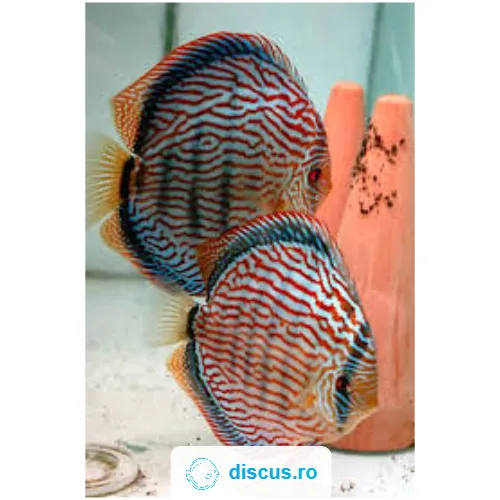
Disc-shaped body, laterally compressed. The body color ranges from bright red-orange to brownish-red. On this base, bright turquoise-blue wavy horizontal stripes overlay, covering between 60-100% of the body surface. The eyes are vivid red. The dorsal, anal, and caudal fins feature filamentous extensions and turquoise stripes. The stripes are thick ('thick line') and evenly distributed.
🧬 Genetic background
At the base: wild Royal Blue discus (Symphysodon aequifasciatus haraldi) × Tefé green discus (Symphysodon aequifasciatus aequifasciatus). The turquoise stripes derive from the horizontal stripping gene of the Wild Blue/Royal Blue, while the red-brown base comes from intensive selection of carotenoid pigments. The genotype is dominant over strains without stripes.
Recommended water parameters
Care
Regular water changes of 25–30%, 2–3 times a week. Sensitive to sudden changes in parameters.
Breeding
Relatively easy to breed. Pairs deposit eggs on vertical surfaces. The fry feed on parental mucus.
💡 Practical tips
- →A dark aquarium background enhances the turquoise stripes
- →Temperatures below 27°C can lead to Hexamita
- →Groups of at least 6 specimens reduce stress
Related guides
Articles relevant to you
Useful tools
Quick aquarium calculators
Other varieties in the Turquoise / Blue group
Products for this variety
Filters, food, tests and treatments for discus