Common discus fry diseases: 7 conditions in the first 3 months
Discus fry have different sensitivities from adults. A complete guide to 7 common diseases (gill flukes, Velvet, Ich, bacterial gill disease, Costia, stunting), diagnosis and reduced-dose treatments for juveniles.
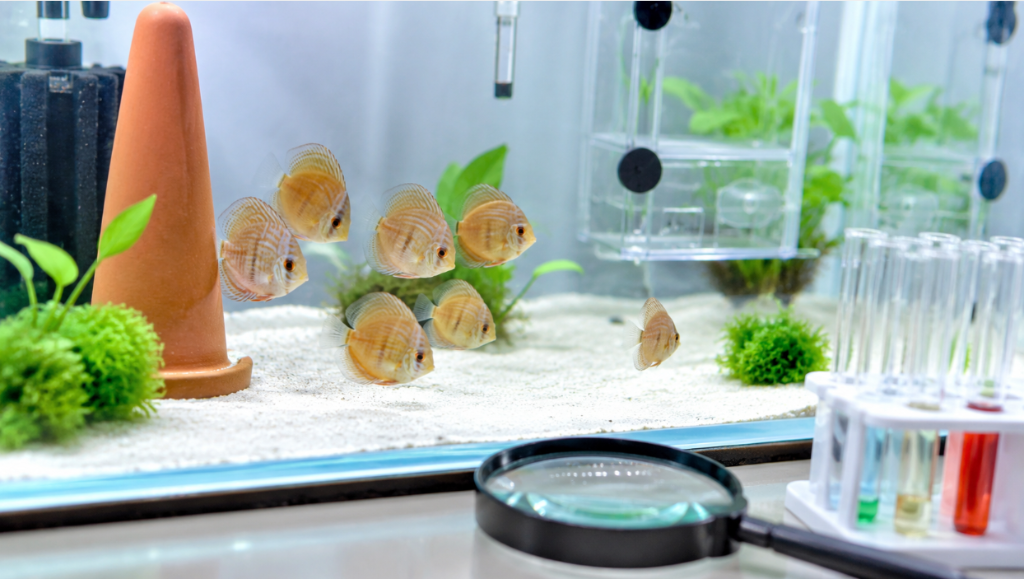
Quick summary
- Fry under 5 cm (2 in) tolerate ~half the adult medication dose and disease progresses 3–4× faster
- An infection that takes 2 weeks in adults can kill a fry in 48–72h
- 7 common conditions: gill flukes, Velvet (Oodinium), Ich, bacterial gill disease, Costia, juvenile Hexamita, stunting
- Copper is toxic to fry under 3 cm (1.2 in) — use heat + salt + darkness instead
- Stunting after month 2 is irreversible — it's a pseudo-disease (genetic + nutritional growth block)
- Prevention > treatment: perfect water + 30–31°C (86–88°F) inhibits ~80% of common pathogens
Common discus fry diseases — juvenile sensitivity
Diseases in discus fry (Symphysodon spp.) in the first 3 months can't be treated the same way as those in adults. Fry under 5 cm (2 in) have immature gills, a partially developed immune system, reduced medication tolerance (half the adult dose) and a disease progression rate 3–4× faster. An infection that would take 2 weeks in adults can kill a fry in 48–72h. The 7 most common conditions: gill flukes (Dactylogyrus — gill parasites, high mortality), Velvet (Oodinium — "rust" on the body, fatal in 3–4 days without treatment), Ich (Ichthyophthirius), bacterial gill disease, Costia (Ichthyobodo — skin parasites), juvenile Hexamita (white feces, food refusal) and stunting (a genetic + nutritional growth block — a pseudo-disease). This guide shows you rapid diagnosis, fry-adapted doses and the prevention protocol.
Why fry are more vulnerable than adults
Critical biological differences:
| Aspect | Fry (under 5 cm / 2 in) | Adults |
|---|---|---|
| Gill surface / volume | Large, sensitive | Normal |
| Immune system | Developing | Mature |
| Protective mucus | Thin | Thick |
| Energy reserve | Minimal | Substantial |
| Medication tolerance | 50% of the adult dose | 100% |
| Disease progression speed | 3–4× fast | Normal |
| Mortality without treatment | 80–100% in 1 week | 40–60% |
Conclusion: in fry, prevention > treatment. Perfect water and a temperature of 30–31°C (86–88°F) inhibit 80% of common pathogens.
Disease #1: Gill Flukes (Dactylogyrus / Gyrodactylus)
The most common parasites in fry — 60% mortality without treatment.
Symptoms (classic in fry)
- Accelerated breathing (gasping at the surface)
- Rubbing against objects (decor, glass)
- Visibly inflamed gills (intense red or discolored)
- Excessive mucus on the gills (a white-gray film)
- Food refusal
- Sudden mortality — fry seemingly OK, then dead within a few hours
Diagnosis
- A 100x microscope → you see the parasites in the gill tissue (classic)
- Or diagnosis through treatment (a rapid response to praziquantel = confirmation)
Treatment — Praziquantel (fry dose)
Fry-adapted doses:
- 2.5 mg/L of water (half the adult dose)
- 2 treatments 7 days apart
- Water at 30–31°C (86–88°F) mandatory
Commercial products:
- Sera Tremazol — 1 drop/4L (half the label dose)
- eSHa gdex — 5 ml/100L (instead of the standard 10 ml)
- JBL Spirohexol Plus 250 — for fry over 3 cm (1.2 in)
14-day protocol:
- A 30% water change beforehand
- A reduced initial dose
- Maximum aeration (dying parasites → oxygen consumption)
- At 7 days: a 50% water change + the second dose
- At 14 days: a 50% water change, observe for 1 week
⚠️ Caution: fry under 2 cm (0.8 in) may not tolerate praziquantel. The alternative: raising the temperature to 32°C (90°F) for 14 days (the parasites don't reproduce), daily 50% water changes.
Disease #2: Velvet (Oodinium)
Fry "rust" — fatal in 3–4 days without treatment.
Symptoms
- A gold/silver dust on the body (visible with a flashlight)
- Intense rubbing against objects
- Food refusal
- Rapid breathing (gills attacked)
- The fry group at the surface (for oxygen)
Treatment — Copper Sulfate (ONLY for fry over 3 cm / 1.2 in)
⚠️ Warning: copper is toxic to fry under 3 cm (1.2 in).
For larger fry:
- JBL Oodinol — 5 ml/100L (the standard dose)
- eSHa Oodinex — per the label
- 5 days of treatment
- Temperature 30°C (86°F) + complete darkness 24/7 (Velvet photosynthesizes)
For small fry (<3 cm / 1.2 in):
- Complete darkness for 14 days
- Temperature 32°C (90°F) (suppresses the parasite)
- Daily 50% water changes
- Salt 1g/L (pure NaCl, no iodine) — a gentle alternative
- Methylene blue 1 drop/10L every 24h
See Oodinium Velvet — full adult treatment.
Disease #3: Ich (White spot)
White spots (1–2 mm) on the body + fins.
Fry treatment (gentler than for adults)
The temperature + salt method (recommended for fry):
- Raise the temperature gradually to 32°C (90°F) over 24h
- Add salt 0.5g/L (in doses, over 3 days)
- Maintain for 14 days
- Daily 50% water changes
The medication method (fry over 4 cm / 1.6 in):
- JBL Punktol Plus 125 — 0.5 ml/10L
- 5 days of treatment
See Ich white spot — treatment.
Disease #4: Bacterial gill disease (fry)
The deadliest disease for fry — 70% mortality without rapid intervention.
Symptoms
- Gasping at the surface (O2 deficit)
- Stuck gills (the opercula don't close normally)
- Dense mucus on the gills
- Rapid mortality (24–48h)
Fry emergency treatment
- A 70% water change immediately
- Maximum aeration (3 air stones)
- External antibiotics for fry:
- eSHa 2000 — the standard dose (gentler)
- JBL Ektol Bac Plus 250 — fry over 3 cm (1.2 in)
- 5 days of treatment
- A 50% water change afterward
⚠️ Caution: gill disease in fry is often secondary to poor water quality. Treatment without improving the environment = recurrence.
Disease #5: Costia (Ichthyobodo)
Fry-specific skin parasites — a white-gray film on the body.
Symptoms
- A dull white-gray film on the body (more visible on the flanks)
- Loss of color
- Rubbing against objects
- Abnormal schooling/grouping
Treatment
For fry:
- Salt 2g/L gradually over 24h (the gentlest option)
- Maintain for 7–10 days
- 30% daily changes with salt-free water (gradual elimination)
Or: A gentle chemical treatment:
- eSHa Exit — a 50% reduced dose
- JBL Punktol — fry over 4 cm (1.6 in)
Disease #6: Juvenile Hexamita
Rarer than in adults, but fatal in fry.
Symptoms
- White, transparent feces
- Sudden food refusal
- Visible wasting (a concave belly)
- Loss of color
Fry treatment
- Metronidazole 200 mg/100L (half the adult dose)
- 10 days, re-dose every 3 days with a 30% water change
- Medicated food with metronidazole (the most effective):
- 250 mg of metronidazole in 50g of food (beef heart mix)
- 5 consecutive days
See Hexamita — full treatment.
Disease #7: STUNTING (a pseudo-disease)
Not an infectious disease — a genetic + nutritional growth block.
Symptoms
- The fry stays small while the siblings grow normally
- A proportionally large head for the body (a classic sign)
- Large eyes relative to the head
- A body that's sharp toward the tail ("pinched")
- Food refusal or feeding with no effect
Causes
- Insufficient nutrition in the first 4 weeks (infrequent meals, little brine shrimp)
- Poor water quality (ammonia, infrequent changes)
- Growth-inhibiting hormones (released by the fry into unchanged water)
- Poor genetics (inbreeding, worn-out lines)
"Treatment" (limited)
⚠️ Stunting after month 2 is IRREVERSIBLE.
Actions:
- Separate from the siblings (food competition)
- Daily 70% water changes (removes the inhibiting hormones)
- Feeding 7–8 meals/day with brine shrimp + fine beef heart
- Temperature 31°C (88°F) maximum
The reality: most "stunted" fry stay small for life. They're not commercially sellable.
Prevention = the only solution: daily 50% water changes, feeding 6 meals/day, high temperatures.
Rapid diagnosis — a fry comparison table
| Symptom | Probable disease | Action |
|---|---|---|
| Gold dust on the body | Velvet | Darkness + salt/copper |
| White spots 1mm | Ich | Temperature 32°C / 90°F |
| Red, inflamed gills | Bacterial gill disease | Antibiotics + aeration |
| Rubbing + rapid breathing | Gill flukes | Praziquantel |
| White-gray film on the skin | Costia | Salt 2g/L |
| White feces + food refusal | Hexamita | Metronidazole |
| Stays small, large head | Stunting | Separation + maximum food |
Prevention — the "zero diseases" protocol for fry
Water (90% of prevention)
- Daily 50% changes (nothing is more important)
- Ammonia strictly 0 ppm (tested daily for the first 4 weeks)
- Temperature 30–31°C (86–88°F) constant
- Maximum aeration 24/7
- A pre-colonized sponge filter (from a mature tank)
See Fry water quality in the first months.
Food (the immune system)
- 5–6 meals/day for the first 4 weeks
- Freshly hatched brine shrimp mostly
- Vitamins on the food (Sera Fishtamin, JBL Atvitol)
- Garlic 2x/week (a natural antiparasitic)
See Daily fry feeding — concrete schedule.
Tank
- Density max 1 fry / 2L (0.5 US gal) (over = stress + disease)
- Bare bottom (hygiene)
- No adult fish in the fry tank (a source of pathogens)
- Quarantine for 4 weeks anything new (decor, plants, other fish)
A medical kit for fry (~€80, an orientation estimate)
Buy from the start (costs vary by country):
- Sera Tremazol (parasites) — ~€12
- JBL Oodinol (Velvet) — ~€15
- eSHa 2000 (antibacterial) — ~€10
- Coarse non-food salt (pure NaCl) — ~€3
- Methylene blue — ~€5
- Metronidazole (250mg capsules) — ~€10
- Seachem Prime (emergency detoxification) — ~€15
- A fry test kit (ammonia, nitrite quick) — ~€15
Total: ~€85 — an investment that saves the whole spawn.
Fatal fry-treatment mistakes (avoid!)
❌ Adult doses in fry → toxicity, mortality ❌ Combined treatments simultaneously → chemical shock ❌ Copper in fry under 3 cm (1.2 in) → certain mortality ❌ Large water changes during treatment (>30%) → dilutes the medication ❌ Stopping treatment at the first signs of improvement → recurrence ❌ "Guesswork" treatments without a diagnosis → wasted money + fry stress
When to call a "fish specialist vet"
Vets who specialize in fish are uncommon and unevenly distributed — in many countries they're concentrated in a few large cities or university veterinary faculties. Search locally and call ahead to confirm they handle ornamental fish before you need them.
Situations:
- Unexplained massive mortality (>20% in 24h)
- Rare, unknown diseases
- Suspected virus (very rare in hatchery-bred fry)
For most cases, the online community + this guide provide enough information.
Conclusion
Diseases in discus fry are rare under optimal conditions (perfect water, good food, moderate density). 95% of fry mortality is caused by poor water quality, not by pathogens. Invest in daily prevention and keep a basic medical kit (~€85, an orientation estimate) for the rare times something does come up.
The golden rule: at the first sign of disease in fry, you treat within 6 hours or you lose the spawn in 48h. Speed > diagnostic perfection.
🛒 See the aquarium treatments available for a fry medical kit.
See also Fry water quality — first months, Daily fry feeding — schedule, Raising the fry (12 weeks), Hexamita HITH, Ich white spot and bacterial gill disease.
Recommended products
Picked from the shop based on what you just read
Recommendations are selected from the discus.ro shop based on this guide's topic. Availability and prices may vary.