Discus growout: how to raise big juveniles without stunting
The first 6–12 months decide a discus's final size. Complete growout guide: large daily water changes, 5–8 feedings a day, 30–31°C, stocking density and the signs of stunting.
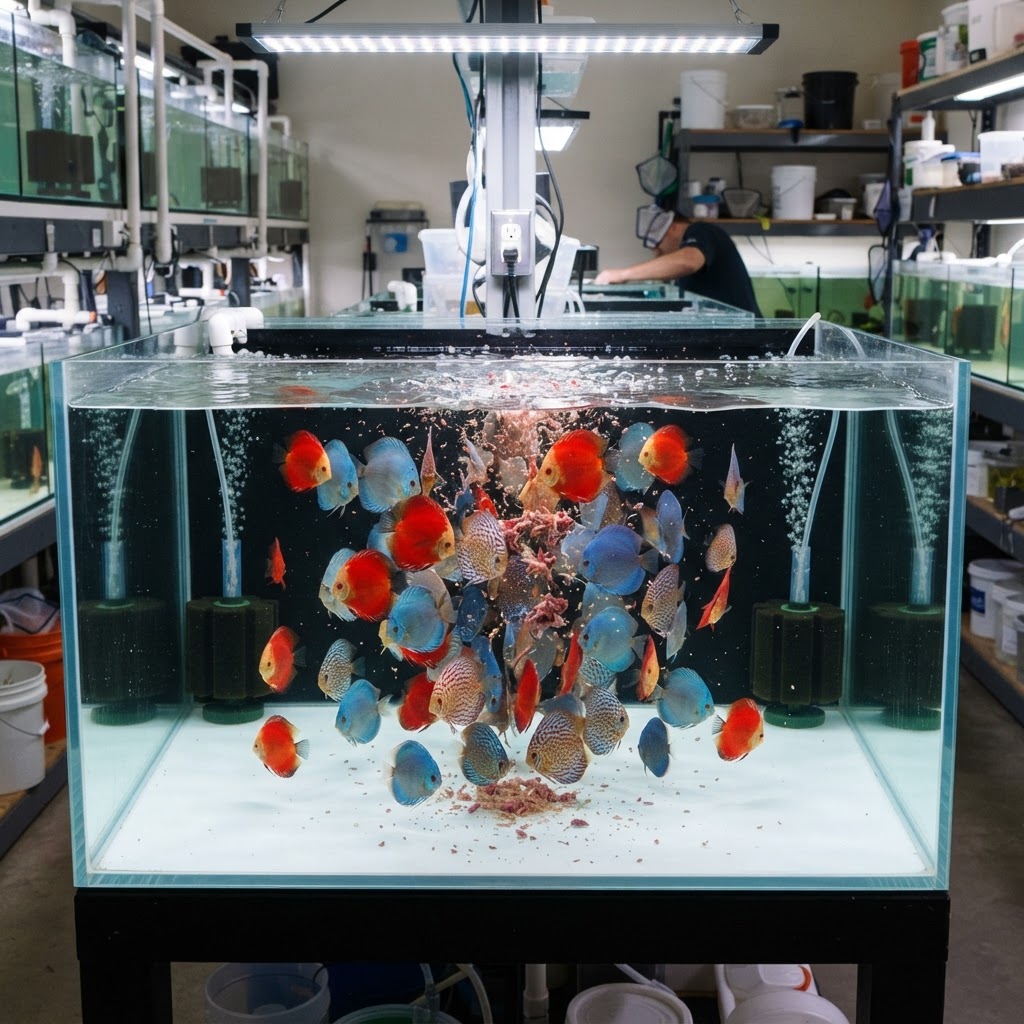
Quick summary
- Final size is decided in the first 6–12 months
- 50–90% water changes DAILY
- Feed 5–8 times a day, small portions
- Temperature 30–31°C during growout
- Bare-bottom tank, siphoned daily
- Stunting is irreversible
In short
- Growout = the period when 3–5 cm fry become 10–12 cm juveniles (about 3–12 months).
- A discus's final size is decided almost entirely during this period.
- The recipe: massive daily water changes + protein-rich food 5–8 times a day + 30–31°C (86–88°F).
- A fry whose growth stalls (stunting) never recovers its size, however well you care for it later.
What you'll learn
- Jack Wattley's experiment and why water matters more than food
- The ideal growout setup
- The daily feeding and water change schedule
- Correct stocking per liter
- How to recognize and prevent stunting
Jack Wattley's experiment
Jack Wattley, one of the pioneers of discus breeding, kept identical batches of fry on the same food and at the same temperature. The only difference: water change frequency. The batch with large daily changes grew visibly bigger and rounder than the one with weekly changes.
The explanation: discus release hormones and substances into the water that inhibit growth at high density. Heavy feeding also produces a lot of nitrate. Only daily dilution lets them reach their genetic potential.
The growout setup
| Element | Recommendation |
|---|---|
| Tank | 150–300 L (40–80 gal), bare bottom |
| Filtration | Sponge filters + canister/sump; moderate flow |
| Temperature | 30–31°C (86–88°F) |
| Light | Moderate, 10–12h; not total darkness |
| Decor | Minimal or none — easy to siphon |
The daily schedule
| Time | Activity |
|---|---|
| 08:00 | Feed (pellets / brine shrimp) |
| 10:00 | Feed beef heart |
| 12:00 | Siphon leftovers + 50% water change |
| 14:00 | Feed |
| 17:00 | Feed beef heart |
| 19:00 | 30–40% change (at high density) |
| 21:00 | Last feeding, small portion |
Water changes: 50–90% daily, at the same temperature and with similar parameters (see storing and preparing water).
Food: beef heart, quality discus pellets, brine shrimp, white worms. Portions they finish in 3–5 minutes; siphon the leftovers.
Correct stocking density
- Fry 3–5 cm: about 1 fry per 4–5 L.
- Juveniles 6–8 cm: 1 per 8–10 L.
- Juveniles 10 cm+: 1 per 15–20 L, then move them to the final tank.
Too many fish = competition for food and inhibiting substances. Too few = fish become shy and eat less. Groups of 10–20 juveniles work best.
Stunting
Main causes:
- Infrequent or insufficient feeding (1–2 meals a day).
- Dirty water, high nitrate, infrequent changes.
- Overcrowding or a tank that's too small.
- Untreated diseases: internal worms, hexamita, flagellates.
- Temperature too low (below 28°C / 82°F) during growout.
Signs:
- Large eyes, out of proportion to the body.
- Large head, elongated rather than round body.
- Small size at 6 months (under 7–8 cm).
- Fins that look too big for the body.
Prevention: follow the schedule above, deworm when needed and sort the fry regularly — the ones falling behind are separated so they aren't outcompeted at feeding time.
Common mistakes
- Moving fry straight into a planted community tank, where frequent feeding and big changes aren't possible.
- Big changes only "when you have time" — consistency matters more than percentage.
- Overfeeding without siphoning → nitrate and bacteria.
- Ignoring white feces or fish that isolate themselves.
Growout checklist
- ☐ Bare-bottom tank, 30–31°C
- ☐ 50–90% water change daily
- ☐ 5–8 meals a day, leftovers siphoned
- ☐ Stocking checked as they grow
- ☐ Monthly sorting by size
- ☐ Monthly photos and measurements
What to do next
📚 Learn more:
- Raising discus fry
- Daily discus fry feeding
- Sorting and culling discus fry
- Common discus fry diseases
- Homemade beef heart recipe
🧮 Calculate:
🛒 Shop: