Conditioning the breeding pair: the complete 28-day protocol
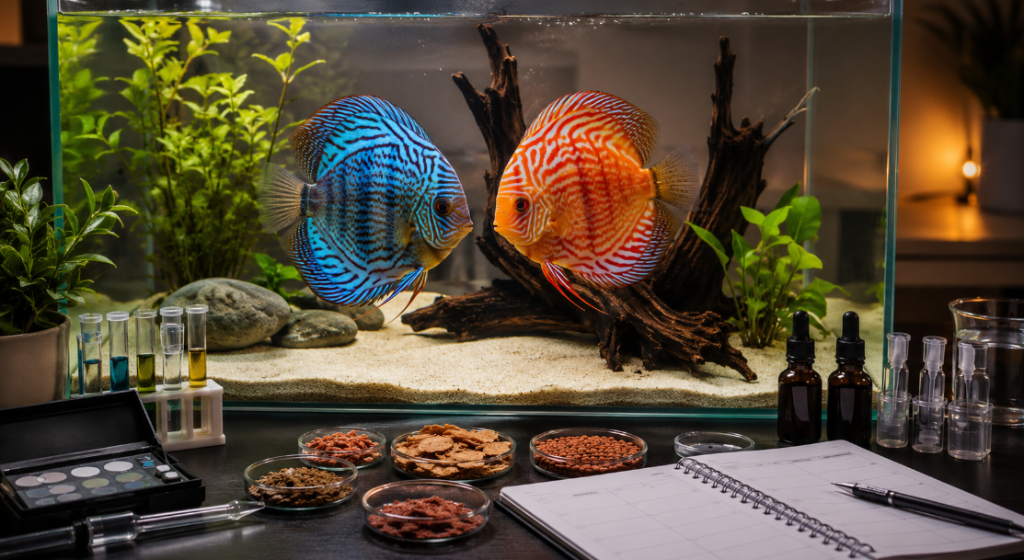
Conditioning a discus pair — a 28-day protocol with a high-protein diet (beef heart + vitamin E + spirulina), simulating the rainy season (gradual TDS drop), plus lighting and temperature to trigger breeding.
Quick summary
- Conditioning = a 28-day protocol that physiologically primes a pair for successful breeding
- Without it: delayed spawns, infertile eggs, weak fry
- Four dimensions: nutrition, water (simulated rainy season), lighting, temperature
- Vitamin E is crucial for fertility — in both male and female
- The golden rule: never more than 0.3 pH units or a 30% water change per day
- Result: the first spawn within 14–21 days of transfer (in ~80% of cases)
Conditioning the breeding pair — the biological preparation
Conditioning the pair before breeding is the 28-day protocol that physiologically and hormonally prepares a discus pair (Symphysodon) for successful breeding. "Conditioning" means bringing them into reproductive form — a multi-dimensional process combining a high-protein diet (fortified beef heart + vitamin E + spirulina), simulating the Amazonian rainy season (a gradual TDS drop, more frequent water changes, a lower pH), and adjusting lighting and temperature. Without correct conditioning: delayed spawns, infertile eggs, weak fry. With it: the first spawn within 14–21 days of moving to the breeding tank, fertilization rates of 90%+, vigorous fry. This guide gives you the protocol week by week.
Why conditioning is necessary
In the natural habitat (the Amazon basin), discus breed seasonally — during the rainy season (December–March in the southern hemisphere), when:
- The water's pH drops (humic acids from fallen leaves)
- TDS drops (rainwater dilutes the mineral concentration)
- The temperature rises slightly (29–31°C / 84–88°F)
- Food becomes abundant (insects, larvae, organic matter)
- Flooding creates new protected areas
In captivity, if you hold parameters constant all year, discus don't get the biological signals that it's breeding season. Conditioning artificially simulates these changes.
The 4 dimensions of conditioning
| Dimension | Goal | Duration |
|---|---|---|
| Nutritional | Building reserves, developing eggs/sperm | 28 days |
| Water (environment) | Simulating the Amazonian rainy season | Weeks 3–4 |
| Lighting | Hormonal photoperiod stimulation | 7–14 days |
| Temperature | Metabolic and reproductive activation | Permanent |
Protocol week 1 — NUTRITIONAL RAMP-UP
Goal: building up quality protein and fats to develop eggs (female) and sperm (male).
Daily diet — 4 meals
| Time | Food | Notes |
|---|---|---|
| 07:00 | Fortified beef heart mix | See the recipe below |
| 11:00 | Live or frozen adult brine shrimp | Rich in carotenoids |
| 15:00 | Beef heart mix + spirulina | Antioxidants + color |
| 19:00 | Bloodworms (1×/week) or mysis | Variety, palatability |
Quantity: eaten within 3 min, but more generously than usual (a slightly fuller belly is OK).
"Conditioning Beef Heart Mix" recipe (300g / ~10.5 oz):
- 200g (7 oz) beef heart fully cleaned of fat and membranes
- 40g (1.4 oz) frozen shrimp, peeled
- 30g (1 oz) fresh spinach, blanched 30 sec
- 15g (0.5 oz) carrot, finely grated
- 5g (0.18 oz) spirulina powder
- 3 vitamin E capsules (400 IU each) — broken open and mixed in
- 2 ml fish oil (omega-3)
- 2 ml fish multivitamins (Sera Fishtamin or JBL Atvitol)
- 3 cloves garlic, crushed (a natural anti-parasitic)
Method: finely chop everything, mix, spread in 5 mm layers on foil, freeze. Use 1× daily for 28 days.
Key supplements:
✅ Vitamin E — CRUCIAL for fertility (both male and female) ✅ Omega-3 — for healthy egg development ✅ Spirulina — antioxidants + intense color (attracts a partner) ✅ Carotenoids (from brine shrimp, krill) — astaxanthin for the gametes
Protocol week 2 — STABILIZE and OBSERVE
Goal: consolidating the diet + watching the initial responses.
Diet: continue identical to week 1.
Key observations:
- The female's belly starts to swell evenly (developing ovaries)
- The male becomes more colorful
- Both become more active, swimming more in the mid water column
- A BIGGER appetite than normal
Water:
- 25% changes every 2 days (more frequent than usual)
- The same parameters as normal maintenance (do NOT change yet)
- Siphon out leftovers after meals — IMPORTANT, an intensive diet = more waste
Red flags (stop if you see): ⚠️ Apathy after 7 days (possibly overfeeding) ⚠️ White or stringy feces (latent parasites triggered) ⚠️ Loss of appetite (stress or disease)
Protocol week 3 — SIMULATING THE RAINY SEASON
Goal: the hormonal trigger through environmental change.
Gradual water changes
Day 15 (start of week 3):
- Water: 80% normal parameters + 20% RO water (lower TDS)
- A 30% water change with this mix
Day 17:
- Water: 70% normal + 30% RO
- A 30% water change
Day 19:
- Water: 60% normal + 40% RO
- A 30% water change
- Add catappa (Indian almond) leaves (1 leaf per 50L / 13 US gal)
Day 21 (end of week 3):
- Water: 50% normal + 50% RO
- Target TDS: lowered by 20–30% versus normal maintenance
- Target pH: lowered by 0.3–0.5 units
- KH: 2–3 dKH (lower)
Target parameters at the end of week 3:
| Parameter | Normal | Final conditioning |
|---|---|---|
| Temperature | 28–29°C (82–84°F) | 30–31°C (86–88°F) |
| pH | 6.5–7.0 | 6.0–6.5 |
| TDS | 200–300 ppm | 100–150 ppm |
| KH | 4–5 dKH | 2–3 dKH |
| GH | 6–8 dGH | 3–5 dGH |
| Tannins | Absent | Moderate (catappa) |
⚠️ THE GOLDEN RULE: never more than 0.3 pH units per day, never more than a 30% water change per day. Gradualness is the key — sudden changes = stress = conditioning halted.
Protocol week 4 — FINAL ACTIVATION and TRANSFER
Goal: consolidating the conditioning and transferring to the breeding tank.
Lighting:
Week 4 — an increasing photoperiod:
- Days 22–24: 8h light / 16h dark
- Days 25–27: 10h light / 14h dark
- Day 28: 12h light / 12h dark
This simulates lengthening days (rainy season = more equatorial light).
Intensity: REDUCED (30% of normal) — discus prefer diffuse light for breeding.
Expected behavior (positive signs):
✅ Female: a visibly swollen belly, the genital papilla starting to show ✅ Male: permanently intense colors, more territorial ✅ Both: a "courtship dance" — swimming side by side, touching ✅ Cleaning surfaces — in the current tank or seeking out a cone/pipe ✅ A significantly increased appetite ✅ Increased activity morning and evening
Day 28 — TRANSFER to the breeding tank:
- Prepare the breeding tank with parameters identical to those at conditioning (day 28)
- Transfer in the morning (the fewest disturbances)
- Use a large container (NOT a small net)
- Drip-acclimate for 30–45 min
- Feed in the morning in the new tank (continuing the diet)
- Darkness for the first 12 hours after transfer
Result: the first spawn within 14–21 days of transfer (in 80% of cases).
Full calendar (28 days)
| Week | Days | Main focus | Key actions |
|---|---|---|---|
| 1 | 1–7 | Diet ramp-up | 4 meals/day, protein + vitamins |
| 2 | 8–14 | Stabilize + observe | Continue the diet, 25% changes every 2 days |
| 3 | 15–21 | Simulate the rainy season | Gradual RO mix, lower TDS/pH/KH |
| 4 | 22–28 | Activation + transfer | Lengthened lighting, transfer to the breeding tank |
Conditioning in a community tank vs separately
Option A — In a community tank (easier, slower):
- Conditioning with other discus present
- Pros: less stress, natural behavior
- Cons: other fish "steal" the special food, parameters are hard to dose
- Duration: 35–42 days (slower)
Option B — In a dedicated conditioning tank (recommended for pros):
- Just the pair, 150–200L (40–53 US gal)
- Pros: full control of diet and parameters, easy observation
- Cons: an extra investment, the pair may be isolated
- Duration: 21–28 days (faster)
Recommended commercial supplements
For effective conditioning, complement the homemade recipes with:
| Product | Role | Dose |
|---|---|---|
| JBL Atvitol | Multivitamins | 2–3 drops/100g food |
| Sera Fishtamin | Breeding stimulation | 1 ml / 100L water, 2×/week |
| Seachem Garlic Guard | Anti-parasitic + appetite | 5 ml / 100g food |
| Tropical Discus Conditioner | Breeding-specific | Per the package |
| Vita-Chem Freshwater | B-complex | 1 ml / 200L, 1×/week |
Supplement cost: roughly €80–150 for one full conditioning session (an orientation estimate — prices vary by country).
Common conditioning mistakes (avoid!)
❌ "I'll just add vitamins, that's enough" — without real protein, vitamins do nothing ❌ Changing parameters over 3–4 days — TOO FAST, induces stress ❌ Overfeeding (>5 meals/day) — overfeeding, water pollution ❌ Conditioning young discus (<14 months) — they don't respond hormonally ❌ Skipping week 3 (the rainy-season simulation) — the biological signals are missing ❌ Beef heart without vitamin E — fertility reduced by 40–60% ❌ 14h+/day of light — excessive lengthening = oxidative stress ❌ "Perfectly clean" water all the time — without tannins, an "anti-breeding" signal
Total estimated conditioning cost
Costs vary widely by country — the figures below are orientation estimates only:
| Category | Cost |
|---|---|
| Fortified beef heart ingredients (28 days) | €30–50 |
| Vitamins + commercial supplements | €80–150 |
| Catappa leaves (~50 pcs) | €8–15 |
| RO water (or an amortized RO filter) | €10–20 / session |
| TOTAL conditioning | €130–235 |
For 2–3 cycles/year = ~€400–700. Quickly recovered from a single successful spawn (50+ fry).
Conditioning success indicators
✅ The female's weight +10–15% (visible) ✅ Vivid colors in both (saturated, increased contrast) ✅ Appetite doubled versus the start ✅ Daily "courtship" behavior (synchronized swimming) ✅ Obsessive cleaning of vertical surfaces ✅ A visible genital papilla (female) — signaling she's ready to spawn ✅ A soft, full belly (female), a toned abdomen (male)
Re-conditioning between spawns
After the first breeding, DO NOT FORCE a new cycle immediately. The pair needs 6–10 weeks of recovery between spawns for long-term health.
Mini-conditioning between spawns (14 days):
- Week 1: a normal diet + Atvitol 3×/week
- Week 2: an intensified diet + water simulation
This allows regular spawns (every 2 months) for 1–2 years without biological exhaustion.
Conclusion
Conditioning turns an ordinary pair into a reproductively optimal one. The 28 days invested in diet, parameters and observation double the success rate of your first spawn compared with a "cold" transfer straight into the breeding tank.
Professional breeders worldwide (Stendker, Wattley, Asian farms) use similar protocols — it isn't optional, it's the standard.
🛒 See food and supplements for healthy fish in the discus.ro shop.
See also Selecting the breeding pair, the breeding tank setup, the breeding process, egg care and incubation and vitamins and supplements for discus.
Recommended products
Picked from the shop based on what you just read

Recommendations are selected from the discus.ro shop based on this guide's topic. Availability and prices may vary.
Frequently asked questions
Put what you just read into practice
One account brings together everything you need to keep your tank on track:
Water parameters, inhabitants, photos and the full history of every change — our most used tool.
Water changes, cleaning and feeding, on your own dates.
See at a glance which values fall outside the safe discus range.
The guides, products and listings you follow, saved in one place.