Selecting the discus breeding pair: 7 criteria and fatal mistakes
How to consciously choose a discus pair for breeding — 7 criteria (age, health, variety, conformation, genetics, behavior, size), avoiding inbreeding and the costly mistakes.
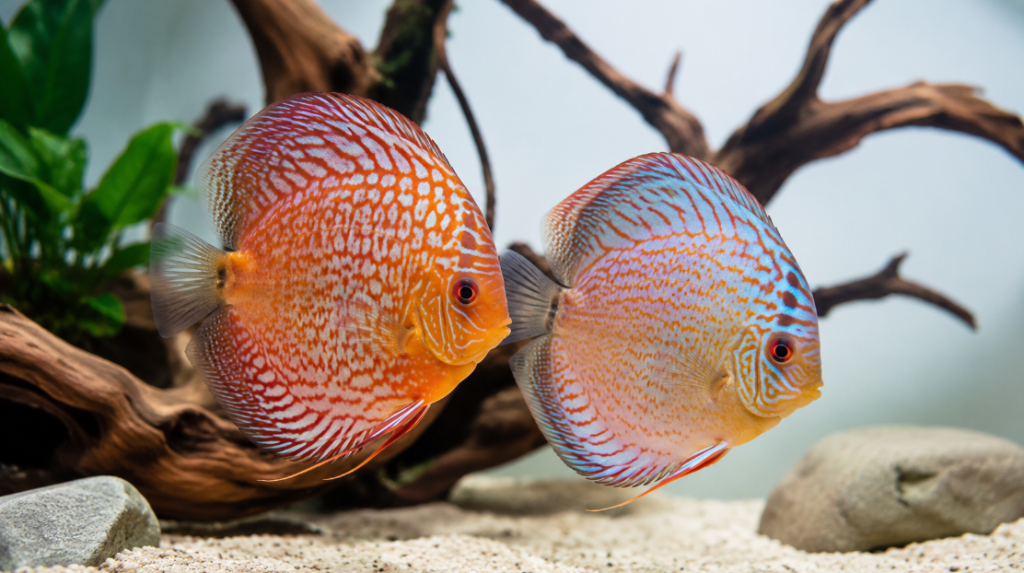
Quick summary
- The pair is the single most important strategic decision — bigger than tank or food
- Optimal first breeding age: 14–18 months, both fish ≥13 cm (5 in)
- Genetic diversity is non-negotiable — NEVER breed siblings (inbreeding)
- Conformation predicts the fry: round body, complete fins, no inherited defects
- Buy 8–12 fry from different lines, raise together, then consciously pick the best pair
- Mandatory 30-day pre-breeding quarantine — stress triggers latent disease
Selecting the breeding pair — the decision that decides everything
Selecting the breeding pair for discus (Symphysodon) is the most important strategic decision a breeder makes — far more important than the tank setup or the food. A poorly chosen pair produces weak fry no matter how well you raise them: deformities, washed-out colors, small size, disease sensitivity. Unlike natural pairing (which is about when and how pairs form), conscious selection means deliberately choosing on objective criteria: optimal age 14–18 months, proven health, genetic diversity (NOT brother-sister — inbreeding), conformation (round shape, complete fins), a compatible variety, breeding behavior and size ≥13 cm (5 in). This guide walks you through the 7 criteria and the fatal mistakes.
Natural selection vs conscious selection
| Aspect | Natural | Conscious |
|---|---|---|
| Who chooses | The discus | The breeder |
| Based on | Mutual affinity | Objective criteria |
| Genetic diversity | Uncontrolled | Guaranteed |
| Fry quality | Variable | Predictable |
| Recommended for | Hobby/beginner | Serious breeders |
The optimal hybrid strategy: buy 8–12 fry from different genetic lines (the 8-12 rule), raise them together, and at maturity consciously select the pair with the best traits — instead of accepting the first pair that forms.
Criterion #1: Age and sexual maturity
Optimal: 14–18 months at first breeding.
| Age | Status | Recommendation |
|---|---|---|
| <10 months | Sexually immature | Do NOT use |
| 10–13 months | Maturing | Possible, but low rates |
| 14–18 months | Optimal maturity | OPTIMAL |
| 18–24 months | Reproductive peak | Excellent |
| 2–4 years | Stable reproductive | Very good |
| 4–6 years | In decline | Acceptable |
| >6 years | Senescent | Avoid |
Why it matters:
- Under 14 months: poor egg quality, low fertilization rates, infertile males
- Reproductive peak: 18 months – 3 years (the best fry quality)
- Females spawn up to 5–6 years, males stay fertile up to 7–8 years
Key indicator: adult size — a perfect pair only after both reach a minimum of 13 cm (5 in) and have spent 6 months stabilized at that size.
Criterion #2: Health history (3+ months)
Never breed a discus that has had recent problems.
Mandatory checklist — both fish:
✅ 3 months free of medical treatments (antibiotics, antiparasitics) ✅ Consistent appetite — eats vigorously at every meal ✅ Normal feces — brown/orange, formed (NOT white, NOT stringy) ✅ Pale-pink gills — no inflammation ✅ Clear eyes — no cloudiness ✅ Complete fins — no tears or erosion ✅ Normal weight — neither too thin (a prominent forehead) nor obese ✅ Alert behavior — not hiding, not lethargic
Why it matters:
- Breeding stress triggers latent disease (Hexamita, gill flukes)
- Weak fry from parents with a compromised immune system
- Risk of passing infection to fry through the parental mucus
Mandatory pre-breeding quarantine: a minimum of 30 days in a dedicated tank, watching them closely before moving them to the breeding tank.
Criterion #3: Physical conformation
The body shape predicts the fry's shape.
The ideal male:
- Round body — not elongated, not pinched
- A slightly domed forehead (but not deformed)
- Complete dorsal and anal fins — no tears, no asymmetry
- A wide, fan-shaped tail
- Proportional eyes — not too large (a sign of deformity/stunting)
- Size ≥14 cm (5.5 in)
The ideal female:
- Round-oval body — perfect "coin" shape
- A slightly swollen belly (developed ovaries)
- The same fin criteria as the male
- Size ≥13 cm (5 in)
Defects that ARE GENETICALLY INHERITED (avoid!):
❌ A "spiky" tail (asymmetric, split) ❌ A short/atrophied dorsal fin ❌ An exaggerated lower lip ❌ "Eyes too big" syndrome — disproportionately large eyes (a stunting sign) ❌ An elongated body (a sign of hybridization with another species) ❌ Permanently visible gills (an opercular deformity)
Criterion #4: Variety and genetic compatibility
Two different strategic situations:
A) Pure breeding (preserving the genetic line)
Goal: fry identical to the parents (a stable variety).
Rules:
- Both parents from the same variety (e.g. Pigeon Blood × Pigeon Blood)
- Preferably: different lines of the same variety (avoids inbreeding)
- Check 3 generations back if possible (verified breeders)
Recommended varieties for beginners:
- Red Turquoise × Red Turquoise
- Pigeon Blood × Pigeon Blood
- Blue Diamond × Blue Diamond
B) Hybrid breeding (creating new varieties)
Goal: new color combinations, but unpredictable results.
Known combinations that work:
| Male | × Female | Likely result |
|---|---|---|
| Red Turquoise | Pigeon Blood | Red Turquoise Pigeon |
| Blue Diamond | Red Melon | Blue Melon (variable) |
| Snake Skin | Leopard | Mixed patterns |
Combinations to AVOID: ❌ Wild (Heckel/Altum) × Domestic — weak, sterile fry ❌ Albino × Albino — frequent eye problems ❌ Snow × Snow — extreme albinism, light-sensitive
Criterion #5: Genetic diversity (anti-inbreeding)
The biggest beginner mistake: using siblings for breeding.
Why it's disastrous:
- Deformed fry in 30–50% of cases
- Sterility in later generations
- Dramatically increased disease sensitivity
- Juvenile mortality of 60–80%
- Reduced colors and size
How to avoid it:
- Buy fry from 2+ different sources (different breeders)
- Ask the breeder about the genetic lines
- Buy 4–5 from different batches for a group of 8–12
- Keep your own pedigree records (a notebook/spreadsheet)
The F1 rule (first generation): the first fry from a pair can be raised, but do NOT breed them with each other. Swap a line with another breeder for F2.
Criterion #6: Breeding behavior
Not every mature discus wants to breed.
Positive signs (select):
✅ Spontaneous cleaning of vertical surfaces (walls, decor) ✅ A visible courtship dance — even with no partner present ✅ Moderate territoriality — defends an area in the tank ✅ Intense colors when another is nearby ✅ Interest in the cone/pipe — explores it frequently
Negative signs (avoid):
❌ Hyper-aggression — attacks any fish, including the future partner ❌ Total passivity — doesn't react to stimuli ❌ Constant refusal to pair with multiple partners (may be infertile) ❌ Repeatedly eats the eggs over 3+ spawns (a confirmed egg-eater)
Criterion #7: Size and the male-to-female ratio
The 10% rule: the male at most 10% larger than the female.
| Male | Optimal female |
|---|---|
| 14 cm (5.5 in) | 12.5–14 cm (5–5.5 in) |
| 16 cm (6.3 in) | 14.5–16 cm (5.7–6.3 in) |
| 18 cm (7 in) | 16–18 cm (6.3–7 in) |
Why it matters:
- A male too large → intimidates the female, she refuses to pair
- A male too small → the female attacks him, possibly fatally
- A big difference → poor egg quality
Undersized fish: smaller than 12 cm (4.7 in) = do NOT use for breeding regardless of age.
The 7 FATAL selection mistakes
- ❌ "They're from the same batch, so they're surely healthy" — siblings = guaranteed inbreeding
- ❌ "They laid eggs in the community tank, so it's a good pair" — behavior doesn't guarantee genetic quality
- ❌ Buying a "formed pair" with no pedigree — often siblings raised together
- ❌ "They're small but young, they'll grow" — fry under 12 cm (4.7 in) = permanent stunting
- ❌ Test breeding at 8–10 months — wears them out biologically, weak fry
- ❌ Ignoring "minor" physical defects — ALL of them are inherited
- ❌ Never quarantining before breeding — latent disease triggered by stress
Cost estimate — a quality pair (Romania estimate, 2026)
Costs vary widely by country and supplier — the figures below are a Romania estimate (2026), for orientation only.
| Source | Pair cost (approx. EUR, RO estimate) | Genetic quality |
|---|---|---|
| Generic pet shop | €20–55 | Unknown/poor |
| Beginner local breeder | €75–150 | Variable |
| Verified local breeder | €150–375 | Good |
| Premium EU breeder (Stendker, Forrest) | €375–1,100 | Excellent, with pedigree |
| Wild import (Heckel/Altum) | €565–1,500 | Wild genetics |
Beginner recommendation: buy 8–12 fry (3–5 cm / 1.2–2 in) from 2–3 different verified breeders. Total cost: approx. €280–660 (RO estimate). You'll have multiple pairing options at maturity, with no inbreeding risk.
Final pair-selection checklist
✅ Both ≥13 cm (5 in), age 14–18 months minimum ✅ 30+ days of quarantine, symptom-free ✅ From different genetic lines (NOT siblings) ✅ Flawless conformation (round body, complete fins) ✅ Documented health: appetite, feces, gills ✅ Breeding behavior present (cleaning, dancing) ✅ Variety compatibility (pure OR a strategic hybrid) ✅ Male/female size ratio within the 10% range ✅ Known or likely pedigree (3 generations back) ✅ A verified source breeder (reviews, transparency)
Conclusion
Conscious pair selection can double the success rate of your first breeding attempt — from 30–40% (random natural pairing) to 70–85% (criteria-based selection). The investment in a good pair (approx. €280–565 for quality genetic lines, RO estimate) is recovered in 2–3 successful spawns (50–100 sellable fry).
Don't economize on the pair — the rest of the equipment can be upgraded over time, but genetics can't be changed.
🛒 See the verified breeders on discus.ro in the Breeders section — all with known pedigrees and documented genetic lines.
See also how discus pairs form, sexing discus, conditioning the pair before breeding and the breeding tank setup.
Recommended products
Picked from the shop based on what you just read
Recommendations are selected from the discus.ro shop based on this guide's topic. Availability and prices may vary.