White discus eggs: 5 causes and treatment (Saprolegnia, infertility)
White discus eggs indicate dead, unfertilized or Saprolegnia-infected eggs. A guide with 5 causes (infertility, fungus, wrong parameters, young pairs, stress), diagnosis and step-by-step treatment with methylene blue.
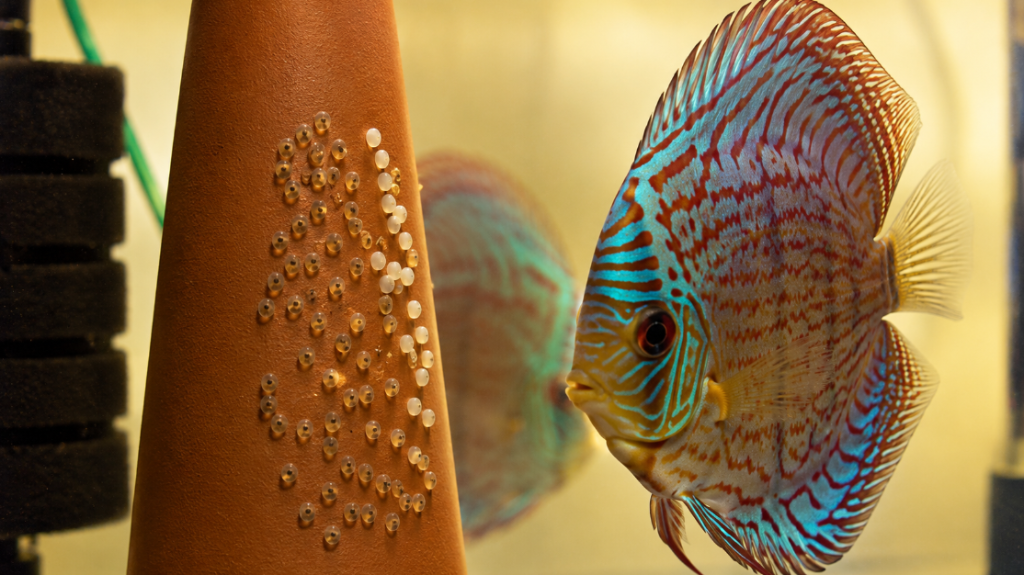
Quick summary
- Healthy eggs = translucent yellow-orange; white/opaque eggs = DEAD
- 2–10% white eggs in a spawn = normal (the parents eat them)
- Over 50% white eggs within 24h = a PROBLEM — urgent diagnosis
- 5 main causes: (1) lack of fertilization, (2) Saprolegnia fungus, (3) wrong parameters, (4) young pairs, (5) stress
- A sure test for fungus: white-gray woolly threads grow from the eggs (mold)
- Treatment: methylene blue 0.5–1 ppm or separating the eggs into an artificial incubator
- Young pairs (first 3–5 spawns): 60–80% turning white is normal — persevere
- Two 'paired' females: 100% white eggs consistently — see how pairs form
In short
- Healthy eggs = translucent yellow-orange; white/opaque eggs = DEAD.
- 2–10% white eggs in a spawn = normal (the parents eat them).
- Over 50% white eggs within 24h = a PROBLEM — urgent diagnosis.
- 5 main causes: (1) lack of fertilization, (2) Saprolegnia fungus, (3) wrong parameters, (4) young pairs, (5) stress.
- A sure test for fungus: white-gray woolly threads appear from the eggs (mold).
- Treatment: methylene blue 0.5–1 ppm or separating the eggs into an artificial incubator.
- Young pairs (first 3–5 spawns): 60–80% turning white is normal — persevere.
- Two 'paired' females: 100% white eggs consistently — see How pairs form.
What you'll learn
White discus eggs (Symphysodon) are one of the most frustrating experiences for beginner breeders. After weeks of prep, the pair lays a beautiful 150–250 yellow-orange eggs — and within 24 hours it's a disaster: all the eggs turn white, opaque or covered with white-gray mold. What happened? There are 5 main causes, each with a specific solution: unfertilized eggs (an immature, infertile male or a "pair" of 2 females), Saprolegnia fungus (the most common — mold that spreads fast), incorrect water parameters (pH above 7.0, TDS too high, temperature below 29°C / 84°F reduce fertilization), young pairs (a low success rate in the first 3–5 spawns — normal!) and stress (lights, disturbances, other visible fish, water changes during incubation). This guide shows you step-by-step diagnosis, methylene blue treatment and long-term strategies for viable eggs.
What healthy vs dead eggs look like
Healthy eggs (fertilized, developing)
✅ Color: translucent yellow-orange ✅ Shape: perfectly round ✅ Adhesion: firmly stuck to the surface ✅ Layout: uniform parallel rows ✅ Visible development: at 24–36h black dots appear (the embryos' eyes) ✅ At 48h: you can see the embryo inside with a dim LED flashlight
Dead eggs (white/opaque)
❌ Color: opaque white, blue-gray, beige ❌ Shape: round but "cloudy" ❌ Adhesion: sometimes detach easily ❌ No visible internal development ❌ No black dots at 24h
Eggs with fungus (Saprolegnia)
❌ A "woolly" white-gray look ❌ Threads that spread toward other eggs ❌ Fast spread (within 12–24h) ❌ Attacks the dead eggs first, then spreads to the live ones
Cause #1: Unfertilized eggs
How to recognize it
- ALL eggs white within 12–24h after spawning
- Uniform whitening (not just a few)
- An opaque white or gray-beige look
- Repeats at every consecutive spawn
Why it happens
Cause A: An immature or infertile male
- A male under 12–14 months → insufficient/immature sperm
- A chronically stressed male → reduced sperm production
- A male with a genetic deficiency (rare, but possible)
Solution: wait 2–3 spawns (he may mature), or replace the male.
Cause B: The "pair" is actually 2 females
This is the most common hidden reason! In ~30% of "pairs" bought ready-formed, they're actually 2 females that:
- Have formed a "pair" for surface cleaning and protection
- Both lay eggs (sometimes on different days)
- ALL eggs are infertile = white within 24h
Diagnosis:
- 3–5 consecutive spawns, ALL 100% white
- No egg with development (black dots at 24h)
- "Perfect" pair behavior, but no result
Solution: see our guides on How pairs form and Sexing discus. Replace one with a confirmed male.
Cause C: The male doesn't fertilize correctly
- Too much distance between the laying female and the following male
- A too-hesitant male (new pairs)
- A water current carrying the sperm in the wrong direction
Solution: reduce filtration during spawning (5–10 min), ensure the pair stays close.
Cause #2: Saprolegnia fungus (the white mold)
What it is
Saprolegnia spp. is an opportunistic aquatic fungus, present in any aquarium. It attacks the dead/unfertilized eggs FIRST, but if it isn't stopped, it spreads to healthy eggs too.
How to recognize it
- Woolly white-gray threads growing from the eggs
- A "star-shaped" spread from one point
- A look like "wet cotton wool", white-gray
- A faint moldy smell if you open the lid
Factors that favor it
- ⚠️ A temperature below 28°C (82°F)
- ⚠️ pH above 7.0
- ⚠️ High KH (above 6 dKH)
- ⚠️ Poor oxygenation
- ⚠️ Poor tank hygiene
- ⚠️ Dead eggs left in place
- ⚠️ Parents that abandon the spawn
Treatment with methylene blue
THE STANDARD METHOD:
- Buy methylene blue (Sera Mycopur, JBL Fungol Plus, or pure methylene blue from a veterinary pharmacy)
- Dose: 0.5–1 ppm (usually 1 ml of 1% solution per 100L / 26 US gal of water)
- Application:
- Directly in the tank (if the pair is actively caring) → ONLY 0.5 ppm
- In a separate incubation tank → 1–2 ppm
- Re-application: at 24h if the infection continues
- DO NOT change the water in the first 48h after application
⚠️ Caution: methylene blue can stress the parents, who sense the blue-colored water and abandon the spawn. Use sparingly when the pair is actively caring.
Saprolegnia prevention
✅ A constant 30°C (86°F) ✅ pH 6.0–6.5 ✅ Catappa (Indian almond) leaves (natural antifungal tannins) — 1 leaf per 50L / 13 US gal ✅ Perfect hygiene (bare-bottom, daily siphoning) ✅ A UV sterilizer if you have one (optional)
Cause #3: Wrong water parameters
Optimal parameters for fertilization/incubation
| Parameter | Value | Importance |
|---|---|---|
| Temperature | 30–31°C (86–88°F) | Critical |
| pH | 6.0–6.5 | Critical |
| KH | 1–3 dKH | Critical (see KH and GH) |
| GH | 2–5 dGH | Important |
| TDS | 80–150 ppm | Critical |
| Ammonia | 0 ppm | Mandatory |
| Nitrite | 0 ppm | Mandatory |
| Oxygen | >6 mg/L | Important |
Common causes of wrong parameters
pH above 7.0
- Reduces fertilization to below 30%
- Causes: alkaline tap water, calcareous decor, no catappa leaves
- Solution: RO water + minimal remineralization, catappa leaves — see blackwater
TDS above 250 ppm
- Osmotic stress on the eggs
- Reduced permeability of the egg shell
- Solution: RO water + remineralization to TDS 100–150 — see reverse osmosis
Temperature below 29°C (84°F)
- Prolonged hatching (over 72h) → increased fungal risk
- Slowed embryonic development
- Solution: 2 heaters with a ±0.5°C (±1°F) thermostat
A quick diagnostic test
If 30–60% of the eggs turn white at 24h with the rest healthy = the problem is parameters. Check all values, adjust gradually, try at the next spawn.
Cause #4: Young pairs
Success rate by pair age
| Pair's age | Normal whitening | Success rate |
|---|---|---|
| First spawn | 70–90% white | ~10–30% survival |
| Spawn 2–3 | 40–60% white | 30–50% survival |
| Spawn 4–5 | 20–40% white | 50–70% survival |
| Spawn 6+ | 10–20% white | 70–90% survival |
Why it's normal
- The female: lays inexperienced, genetically weak eggs
- The male: imperfect fertilization timing
- Both: deficient egg care
- Progressive learning: each spawn refines their skills
What you do
✅ Maximum patience at the first 5 spawns ✅ DO NOT change the pair just because the first one failed ✅ Continue conditioning — see Conditioning, 28 days ✅ Optimize parameters at every spawn ✅ Note what works (a breeding journal)
❌ DO NOT use methylene blue prophylactically at the first spawns → added stress ❌ DO NOT separate the pair for a break — it risks not reforming
Cause #5: Stress during incubation
Common sources of stress
⚠️ Bright lights or sudden on/off ⚠️ Movement in the room (people, pets, children) ⚠️ Other visible fish through the glass ⚠️ Vibrations (noisy filters, washing machines nearby) ⚠️ Sudden parameter changes (cold water, KH suddenly changed) ⚠️ Overfeeding that disturbs the pair ⚠️ Reflections in the tank glass
How it shows
The parents abandon care → insufficient fanning → dead eggs → fast fungus.
Solutions
✅ An isolated breeding tank in a quiet room ✅ Dim ambient lighting 24/7 (a 5W blue LED) ✅ Bottom and walls covered with black film (3 walls + the bottom) ✅ Sponge filtration (silent) — see filtration ✅ Minimal access to the room on days 0–5 ✅ Temporarily cover neighboring tanks with film
Step-by-step diagnosis
Question 1: What percentage of eggs turn white?
- 0–10% → NORMAL, nothing to do
- 10–40% → possibly parameters, check TDS/pH/temp
- 40–80% → young pairs OR parameters OR stress
- 80–100% → infertility (check sex) OR fast fungus
Question 2: When do they appear?
- Immediately (0–6h) → lack of fertilization
- 6–24h → partial infertility OR incipient fungus
- 24–48h → fungus OR stress
- After 48h with visible black dots → embryonic mortality (parameters)
Question 3: How many consecutive spawns?
- Only the first → young pairs, persevere
- 2–3 consecutive with a similar result → optimize parameters
- 5+ consecutive 100% white → check the pair's sex!
Treatment — full protocol
For eggs with fungus appearing (tank with parents)
- Add 1 fresh catappa leaf per 50L (13 US gal)
- Methylene blue 0.5 ppm (only if the pair doesn't react negatively)
- Check the temperature is a strict 30°C (86°F)
- Reduce the lighting to minimum
- DO NOT change the water until they hatch or are abandoned
For artificial raising (Plan B)
If you want to try saving the eggs:
- Move the cone/surface with eggs to a 5–10L (1.3–2.6 US gal) container with tank water
- Light aeration with a fine air stone
- Methylene blue 1–2 ppm
- A temperature of 30°C (86°F)
- Change 50% of the water daily with identical water
- Manually remove the white eggs with fine tweezers
- On hatching → see artificial fry raising
Common mistakes
❌ Giving up after the first failed spawn → normal in young pairs.
❌ Changing the water during incubation → massive stress, spawn abandoned.
❌ Using methylene blue prophylactically → stressed parents, abandonment.
❌ Ignoring the parameters thinking "the pair knows what it's doing" → fertile eggs incompatible with the water.
❌ Buying "another pair" after 2 failures without checking sex → a 30% chance of another 2-female pair.
❌ Feeding the pair on days 0–2 → food leftovers contaminate the eggs.
Treatment costs
The figures below are an approximate RO estimate in EUR and vary widely by country — treat as orientation only:
| Item | Cost (RO estimate) |
|---|---|
| Methylene blue (Sera Mycopur 100ml) | €7–9 |
| Catappa leaves (10 pcs) | €4–6 |
| Water tests (full set) | €19–28 |
| RO water + remineralizers (month 1) | €15–23 |
| TOTAL | €45–66 |
Final checklist — viable eggs
- ☐ A pair over 14 months old
- ☐ Sex confirmed (male + female) — not 2 females
- ☐ A 28-day conditioning completed
- ☐ Parameters: 30°C (86°F), pH 6.5, TDS 100, KH 2 dKH
- ☐ RO water + light remineralization
- ☐ Active catappa leaves (1 per 50L / 13 US gal)
- ☐ An isolated tank, quiet, minimal lighting
- ☐ Lid closed, walls covered
- ☐ NO water changes on days 0–2
- ☐ Methylene blue ready for a quick intervention
What to do next
📚 Continue learning:
- How pairs form — the natural method
- Sexing discus — 5 methods — to check for 2 females
- The breeding process — 6 phases
- Breeding tank — setup — tank prep
- Conditioning, 28 days — biological prep
- Parents eating the eggs — another failure cause
- Egg care — incubation — technical details
- Artificial fry raising — Plan B
🔧 Practical resources:
- Methylene blue + catappa leaves — shop — for quick interventions
- RO water + remineralization — shop — for stable parameters
- Full water tests — shop — precise diagnosis
- Verified breeders — real-time advice
🐠 Final tip: Don't get discouraged. 80% of experienced breeders lost their first 5–10 spawns. Discus breeding is a learned art — every failed spawn teaches you a lesson. Note in your journal: parameters, behavior, what you changed. By the 5th–10th attempt, you'll have stable breeding and 2 spawns/month for 3–5 years.
Recommended products
Picked from the shop based on what you just read

Recommendations are selected from the discus.ro shop based on this guide's topic. Availability and prices may vary.
Frequently asked questions
Put what you just read into practice
One account brings together everything you need to keep your tank on track:
Water parameters, inhabitants, photos and the full history of every change — our most used tool.
Water changes, cleaning and feeding, on your own dates.
See at a glance which values fall outside the safe discus range.
The guides, products and listings you follow, saved in one place.