Sexing discus: 5 methods for male vs female
Sexing discus (Symphysodon) is notoriously difficult — they have no obvious sexual dimorphism. A guide with 5 methods (genital papilla, head shape, fins, size, behavior), success rates of 60–99% and a comparison table.
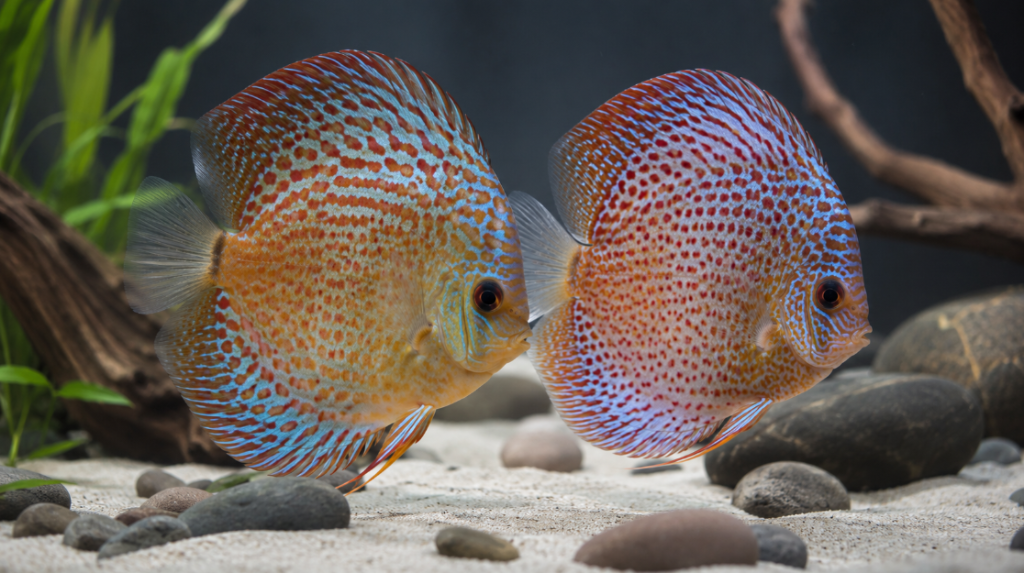
Quick summary
- Discus have NO obvious sexual dimorphism — males and females look almost identical until maturity
- Sexual maturity: 12–18 months, over 12 cm (4.7 in); below that, sexing is impossible
- Method #1 (99%): the genital papilla — visible only 24–48h before spawning
- Method #2 (60%): head shape — a domed forehead in males, straighter in females
- Method #3: pointed dorsal/anal fins (male) vs rounded (female)
- The safest strategy: raise 8–12 juveniles together → pairs form on their own
In short
- Discus have NO obvious sexual dimorphism — males and females look almost identical until maturity.
- Sexual maturity: 12–18 months, over 12 cm (4.7 in). Below that size, sexing is impossible.
- Method #1 (99%): the genital papilla — visible only 24–48h before spawning.
- Method #2 (60%): head shape — a domed forehead in the male, straighter in the female.
- Method #3: pointed dorsal/anal fins (male) vs rounded (female).
- The safest strategy: raise 8–12 juveniles together → pairs form on their own.
- Combining all the clues: ~90% accuracy.
What you'll learn
Sexing discus (Symphysodon) is one of the most frustrating questions for beginner keepers. Unlike other cichlids such as Pterophyllum scalare (angelfish) or Apistogramma spp., discus show no obvious sexual dimorphism — there are no different colors, clearly distinct sizes or unique behaviors that immediately tell you the fish's sex. Mix-ups are common even among keepers with 10+ years of experience, and "pairs" sold on the market often turn out to be 2 males or 2 females. The good news: with the right combination of 5 methods — the genital papilla (99% accurate when visible), head shape (60%), the fins, body size and behavior — you can sex correctly in 80–90% of cases. This guide walks through every method with a comparison table, realistic success rates and the "let them decide" strategy that's the surest way to end up with a breeding pair.
Method #1: The genital papilla (the definitive one)
The surest method — but visible only just before/during spawning. The genital papilla is the small tube that releases eggs (female) or sperm (male), and it appears 24–48 hours before spawning.
In the female
| Aspect | Detail |
|---|---|
| Shape | Short, thick, blunt |
| Size | 3–5 mm |
| Tip | Rounded |
| Color | Pale pink / white |
| Analogy | "A short, thick tube" |
In the male
| Aspect | Detail |
|---|---|
| Shape | Long, thin, pointed |
| Size | 2–3 mm |
| Tip | Narrow |
| Color | White, transparent |
| Analogy | "A fine needle" |
When to look:
- When the pair cleans a surface (a ceramic cone, a leaf, the glass)
- 1–2 hours before spawning (most visible)
- With a side-mounted flashlight for good contrast
⚠️ Outside the breeding window, the papilla is retracted and not visible in either sex.
Method #2: Head shape (60% accuracy)
With experience, the forehead shape gives clues. Not 100% reliable, but useful combined with other methods.
In the male
- A more domed, pronounced forehead
- A more massive, rounded head
- The lower lip sometimes slightly protruding
- In Turquoise, Red Melon, Pigeon Blood varieties the difference is more visible
In the female
- A smoother, straighter forehead
- A more elegant, delicate head
- A generally rounder body shape
⚠️ There are females with a domed forehead and males with a straight one. Use this alongside other clues.
Method #3: The dorsal and anal fins
In the male
- The rear dorsal fin (the back portion) is pointed and elongated
- A long, pointed anal fin
- Both with a "filamentous" tip
In the female
- Rounded dorsal and anal fins, shorter
- A generally more "harmonious" look
How to observe: compare mature discus pairs side by side (over 14–16 cm / 5.5–6.3 in). The differences become obvious only in adults. For fry under 12 cm (4.7 in), this method doesn't work.
Method #4: Body shape
In the male
- 1–3 cm (0.4–1.2 in) larger at maturity
- A broader, more muscular body
- A slightly "square" shape
In the female
- 1–3 cm (0.4–1.2 in) smaller
- A rounder body, more graceful
- A slightly more swollen belly (ovaries)
⚠️ A small male can look like a large female. Size isn't reliable on its own — it requires knowing the genetic line.
Method #5: Behavior (the easiest)
Typical male behavior
- More aggressive toward other males
- Courts the females — dancing, display
- Marked territoriality
- More intense colors during the breeding period
Typical female behavior
- More timid, tends to retreat
- Cleans the spawning site more persistently
- A swollen belly 1–2 days before ovulation
- Accepts the male after courtship
Practical notes
You can't sex fry under 12 cm (4.7 in)
Below that size, the differences are almost invisible. Wait 12–18 months for reliable sexing. See our guide on selecting the breeding pair for the complete maturity criteria.
The "let them decide" method (the safest)
The globally recommended strategy:
- Buy 8–12 discus fry from the same generation
- Raise them together for 14–18 months
- Pairs form on their own through natural affinity
- When you see a pair cleaning a surface, you know exactly which is male and which is female
See how discus pairs form for the detailed process.
Sexing "high bred" varieties
In modern varieties like ghost, snow, red melon, white butterfly, the visual differences are even harder to see — they were genetically selected for appearance, not for dimorphism. Focus on the genital papilla and behavior.
What does NOT work (myths)
❌ "The vertical stress bars" — both sexes show them under stress. ❌ "The bluish spots" — appear in both sexes. ❌ "Eye size" — a myth, there's no real difference. ❌ "The number of vertical bars" — varies with the variety, not the sex. ❌ "Flashlight examination of the vent" — without sexual maturity, you see nothing.
Quick comparison table
| Trait | Male | Female |
|---|---|---|
| Genital papilla | Narrow, pointed | Thick, blunt |
| Forehead | Domed | Straighter |
| Rear dorsal fin | Pointed | Rounded |
| Anal fin | Long, pointed | Shorter |
| Size | +1–3 cm (0.4–1.2 in) | Smaller |
| Body | Broad, masculine | Round, elegant |
| Behavior | Courts, aggressive | Timid, accepts |
Success rates — honestly
| Method | Accuracy |
|---|---|
| Genital papilla (when visible) | ~99% |
| Head shape | ~60% |
| Fins + size | ~70% |
| Behavior at maturity | ~85% |
| All clues combined | ~90% |
| Waiting for a pair to form (8–12 fry) | ~100% |
Common mistakes
❌ Buying a "pair" from an unknown shop/breeder → a 40% chance it's 2 males or 2 females.
❌ Sexing juveniles (8–10 cm / 3–4 in) → impossible, the clues only appear at maturity.
❌ Relying on a single clue → a common error. Combine at least 3 methods.
❌ Ignoring behavior → the most reliable indicator for mature pairs.
❌ Forcing 2 "chosen" fish together → discus can't be made to pair. See how discus pairs form.
What to do if you're not sure
- Buy a formed "pair" from verified breeders in the discus.ro directory — higher cost, but a sure thing.
- Raise a large group (8+ fry) and wait for a pair to form naturally.
- Consult experienced keepers with photos/video — in our community.
- Patience — time resolves most uncertainties.
Final checklist — correct sexing
- ☐ The fish are over 12 cm (4.7 in) (minimum 12–18 months)
- ☐ Genital papilla observed (during the spawning window)
- ☐ Head shape compared (a domed forehead = male)
- ☐ Fins checked (pointed = male, rounded = female)
- ☐ Behavior observed for 2+ weeks
- ☐ At least 3 clues combined
- ☐ Confirmed with an experienced breeder (photos/video)
Did you know?
Discus are one of the harder common aquarium fish to sex precisely because, unlike many cichlids, they show no reliable external sexual dimorphism outside the breeding window — which is exactly why experienced breeders lean on the "raise a group and let pairs form" approach rather than trying to pick a male and a female by eye. The genital papilla is the one near-certain visual sign, but it only everts for a day or two around spawning, so even a 99% method is useless most of the year. This is also why two females can bond and "spawn" together, producing only infertile (white) eggs — behavior alone never confirms sex.
What to do next
📚 Continue learning:
- How discus pairs form — the natural method with 8–12 juveniles
- Selecting the breeding pair — 7 criteria for quality pairs
- The breeding tank setup — preparing the dedicated tank
- Conditioning the pair, 28 days — biological preparation
- The breeding process step by step — 6 phases from courtship to fry
🔧 Practical resources:
- Verified breeders with formed pairs — the directory
- Juvenile discus in the shop — for the "group of 8–12" method
🐠 Final tip: Don't rush. A "pair" bought blind can mean 6–12 months lost with no breeding. Invest in patience — either raise a large group, or buy an already-formed pair confirmed with a spawning video.
Recommended products
Picked from the shop based on what you just read

Recommendations are selected from the discus.ro shop based on this guide's topic. Availability and prices may vary.
Frequently asked questions
Put what you just read into practice
One account brings together everything you need to keep your tank on track:
Water parameters, inhabitants, photos and the full history of every change — our most used tool.
Water changes, cleaning and feeding, on your own dates.
See at a glance which values fall outside the safe discus range.
The guides, products and listings you follow, saved in one place.