Daily discus fry feeding: hourly schedule weeks 0–12 and amounts
A concrete hourly schedule for feeding discus fry — from parental mucus (days 1–4) to brine shrimp nauplii (6x/day in weeks 1–2), micro-pellets and beef heart. Amounts, hatching brine shrimp at home and signs of over/under-feeding.
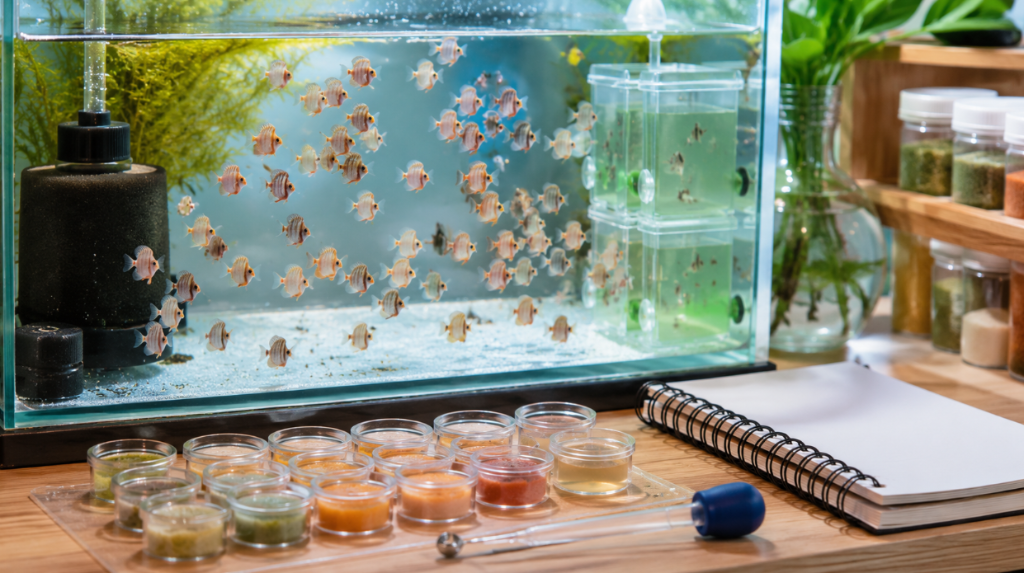
Quick summary
- Fry need 5–6 small meals/day (vs 2–3 for adults) — small stomachs, fast metabolism
- Days 1–4: parental mucus only — DON'T add any food
- Days 5–14: freshly hatched brine shrimp nauplii, 6 meals/day — the best food in the world for discus fry
- Weeks 3–4: diversify with micro-pellets + daphnia; weeks 5–8: add finely chopped beef heart
- Temperature 30–31°C (86–88°F) + abundant food = maximum growth: 1.5–2 cm at 4 weeks, 5–6 cm at 12 weeks
- Under 4 meals/day → guaranteed stunting; over 7 meals/day → water quality degrades
Daily discus fry feeding — the hourly schedule that works
Feeding discus fry (Symphysodon spp.) is the #1 factor that decides the growth rate, final size and colors at maturity. Unlike adult discus (2–3 meals/day), fry have a small stomach and an extremely fast metabolism — they need 5–6 small meals a day, at regular intervals. In the first 4 days they eat parental mucus (a phenomenon unique in the fish world), then a slow transition to freshly hatched brine shrimp nauplii (the best food in the world for discus fry), followed by diversification with micro-pellets, daphnia and finely chopped beef heart. With correct feeding, fry grow 1.5–2 cm (0.6–0.8 in) in 4 weeks, 5–6 cm (2–2.4 in) in 12 weeks. This guide gives you the exact hourly schedule, the amounts per meal and instructions for hatching brine shrimp at home.
Why 5–6 meals a day (not 2–3 like adults)
Discus fry have:
- An extremely small stomach — they can only consume small amounts in a single meal
- A metabolism 3–4 times faster than adults (they grow fast, burn fast)
- A high protein demand — 50–60% protein from the diet (vs 35–45% for adults)
- A short digestive tract — they don't retain food long, they need a quick "refill"
Practical consequences:
- Under 4 meals/day → slow growth, the "stunting phenomenon" (they stay small for life)
- Over 7 meals/day → water quality degrades, overfeeding risk
- Optimal: 5–6 small meals 2–3 hours apart
Phase 1: Days 1–4 — parental mucus (DON'T intervene!)
In the first 3–4 days after free swimming (D4–D5 after spawning), the fry stick to the parents' skin and feed on the nutritious mucus they secrete.
What NOT to do: ❌ Don't add any kind of food to the tank (brine shrimp, pellets, egg yolk) ❌ Don't separate the fry from the parents ❌ Don't change more than 10% of the water daily ❌ Don't turn the light on/off abruptly — it stresses the parents
What to do: ✅ Keep a constant temperature of 30–31°C (86–88°F) ✅ Gentle aeration (NOT directed at the fry) ✅ Dim, diffuse light ✅ Complete quiet — no tapping on the glass
⚠️ Important: if you try to feed during this phase, the fry will ignore the food (they're biologically programmed for mucus) and the food will rot and contaminate the water.
Phase 2: Days 5–14 — freshly hatched nauplii (weeks 1–2)
When you see the fry occasionally detaching from the parents and swimming independently, you're ready. This usually happens on day 5–7 after free swimming.
The exclusive food: freshly hatched brine shrimp nauplii (Artemia salina, max 12–24h after hatching).
Why freshly hatched nauplii:
- Rich in yolk (the nutrient sac) — 60% protein, essential fats
- The perfect size (0.4 mm) — they fit in the fry's mouth
- Live movement — stimulates the hunting instinct
- Complete digestion — leaves no toxic residue
Exact hourly schedule — weeks 1–2
| Time | Food | Approximate amount |
|---|---|---|
| 06:00 | Brine shrimp nauplii | 1 ml concentrate / 50 fry |
| 09:00 | Brine shrimp nauplii | 1 ml concentrate / 50 fry |
| 12:00 | Brine shrimp nauplii | 1 ml concentrate / 50 fry |
| 15:00 | Brine shrimp nauplii | 1 ml concentrate / 50 fry |
| 18:00 | Brine shrimp nauplii | 1 ml concentrate / 50 fry |
| 21:00 | Brine shrimp nauplii (smaller portion) | 0.5 ml / 50 fry |
Total: 6 meals / day
How to measure "1 ml of concentrate":
- After filtering with a fine mesh (100 micron), the nauplii remain in a dense suspension
- 1 ml of suspension = roughly 1,500–2,000 nauplii
- For 50 fry = ~30–40 nauplii / fry / meal
Pro tip: watch the fry's belly after 15 min — it should be pink/orange (a sign of brine shrimp consumed). If not, give more; if it's exaggeratedly swollen, reduce.
How to hatch brine shrimp at home (step by step)
Equipment needed (~€30–50 total, an orientation estimate):
- Decapsulated or normal brine shrimp eggs (JBL NovoArtemio, Sera Artemia-Mix) — ~€15 / 50g
- A hatching cylinder/bottle (2L / 0.5 US gal clear plastic) — €5
- An air pump + tube — €10
- A fine 100-micron mesh (filtering) — €5
- Coarse non-food salt (pure NaCl) — €2
The procedure (a 24h cycle):
- Prepare the water: 2L (0.5 US gal) of warm water (28°C / 82°F) + 60g coarse salt (a 30g/L concentration)
- Add the eggs: 1 level teaspoon (~5g) of eggs
- Strong aeration: insert the tube with an air stone, large bubbles, continuous movement (keeps the eggs from settling)
- Constant light: a simple LED lamp 20–30 cm (8–12 in) away (stimulates hatching)
- Wait 24h at 26–28°C (79–82°F)
- Harvest:
- Stop the aeration, wait 5 min
- The live nauplii gather at the bottom (drawn by light) or in lit areas
- With a thin siphon, suck up the nauplii (leave the shells on top and the unhatched eggs at the bottom)
- Pass through a fine 100-micron mesh — rinse with fresh water
- Feed immediately or keep in a glass of cold water (the fridge) for max 24h
Operating costs: ~€3–5 / month for 50 fry (eggs + salt + electricity), an orientation estimate.
Phase 3: Weeks 3–4 — diversification
The fry reach 1–1.5 cm (0.4–0.6 in) and can accept more varied food.
Hourly schedule — weeks 3–4
| Time | Food | Notes |
|---|---|---|
| 06:00 | Brine shrimp nauplii | Continue, but more |
| 09:00 | Micro-pellets (0.3–0.5 mm) | Sera Discus Granulat baby, Hikari First Bites |
| 12:00 | Brine shrimp nauplii + small daphnia | Daphnia moina, frozen or live |
| 15:00 | Micro-pellets | An amount consumed in 2 min |
| 18:00 | Brine shrimp nauplii | A good portion |
| 21:00 | Daphnia / micro-pellets (small portion) | Only if the water is clean |
Total: 5–6 meals / day
Recommended pellets (EU, available in RO):
- Sera Discus Granulat baby — ~€12 / 250g
- Hikari First Bites — ~€10 / 10g (a small portion, but dense)
- Tropical Discus Gran D-50 Plus — ~€8 / 100g
- JBL NovoTab crushed fine — an alternative
How to introduce the pellets:
- Soak for 30 sec in warm water (softens the texture)
- Drop a small pinch (the size of a grain of rice)
- Watch consumption over 2 min — if any are left, reduce
- Increase the amount gradually over the week
Phase 4: Weeks 5–8 — accelerated growth
The fry reach 2–3 cm (0.8–1.2 in). Now a high temperature (30–31°C / 86–88°F) + abundant food = maximum growth.
Hourly schedule — weeks 5–8
| Time | Food | Amount |
|---|---|---|
| 06:30 | Frozen adult brine shrimp | As much as is consumed in 2 min |
| 10:00 | Finely chopped beef heart mix | A small amount, consumed in 2 min |
| 13:00 | Pellets (1 mm) Sera Discus | 1–2 teaspoon tips / 50 fry |
| 16:00 | Frozen daphnia / mysis | An important variation |
| 19:00 | Beef heart + spirulina | Ensures protein + vitamins |
| 21:30 | Pellets (small portion) | Only if the water allows |
Total: 4–5 meals / day (can reduce from 6)
A simple beef heart mix recipe for fry:
- 200g of lean beef heart
- 50g of frozen shrimp
- 30g of boiled spinach
- 1 teaspoon of spirulina
- 2 drops of JBL Atvitol (a multivitamin)
- Chop fine (finer than for adults — like a paste)
- Freeze in 3 mm layers
- Break off small pieces, thaw in tank water, feed
Phase 5: Weeks 9–12 — transition to adult food
The fry are 4–6 cm (1.6–2.4 in) and approaching the juvenile stage. Now you reduce the frequency to 4 meals/day and introduce adult food.
Hourly schedule — weeks 9–12
| Time | Food |
|---|---|
| 07:00 | Discus pellets (1.5 mm) |
| 12:00 | Beef heart mix |
| 17:00 | Live/frozen food (brine shrimp, daphnia, bloodworms) |
| 21:00 | Pellets or a small beef heart portion |
Week 12+: move to 3 meals/day (the adult schedule). See adult discus feeding schedule.
Amounts — the simple visual rule
"3 minutes down to 30 seconds"
| Fry age | Meal consumption time | Action |
|---|---|---|
| Weeks 1–2 | Must be consumed in 30 sec | A small, frequent amount |
| Weeks 3–4 | 1–2 min | Increase gradually |
| Weeks 5–8 | 2–3 min | A medium portion |
| Weeks 9–12 | 3 min max | The adult rule |
The golden rule: any food left after 3 min = siphon it out immediately (the fry don't eat scraps fallen to the bottom, but bacteria do → ammonia).
Signs of OVER-feeding (correct immediately)
❌ A prominent, distinct belly on the fry — a sign of constipation ❌ Long, thread-like, whitish feces — faulty digestion ❌ The water turns cloudy quickly after meals ❌ A film on the surface — undigested protein ❌ Ammonia >0 ppm in the tank ❌ The fry no longer come to the next meal with the same enthusiasm
Correction:
- Reduce the amount per meal by 30%
- Increase water changes (60% daily for 3 days)
- Add 1 fasting day / week (very easily tolerated by healthy fry)
Signs of UNDER-feeding (increase the amount)
⚠️ A concave / sunken belly 2 hours after a meal ⚠️ Aggressive behavior between fry (fighting for food) ⚠️ Growth slower than 1 cm / 4 weeks ⚠️ Pale, weak colors ⚠️ A "pinched" tail — a sharp body at the tail (a classic stunting sign)
Correction:
- Increase to 6 meals/day (even in weeks 5–8)
- Add 1 night meal (at 22:00 with minimal light)
- Diversify the sources (more brine shrimp + beef heart)
Normal growth rates (check yourself)
| Week | Normal size | Watch out below |
|---|---|---|
| Week 4 | 1.5–2 cm (0.6–0.8 in) | <1 cm = a problem |
| Week 8 | 3–4 cm (1.2–1.6 in) | <2.5 cm |
| Week 12 | 5–6 cm (2–2.4 in) | <4 cm |
| Month 4 | 6–8 cm (2.4–3.1 in) | <5 cm |
| Month 6 | 8–10 cm (3.1–3.9 in) | <7 cm |
🧮 Calculate the daily amount using the nutrition calculator — enter the number of fry and their age.
Common mistakes (avoid!)
❌ "I feed them 3x/day, that's enough" — for fry = guaranteed stunting ❌ Frozen brine shrimp instead of freshly hatched in weeks 1–2 — not enough nutrients ❌ Bloodworms in weeks 1–4 — too hard to digest, constipation risk ❌ Normal pellets (2 mm) given directly to small fry — they choke ❌ Feeding before a water change — the leftovers contaminate immediately ❌ Switching abruptly from brine shrimp to pellets — food refusal
Daily fry-raiser checklist
✅ Brine shrimp hatch prepared 24h in advance ✅ Temperature checked (30–31°C / 86–88°F) ✅ Ammonia tested (must be 0) ✅ 5–6 meals spread 2–3h apart ✅ Leftovers siphoned after each meal (max 3 min) ✅ Behavior observed at each meal ✅ Water change 30–50% / day (see fry water quality)
Conclusion
Feeding discus fry correctly is military discipline — a fixed schedule, measured amounts, constant observation. Professional breeders feed 6x/day in the first month without exception — this is the difference between 12 cm (4.7 in) discus at 6 months and "stunted" 7 cm (2.8 in) discus that never grow again.
The time investment is large, but the results are visible: healthy, vigorous fry with intense colors that sell at premium prices.
🛒 See the specialized food for fry and juveniles in the Discus.ro shop.
See also fry water quality in the first months, Raising the fry — 12 weeks and when to separate the fry from the parents.
Recommended products
Picked from the shop based on what you just read
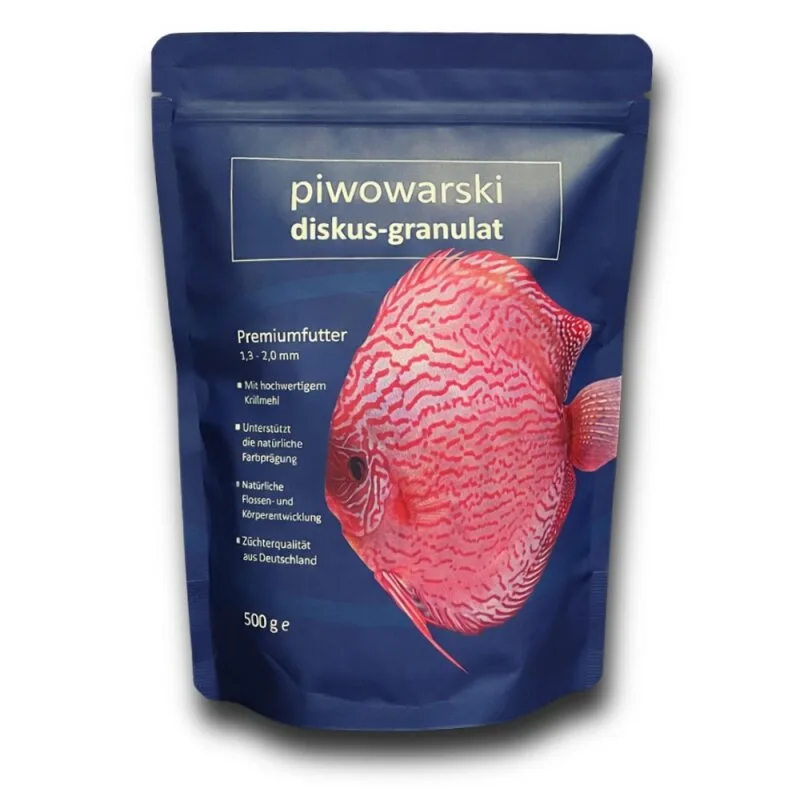
Recommendations are selected from the discus.ro shop based on this guide's topic. Availability and prices may vary.