Stendker vs your own breeding for discus: cost-benefit and decision
Want to breed? Before you buy 12 fry, weigh it up: a Stendker formed pair (€1,000, 6-month ROI) vs a group of fry raised yourself (€3,000 + 18 months). A detailed comparison of costs, time, risks and realistic ROI.
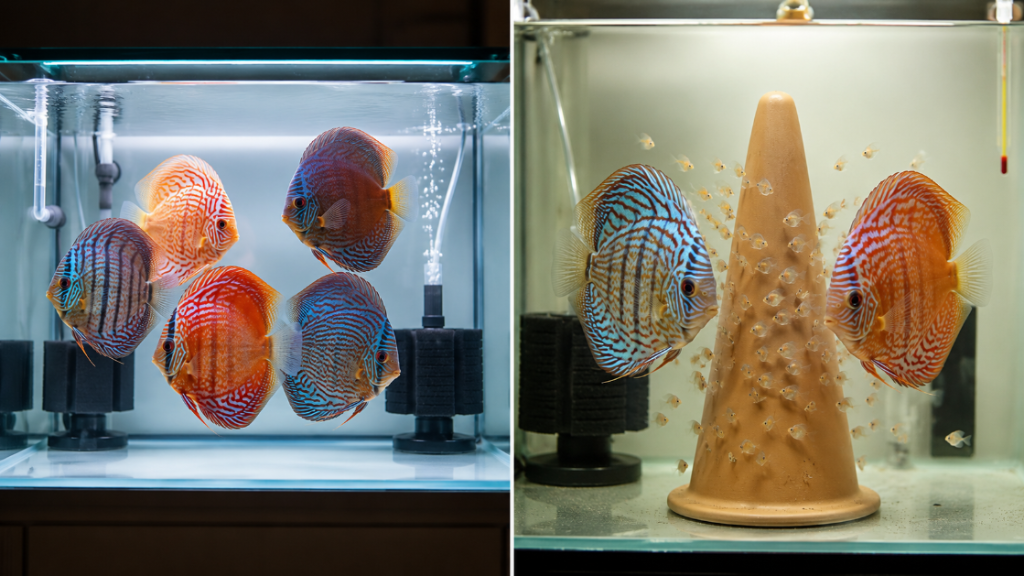
Quick summary
- Strategy A — Stendker formed pair: ~€1,000–1,500, fast ROI (first spawn in 1–3 months), minimal risk
- Strategy B — raise from fry: ~€2,000–3,500 total, slow ROI (first spawn after ~18 months), higher risk
- Stendker wins mathematically in the first 2 years; raising from fry wins on learning and passion
- A formed pair has an 80–95% breeding success rate vs 50–70% when you hope fry pair up
- Best for most: the hybrid strategy — Stendker in year 1, then raise fry from year 2 with the profit
- Investment and sale-price figures are EUR orientation estimates (sale prices an RO-market estimate) — both vary by country
Stendker vs your own breeding — the strategic decision
Stendker vs your own breeding for discus (Symphysodon) is the first major strategic decision for anyone who wants to get seriously into discus breeding. The 2 paths differ fundamentally in investment, time, risks and ROI (return on investment): The Stendker strategy (you buy a documented formed pair from a premium European breeder — Stendker DE, Wattley US, or a verified local pair) — an investment of €1,000–1,500 but a fast ROI (the first spawn in 1–3 months) and minimal risk; The "raised from fry" strategy (you buy 8–12 juveniles from a good source, raise them for 14–18 months, and let pairs form naturally) — a total investment of €2,000–3,500 but a slow ROI (a potential first spawn after 18 months) and higher risk (you may get 0–2 valid pairs out of 12 fry). Analyzed purely financially: Stendker wins for those who want fast income. Analyzed from a learning perspective: raising from fry wins for enthusiasts. This guide shows you all the real math.
All figures below are orientation estimates. EUR amounts vary by country; the sale prices are an RO-market estimate and differ widely by market, variety and grade.
The 2 strategies — an overview
Strategy A: Stendker (a premium formed pair)
You buy:
- 1 formed and verified pair
- Documentation: pedigree, age, medical history
- Source: Stendker DE (the best known), Wattley US, or top local breeders
Next step: transfer to your breeding tank → spawns in 1–3 months → sell fry.
Strategy B: Raised from fry (natural selection)
You buy:
- 8–12 juvenile fry (3–5 cm / 1.2–2 in) from the same generation
- Source: a serious breeder with a history of the variety
Next step: you raise them for 14–18 months → 1–2 pairs form naturally → breeding.
A direct comparison — all the variables
| Aspect | Stendker (formed pair) | Raised from fry |
|---|---|---|
| Initial investment | €1,000–1,500 | €600–1,500 fry + raising |
| Cost to raise to breeding | 0 (already mature) | €800–1,500 (food + water + electricity over 18 months) |
| TOTAL investment | €1,000–1,500 | €2,000–3,500 |
| Time to first spawn | 1–3 months | 14–18 months |
| Tanks needed | 1 (breeding) | 2–3 (grow-out + breeding) |
| Breeding success rate | 80–95% (a proven pair) | 50–70% (depends on luck) |
| Number of resulting pairs | 1 guaranteed | 0–2 out of 12 (unknown) |
| Total loss risk | Moderate (disease, mortality) | High (many surprises) |
| Pure variety | Guaranteed (documented) | Depends on the source |
| Learning | Limited (already pairs) | Maximum (the full process) |
| Personal satisfaction | High at a fast first spawn | High at natural pairing |
Detailed financial analysis — Strategy A (Stendker)
Initial investment
| Item | Cost |
|---|---|
| A Stendker pair (documented for breeding, 16–18 cm / 6.3–7 in) | €1,000–1,500 |
| Shipping DE → your country | €80–150 |
| A breeding tank (90×45×45 cm / 35×18×18 in, ~48 US gal) | €120 |
| Equipment (sponge filter, 2 heaters, etc.) | €150 |
| RO water + treatments | €30 |
| Food for the first 3 months | €50 |
| TOTAL | ~€1,400–2,000 |
Calendar and ROI
Month 1: Purchase + transfer + conditioning (10 days) Month 2: First spawn (likely successful — a proven pair) Month 3: Fry at 4 weeks, first sale Months 4–6: 2nd spawn
Projected income (year 1) — RO estimate:
- Spawn 1:
150 fry × €7 = **€990** (sold at 4–6 cm / 1.6–2.4 in) - Spawn 2:
200 fry × €7 = **€1,320** - Spawn 3:
200 fry × €7 = **€1,320**
Total year 1: ~€3,600–3,800
ROI: ~6 months to recover the investment, net profit year 1: ~€2,000.
Detailed financial analysis — Strategy B (raised from fry)
Initial investment (Month 0)
| Item | Cost |
|---|---|
| 12 discus fry 3–5 cm (1.2–2 in) | €1,200–1,800 (€100–150 each) |
| Shipping | €50–100 |
| A grow-out tank (120×50×50 cm / 47×20×20 in, 300L / ~79 US gal) | €200 |
| Complete equipment | €250 |
| A breeding tank (for the future) | €150 |
| INITIAL TOTAL | ~€1,850–2,500 |
Monthly raising costs (18 months)
| Item | Monthly cost |
|---|---|
| Food (brine shrimp + beef heart + pellets) | €40–60 |
| Electricity (filter + 2 heaters + lamp) | €25–35 |
| RO water + treatments | €10–15 |
| Miscellaneous (emergency meds, etc.) | €5–10 |
| MONTHLY TOTAL | ~€80–120 |
Total raising over 18 months: €1,440–2,160
TOTAL investment Strategy B: ~€3,300–4,660
Calendar and ROI
Month 0: Buy 12 fry (normal mortality: 10–20%) Month 6: Fry at 8–10 cm (3.1–3.9 in), split into 2 tanks Month 12: Nearly mature, visible dimorphism Months 14–16: Identify natural pairs (1–2 pairs out of 12) Month 17: Transfer pairs to the breeding tank Months 18–20: Conditioning + first spawn
Projected income (months 18–24) — RO estimate:
- 1–2 pairs × 2–3 spawns = ~700–1,400 fry
- Income: ~€5,000–10,000
ROI: ~24 months to recover the investment, profit by month 24: ~€0–1,000 (marginal).
Direct ROI comparison
| Month | Stendker (cumulative) | Raised from fry (cumulative) |
|---|---|---|
| 0 | -€1,500 | -€2,500 |
| 6 | +€500 | -€2,900 |
| 12 | +€2,500 | -€3,500 |
| 18 | +€4,500 | -€2,000 |
| 24 | +€6,500 | +€1,500 |
| 36 | +€10,000 | +€6,500 |
The mathematical conclusion: Stendker wins in the first 24 months. After 36+ months, the difference shrinks (personally raised pairs have a similar longevity).
Subtle NON-financial advantages
Strategy A: Stendker
✅ Guaranteed genetic quality (professional selection over 4+ generations) ✅ Sellable documentation ("Stendker descendant" = a premium price) ✅ Technical support from purchase ✅ Minimal disease risk (Stendker quarantine) ✅ Freed-up time to improve the setup
Strategy B: Raised from fry
✅ Deep learning of all phases (from fry to breeding) ✅ A "loyal" pair — naturally formed pairs are more stable long-term ✅ Personal passion — the satisfaction of "I raised them from fry" ✅ Visual selection — you pick the most beautiful from the group ✅ The possibility of controlled hybridization
Specific risks of each strategy
Stendker risks:
❌ The pair doesn't acclimate to your water/conditions (5–10% of cases) ❌ A latent disease activated by transport stress (a frequent cause of death within 30 days) ❌ A large investment in a single "asset" — if it dies, you lose €1,500 ❌ Dependence on an external source (Stendker may stop exporting to your country at some point)
Raised-from-fry risks:
❌ Fry mortality (5–20% in the first 6 months) ❌ All 12 fry the same sex (rare, but possible — you lose everything) ❌ No compatible pair (10–15% of cases) ❌ A disease in the group that wipes out everything ❌ Hidden costs (electricity for heating, especially in cold seasons / climates without temperature control)
Cases where each strategy is BETTER
Stendker is BETTER for:
✅ People with a limited time budget (a demanding job, family) ✅ Beginners who want to learn breeding without the first 18 months of mistakes ✅ Commercial breeders who want fast income ✅ Small apartments — 1 breeding tank is enough ✅ Those who want a guaranteed pure variety
Raised from fry is BETTER for:
✅ True enthusiasts who love the process ✅ A good budget for 24 months without financial pressure ✅ Retirees/freelancers with daily time available ✅ People with space for 2–3 large tanks ✅ Those who want genetic flexibility (hybridizations, new varieties) ✅ Those with access to mentoring locally (an experienced breeder nearby)
The hybrid strategy — our recommendation
De facto the smartest strategy for most:
Year 1: Stendker (fast learning + profit)
- Buy a Stendker pair
- Learn the process (conditioning, spawning, raising fry)
- Generate income (6-month ROI)
Years 2–3: Raised from fry (with funds from year 1)
- With the profit from year 1, buy 8–12 premium fry
- Continue the Stendker breeding (steady income)
- Raise fry for future pairs (year 4+)
Year 4+: Diversification
- Multiple genetic lines
- Multiple varieties
- Stable production of 4–6 pairs
Advantages of the hybrid strategy:
- Fast cash flow (Stendker)
- Progressive learning (raised fry)
- Risk diversification
- Multiple genetic quality
Frequently asked questions
"Can I do just 1 Stendker pair for a hobby?"
YES — perfectly. 1 Stendker pair = 150–300 fry/year = more than you can sell locally. Plus income (~€950–1,900/year, RO estimate) that covers the hobby completely.
"How much real profit can a serious breeder make in 3 years?"
Conservatively:
- Year 1: €1,500 profit (1 Stendker pair)
- Year 2: €3,000 profit (2 pairs + learning)
- Year 3: €5,000–8,000 profit (3–4 diversified pairs)
Total 3 years: €9,500–12,500 net profit (after all expenses).
Note: this is daily work equivalent to 20–30 hours/week, not passive income.
"Does Stendker DE export internationally?"
YES, shipping with a specialized firm costs €80–200. Recommended in spring/autumn (mild temperatures). Winter has extra fees (heating). Summer carries a heat risk.
"Are there breeders at the Stendker level locally?"
A few very good ones exist in most countries. Verification is mandatory:
- Documentation of age + genetic line
- A physical visit to the tanks
- Your own quarantine of at least 6 months
- A documented breeding history (video, photos)
See verified breeders on Discus.ro.
The final decision table
Answer 5 questions:
-
Total budget available?
- <€2,000 → Stendker or a good local pair
- €2,000–4,000 → Stendker (premium) or raised from fry (medium)
-
€4,000 → Hybrid ideal
-
Monthly time available?
- <40 hours/month → Stendker (more efficient)
- 40–80 hours/month → Either
-
80 hours/month → Raised from fry (you can manage it)
-
Space available?
- 1 tank (max) → Stendker
- 2–3 tanks → Either
- 4+ tanks → Hybrid + diversification
-
Aquarium experience?
- Beginner → Stendker (learn fast)
- Intermediate → Either
- Advanced → Raised from fry or hybrid
-
Main objective?
- Commercial income → Stendker
- Passionate hobby → Raised from fry
- Balance → Hybrid
Costly mistakes (avoid!)
❌ Buying Stendker without a prepared tank → the pair dies at transfer ❌ 12 fry from 12 different sources → introduced diseases, mortality ❌ Breeding without a commercial strategy → you have 200 fry and don't know who to sell them to ❌ Selling at a loss (under ~€6 per 5 cm fry — RO estimate) → ruins the local market ❌ Stendker plus raised fry simultaneously without 4 tanks → overpopulation
Conclusion
Stendker wins mathematically in the first 2 years, raising from fry wins on passion and satisfaction. For most enthusiasts with a medium budget and limited time, Stendker is the right choice.
For professional breeders who want to build a sustainable operation over 5+ years, the hybrid strategy (Stendker in year 1 + diversification in years 2–5) is the winning formula.
The fatal mistake: whatever the strategy, DON'T skip the correct setup phase — a quality tank, stable parameters, conditioning done well. That's where 80% of enthusiasts fail, not in choosing the pair.
🛒 See the verified breeders and the equipment shop for your preparation.
See also Selecting the breeding pair — criteria, conditioning the pair, Discus breeding tank — setup, The breeding process, monthly maintenance cost and before you buy discus.
Recommended products
Picked from the shop based on what you just read
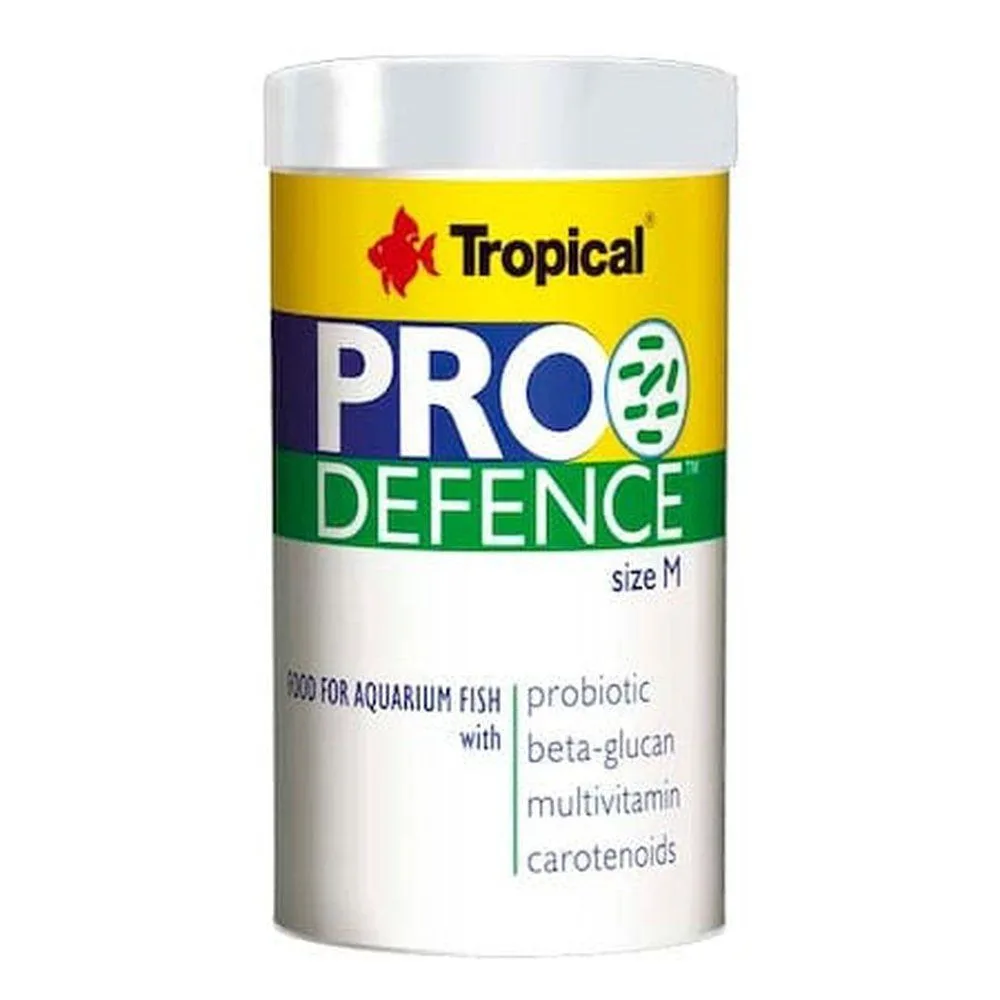
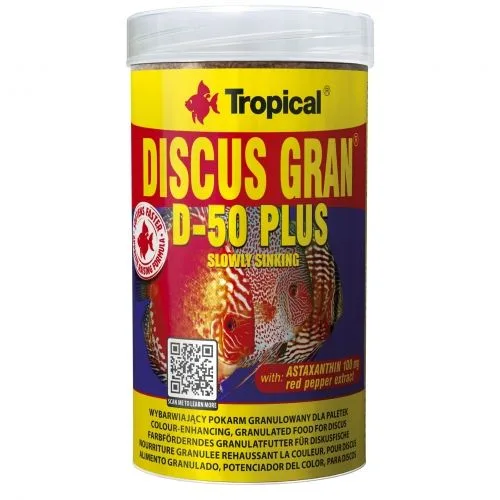
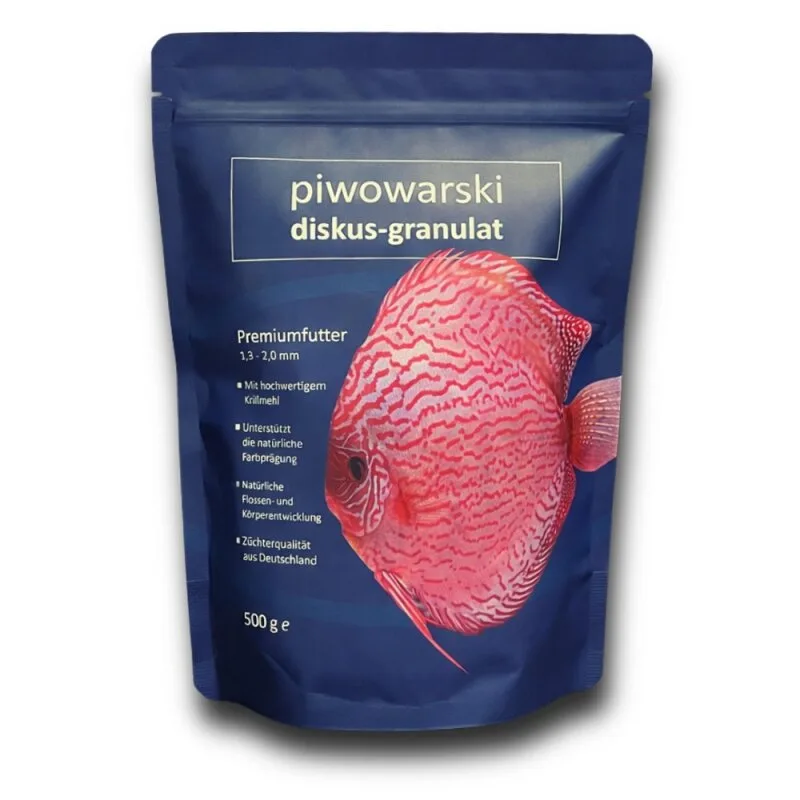

Recommendations are selected from the discus.ro shop based on this guide's topic. Availability and prices may vary.
Frequently asked questions
Put what you just read into practice
One account brings together everything you need to keep your tank on track:
Water parameters, inhabitants, photos and the full history of every change — our most used tool.
Water changes, cleaning and feeding, on your own dates.
See at a glance which values fall outside the safe discus range.
The guides, products and listings you follow, saved in one place.